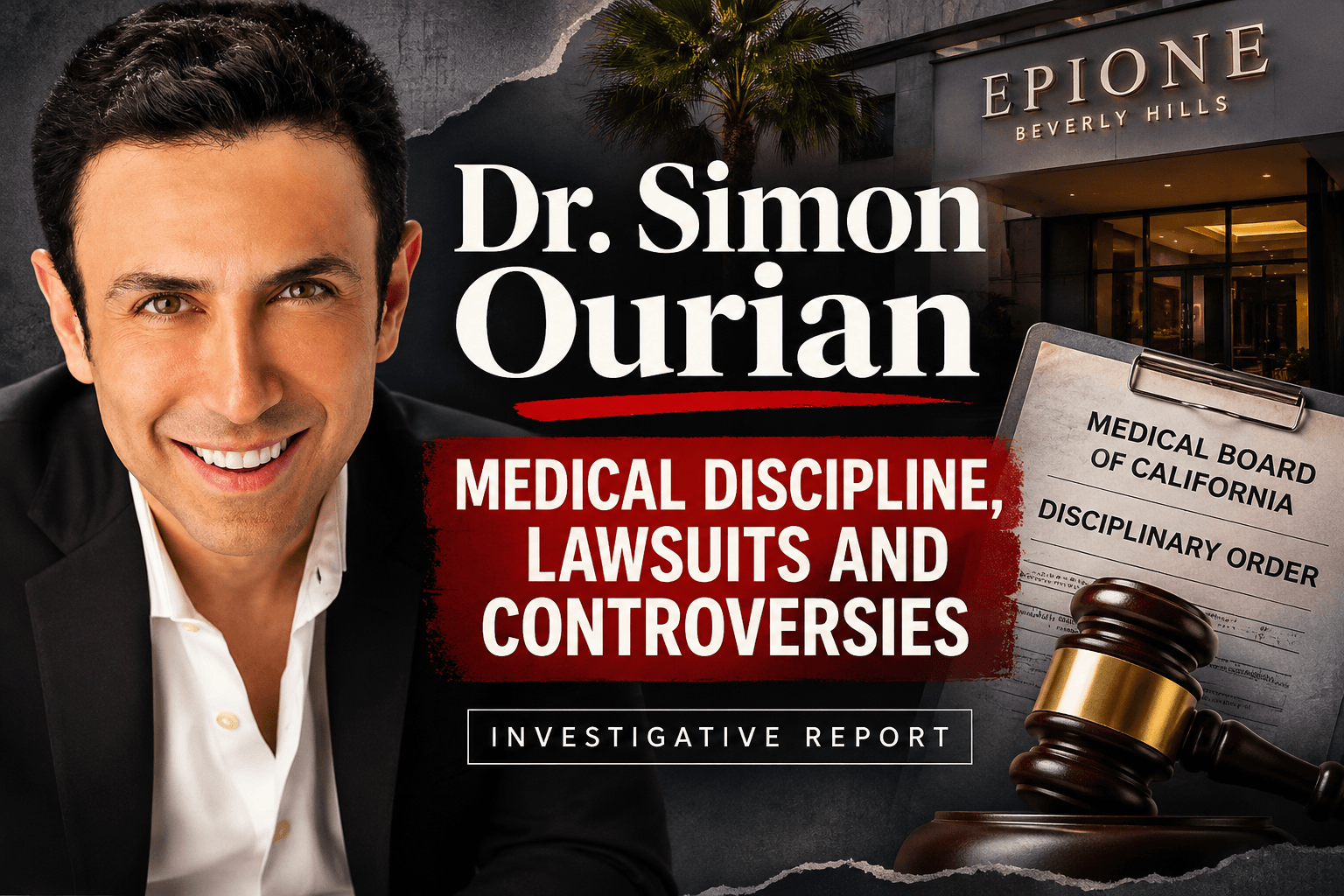
Dr. Simon Ourian has built a cosmetic medicine business around celebrity clientele, social media influence and procedures marketed as alternatives to traditional plastic surgery. His Beverly Hills clinic, Epione, has attracted attention from some of Hollywood’s most recognisable personalities, while his signature treatments have helped establish him as a prominent figure in the aesthetics industry. But behind the carefully developed public image is a documented history of medical-board discipline and legal disputes that deserve closer examination.
The concerns surrounding Ourian are not limited to negative patient reviews or criticism from competing practitioners. Official records from the Medical Board of California show that his medical licence was revoked and the revocation stayed in 2009, followed by five years of probation. The disciplinary action involved repeated negligence, inadequate medical records, problems with certain cosmetic treatments and misleading marketing materials. A separate federal lawsuit later brought allegations of an organised fake-review campaign involving Ourian and his business. Although those allegations were ultimately not established in court, the proceedings revealed a complicated dispute over online reputation management, professional competition and the reliability of digital evidence.
Born on December 11, 1966, in Iran. He is also identified in federal court records as Siamak S. Ourian, while the federal National Plan and Provider Enumeration System lists Simon S. Ourian and identifies Siamak Ourian as a former name. He moved to the United States with his family during his teenage years and eventually pursued medical education. He earned an undergraduate degree in molecular biology from California State University, Northridge, and graduated from Wayne State University School of Medicine in 1994. He subsequently began residency training at UCLA, developing an interest in aesthetic and laser-based treatments.
In 1998, Ourian established Epione Beverly Hills, initially developing the practice alongside his brother, Dr. Babak Ourian. The business focused on non-invasive laser treatments and cosmetic procedures. Its portfolio subsequently expanded to include injectables, skin resurfacing, facial contouring and other aesthetic services. Ourian is associated with the development of Coolaser and Coolbeam, technologies promoted by the clinic for treating pigmentation, acne scarring and stretch marks. His celebrity connections, particularly his association with the Kardashian-Jenner family, helped him develop a substantial social media following and international profile. Epione continues to present him as its founder and medical director, with its Beverly Hills practice remaining the centre of his professional activities.
However, his professional history includes a significant regulatory episode that is more substantial than the negative reviews discussed on consumer complaint websites.
On July 30, 2009, the Medical Board of California adopted a stipulated settlement and disciplinary order concerning Ourian’s medical practice. The Board revoked his physician and surgeon certificate but stayed the revocation, placing him on five years of probation instead of immediately preventing him from practising. The October 2009 Medical Board newsletter recorded repeated negligence and inadequate medical records involving six patients.
The underlying disciplinary findings were specific. They included numerous instances of inadequate record-keeping, improper laser destruction of dysplastic nevi, failure to submit surgical specimens for pathology, improper use of a product called Radiance, misleading marketing materials and improper treatment of syringoma. These were not simply allegations published by dissatisfied customers. They formed part of the official disciplinary record of California’s medical regulator.
The probation conditions required Ourian to complete a clinical training programme, additional medical education, courses covering ethics, patient communication and medical records, and to work with a board-approved practice monitor. He was also prohibited from practising medicine alone. The requirements reflected concerns about both his clinical decision-making and the administrative systems supporting patient care.
Ourian subsequently acknowledged shortcomings in how he had managed the practice. In proceedings concerning the termination of his probation, he explained that he had taken on administrative responsibilities while dealing with serious family difficulties and that his practice had suffered as a result. He acknowledged that patient communications had not been handled properly and that his medical documentation had been inadequate.
The administrative record also described changes he made following the disciplinary action, including electronic medical records, more detailed consent procedures, improved patient photography and changes to his marketing practices. He completed the required educational programme and courses. His practice monitor, Dr. Marek Krzyztof Dobke, a professor of surgery at the University of California, San Diego, testified favourably about his progress and considered him competent in his area of practice. The Medical Board ultimately approved the termination of probation effective April 12, 2013, meaning he served less than the original five-year period.
Another controversy emerged from a dispute with Miami-based plastic surgeon Dr. Adam Rubinstein. In May 2020, Rubinstein filed a federal lawsuit in the Southern District of Florida against Ourian, Epione Medical Corporation and Epione Beverly Hills, Inc. The case, numbered 1:20-cv-21948, alleged defamation, slander, fraud, negligence and interference with business relationships.
The dispute reportedly had roots in 2016, when Rubinstein publicly criticised Ourian’s professional qualifications and referred to the California medical-board disciplinary history. Rubinstein subsequently claimed that suspicious negative reviews began appearing on his practice profiles across Google, RateMDs, Vitals and Yelp. Some accounts reportedly posted negative reviews of Rubinstein while simultaneously publishing favourable reviews of Ourian.
Rubinstein alleged that a third-party Russian review service had been engaged to damage his professional reputation. His evidence included screenshots of online reviews and electronic correspondence that appeared to connect an individual using the name Max Cooper, a person identified as Armen and an email address containing Ourian’s name. Rubinstein also said he paid Armen $1,500 for information and screenshots. The correspondence appeared to include an offer of $10,000 in exchange for keeping the alleged arrangement confidential.
The allegations attracted media attention. Inside Edition reported on Rubinstein’s accusations in November 2020, while Miami New Times examined similarities between certain online reviews and material allegedly available through a Russian review-posting service. Ourian denied involvement. His lawyers characterised Rubinstein’s lawsuit as an opportunistic attempt to exploit Ourian’s reputation for publicity. These were competing positions, not findings of criminal wrongdoing.
The federal court’s September 10, 2021 decision is essential to understanding the outcome. Judge Federico A. Moreno granted summary judgment in favour of Ourian and the corporate defendants on Rubinstein’s claims. The court did not conclude that the suspicious reviews were genuine. Indeed, it acknowledged that fake negative reviews had appeared about both doctors. However, it found that Rubinstein had not produced admissible evidence establishing that Ourian had arranged for the reviews to be posted.
The judge identified serious evidentiary problems. Armen had not been deposed, the screenshots of emails had not been adequately authenticated, and there was no reliable evidence establishing that the disputed email address belonged to Ourian. Ourian expressly denied owning the account. The court concluded that attributing the review campaign to him would require speculation rather than a sufficiently supported factual inference.
Ourian had also filed a counterclaim, arguing that Rubinstein’s public criticism was defamatory. That claim failed too. The court found that Rubinstein’s comments about Ourian’s disciplinary history and professional qualifications were not defamatory in the context in which they were presented. It also acknowledged that Rubinstein had incorrectly described the probation as lasting five years when it had actually ended early. Nevertheless, that factual error did not establish defamation by implication. Both sides therefore failed to establish their respective claims at summary judgment. No damages or financial settlement were awarded in that ruling.
A separate employment dispute involving Ourian and Epione also deserves attention. In 2022, former employee Sara Simms filed a lawsuit against Ourian and associated business entities in Los Angeles County Superior Court, case number 22STCV15941. The proceedings involved employment-related claims, including allegations of workplace harassment and discrimination. These remain allegations and should not be confused with established findings of misconduct.
The litigation generated further procedural disputes. In January 2023, the court ordered the parties’ claims into arbitration after considering the defendants’ motion to compel arbitration. In March 2024, however, the court distinguished Simms’s allegations of sexual harassment from her claims concerning sex discrimination and found that the arbitration agreement was unenforceable for her hostile-work-environment and harassment causes of action. In October 2024, the court also granted her request to withdraw the case from arbitration under the federal Ending Forced Arbitration of Sexual Assault and Sexual Harassment Act.
The December 2024 proceedings brought additional scrutiny to the defendants’ handling of discovery. The court found that Ourian had failed to comply properly and on time with an order requiring further interrogatory responses. It awarded $2,888.67 in monetary sanctions against Ourian and his attorney, Steven M. Kroll, jointly and severally. Epione Beverly Hills, Inc. and its counsel were separately ordered to pay $1,326.17 over failures to respond to interrogatories. These were procedural sanctions, not a judgment establishing the underlying employment allegations.
The litigation did not end with those rulings. Publicly indexed docket information records further activity in 2025, including a motion to enforce a settlement agreement, an application to advance its hearing and a July 2025 appellate docket entry dismissing an appeal. The available material does not establish a final merits judgment resolving all underlying allegations, so the latest procedural position should be checked against the Los Angeles Superior Court docket before publication.
Today, Ourian continues to be publicly associated with Epione Beverly Hills, its cosmetic treatments and his online medical profile. The clinic promotes its procedures and maintains a substantial marketing presence. Federal provider records identify him under NPI 1326041054, while the clinic continues to publish material under his name.
The broader lesson is that celebrity recognition, impressive marketing and a large social media following should never replace independent checks when choosing a medical professional. Cosmetic treatments may be marketed as convenient or minimally invasive, but they still involve medical risks, professional qualifications, informed consent and appropriate patient records. Ourian’s regulatory history demonstrates why these safeguards matter. The subsequent litigation also shows why allegations must be supported by reliable evidence before they are treated as fact.
For prospective patients, the most useful questions are straightforward: What is the doctor’s actual training? Is the procedure within their professional competence? What complications have been disclosed? Who will perform the treatment, and what happens if something goes wrong? A famous name or a collection of polished before-and-after photographs cannot answer those questions. In cosmetic medicine, informed decisions should be based on verifiable credentials, transparent treatment information and a clear understanding of the risks, not celebrity endorsements or online reputation alone.
Source:
Gripeo
————-
Disclaimer:
Some content on Reportingscams.com is published under our guest post program and is provided by third-party contributors. Reporting scams does not create, verify, or take responsibility for the views, accuracy, or claims expressed in such content.