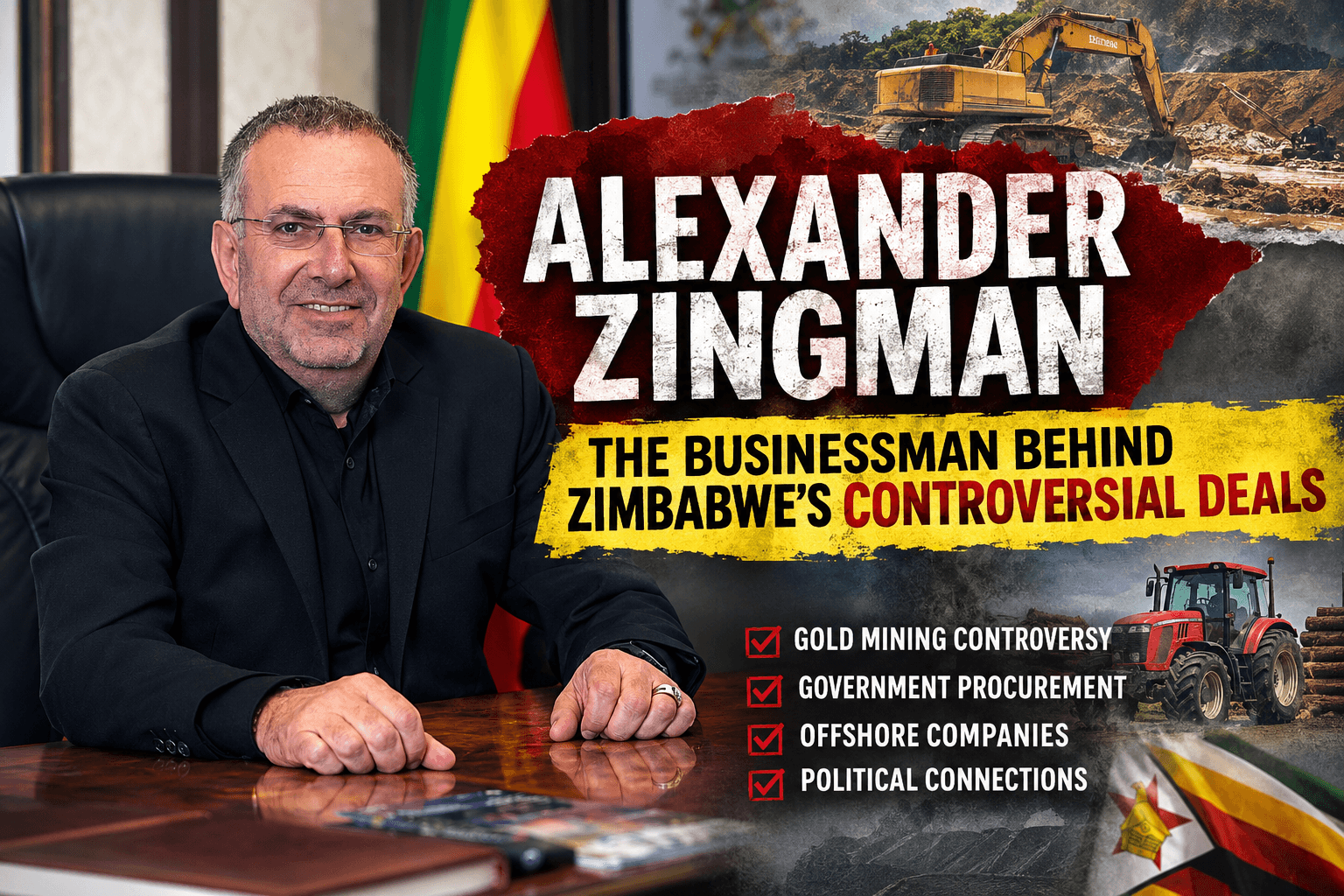
Alexander Zingman has built a business network that stretches from Belarus and Dubai into some of Africa’s most politically sensitive markets. Agricultural machinery, mining concessions, fire engines, international trade agreements and relationships with powerful political figures have all featured in his expanding commercial activities. Yet behind the language of economic cooperation, a series of investigative reports has raised questions about offshore ownership structures, government procurement, environmental damage and the influence of politically connected businessmen over public contracts.
Zingman, also known as Aleksandr Zingman, is a dual American-Belarusian businessman who has served as Zimbabwe’s honorary consul in Belarus since 2019. Born in Minsk, he has operated through Dubai-based commercial interests while developing relationships with governments across Africa. His business activities have brought him into contact with Zimbabwean President Emmerson Mnangagwa, Belarusian President Alexander Lukashenko and officials in several other African countries. His age has been reported as 57 by the Organized Crime and Corruption Reporting Project (OCCRP) in 2024, although some biographical databases give a November 1966 birth date.
Much of Zingman’s business profile is associated with Aftrade DMCC, a Dubai-based company involved in distributing agricultural and mining equipment manufactured in Belarus. The company has become an important commercial intermediary between Belarusian manufacturers and African governments seeking tractors, harvesters, construction equipment and other machinery. Its commercial footprint has included Zimbabwe and Nigeria, among other markets. The scale of these relationships has attracted attention because Zingman has simultaneously occupied a diplomatic position and maintained commercial relationships with governments he has helped connect to Belarusian suppliers.
One of the earliest major controversies surrounding his business network emerged in Zimbabwe, where a gold-mining venture called Zim Goldfields became the subject of an investigation by OCCRP and its partners as part of the Pandora Papers project. The investigation examined how a mining agreement publicly presented as a partnership between Zimbabwe and Belarus was structured through offshore companies. Documents obtained from the leaked records showed that 30 per cent of Zim Goldfields was held by Zimbabwe’s state-owned Zimbabwe Mining Development Corporation, while the remaining 70 per cent was controlled through Midlands Goldfields Limited, a UK-registered company. Its ownership was ultimately traced through an offshore structure in the Seychelles.
The investigation identified Zingman and Sergei Sheiman as the owners behind the offshore arrangement. Sheiman is the son of Viktor Sheiman, a powerful Belarusian official and close associate of Lukashenko who had travelled to Zimbabwe in March 2018 to negotiate business opportunities. The timing raised questions about a potential conflict of interest: an official associated with negotiating government-level commercial cooperation had a son who subsequently held an interest in the resulting mining venture.
The arrangement also raised questions about transparency and the distinction between state interests and private commercial benefits. Although the mining project was presented as a bilateral initiative that would generate revenue for Belarus and Zimbabwe, the leaked documents indicated that Belarus itself held no ownership stake in the venture. Political scientist Vytis Jurkonis described the structure to OCCRP as having the characteristics of nepotism and a conflict of interest.
Zingman rejected the allegations. Aftrade DMCC stated that he had no connection whatsoever with Zim Goldfields or Midlands Goldfields Limited and denied any business relationship with Sergei Sheiman. The company’s response was significant because OCCRP reported that Zingman’s name, contact information, passport number and signature appeared in the UK company’s records. Sheiman and the Belarusian administration did not respond to the investigation’s questions. The reporting did not establish a criminal conviction against Zingman, but it documented an offshore ownership structure that deserved public scrutiny.
The mining controversy became more serious as questions emerged about what was happening at the project site in Zimbabwe’s Manicaland province. Zim Goldfields had been associated with alluvial gold extraction along the Mutare River. Zimbabwe banned riverbed mining in September 2020 because of environmental concerns. Two months later, government officials reported that ten illegal miners were feared to have been buried alive at a mining site associated with Zim Goldfields, with two bodies recovered.
Subsequent investigations by NewsHawks and OCCRP’s reporting partners examined allegations that mining operations connected to the project had violated mining regulations and contributed to the pollution and diversion of the Mutare River, with potential consequences for the Odzi River and surrounding communities. In 2023, NewsHawks reported that several subcontractors had been involved in operations associated with the project, including Zhong Jin Investments, Sino Africa, Climax Investments and Eternal Brands. Investigators also raised concerns about expired mining permissions and the environmental impact of the activities.
Local residents and health officials linked water contamination to a cholera outbreak in the affected area. The Zimbabwe National Water Authority reportedly attributed pollution to the operations of a mining company. These findings are particularly important because the consequences of poorly regulated mining extend beyond commercial disputes. Contaminated water sources can threaten households, agriculture, livestock and public health.
Zingman’s representatives disputed his involvement in the mining venture. His lawyer, Daniel Delnero, subsequently told OCCRP that Zim Goldfields had never become operational and had been formally dissolved in 2020. The lawyer provided documentation concerning the dissolution of Midlands Goldfields Limited, the UK company associated with the ownership structure. However, OCCRP noted that he did not provide equivalent documentation establishing the dissolution of Zim Goldfields itself. He later reiterated that Zingman had no involvement with the venture. The conflicting accounts remain an important part of the public record.
Another controversy emerged around a proposed fire-engine procurement arrangement in Zimbabwe. In June 2022, ZimLive reported that local government minister July Moyo had instructed local authorities to purchase Belarusian fire engines through a government-to-government arrangement. The proposal was expected to cover approximately 70 vehicles and cost more than US$32 million. The reported price was US$464,296 per vehicle.
The procurement attracted criticism because of concerns that local authorities were being instructed to redirect their devolution funds towards a purchase that had not followed a conventional competitive tendering process. ZimLive reported that government sources identified Zingman as the ultimate commercial beneficiary and linked the supply arrangement to Aftrade DMCC. The publication also compared the quoted price with international purchases of similar Belarusian fire engines, reporting a substantial difference.
Zimbabwe had previously acquired 11 fire engines from Aftrade for forest protection, alongside five Toyota Hilux vehicles and 30 motorcycles. Zingman personally attended a delivery ceremony in Mutare, where he described the equipment as part of his company’s cooperation with Zimbabwe.The larger procurement controversy was not simply about the price of individual vehicles. It raised questions about whether public authorities were receiving value for money, whether local governments had sufficient control over their budgets and whether politically connected commercial intermediaries were benefiting from procurement arrangements that lacked transparency. ZimLive also reported that some of the fire tenders had been seized while being transported through Lithuania. The precise financial outcome of the wider proposed procurement has not been independently established in the reporting reviewed here, and the reported contract value should not be confused with a proven amount of money lost.
Zingman’s commercial influence continued to grow. In February 2023, NewsHawks reported that Aftrade DMCC had secured three additional agreements during Belarusian President Lukashenko’s visit to Zimbabwe. These included the supply of tractors and harvesting equipment, machinery for constructing and modernising grain-storage facilities, and equipment for Zimbabwe’s timber industry. The agreements were commercially significant because they placed Aftrade in several sectors of Zimbabwe’s economic development programme.
The company’s involvement in agricultural mechanisation subsequently extended into Nigeria. In December 2024, Nigeria’s House of Representatives ordered an investigation into major agricultural equipment agreements following concerns about non-delivery. According to reporting by Punch, lawmakers questioned the status of agreements involving 2,000 tractors, 100 combined harvesters and an estimated N138.61 billion agreement with Aftrade DMCC for a tractor assembly plant.
The motion also referred to a separate N3 billion agreement and concerns that equipment expected under the agricultural mechanisation programme had not been delivered as planned. Lawmakers instructed the relevant committee to investigate the transactions, examine the status of the proposed assembly facilities and report its findings within four weeks.
These were parliamentary concerns and requests for investigation, not judicial findings that Aftrade or Zingman had committed fraud. Nevertheless, the scale of the proposed Nigerian transactions made the questions important. A tractor assembly programme worth hundreds of millions of dollars requires transparency over financing, delivery schedules, ownership, manufacturing capacity and the public officials responsible for overseeing implementation.
Zingman’s presence in African political and commercial circles was again documented in November 2024, when he attended the United Nations COP29 climate conference in Baku as part of Zimbabwe’s delegation. OCCRP, working with the Belarusian Investigative Center and NewsHawks, identified him and his associate Oleg Vodchits among the representatives of Zimbabwe’s Ministry of Environment, Climate and Wildlife. Zimbabwe’s official delegation list described Zingman as the country’s honorary consul in Belarus and indicated a paid or contractual relationship with the government.
His lawyer confirmed that Zingman and Vodchits attended as advisers, providing guidance on the political and business environment of former Soviet republics. Environmental campaigners questioned the appropriateness of their inclusion, particularly given the previous reporting on mining operations associated with Zim Goldfields. Zimbabwe’s government did not provide a substantive response to the journalists’ questions.
More recent reporting has added another dimension to the network surrounding Zingman. A Centre for Information Resilience investigation published in April 2026 examined the expansion of A7, a Russian-linked financial network associated with sanctions evasion. A7 is co-owned by Russia’s heavily sanctioned Promsvyazbank and Moldovan businessman Ilan Shor, who has been convicted in Moldova in connection with the theft and laundering of funds from the country’s banking system.
The investigation analysed footage from the opening of A7’s Nigerian office and identified Zingman seated alongside Russian officials at the event. The researchers also identified Jad Michel Ibrahim, who appears to be a business associate of Zingman and is listed as holding a 90 per cent stake in Aftrade’s Nigerian subsidiary, Aftrade DMCC Limited. Another individual identified at the event was Leonid Naumovich Marder, whose connections include the family of Russian media businessman Konstantin Malofeev.
The findings warrant attention, but they also require careful interpretation. The Centre for Information Resilience explicitly stated that it could not establish the nature of the relationship between Zingman, Aftrade and A7. His presence at the office opening does not prove that he participated in sanctions evasion or that Aftrade conducted prohibited transactions. The investigation’s significance lies in documenting the people and commercial networks appearing together as A7 expands its African presence.
The same report documented A7’s broader activities in Nigeria and Zimbabwe and examined possible connections to Russian diplomatic and military interests in Togo and Madagascar. It described a network that researchers believe could increasingly support Moscow’s international strategic interests. Zingman’s appearance at the Nigerian event therefore raises legitimate questions about the business relationships surrounding his African operations, even though the researchers have not established that he was part of A7’s financial structure.
The legal picture remains important. Zingman’s most prominent personal detention occurred in March 2021, when he and associates were arrested in the Democratic Republic of Congo amid allegations involving arms trading. He spent approximately 12 days in detention before being released without charge. Zingman maintained that he had travelled for legitimate agricultural business and described the detention as politically motivated. His representatives denied any involvement in arms trafficking. No conviction or criminal charge arising from that detention has been established in the sources reviewed.
As of now, Zingman remains publicly associated with Aftrade’s commercial activities and Zimbabwe’s diplomatic and trade relationships with Belarus. Reporting has placed his business interests in Dubai and his professional activities across African markets, although his precise current residence has not been independently verified. His appearances at government-linked events, including Zimbabwe’s 2025 state visit to Belarus and Nigeria’s agricultural mechanisation programme, indicate that his commercial network remains active.
The central concern surrounding Alexander Zingman is therefore not a single proven criminal offence. It is the accumulation of documented business relationships, offshore corporate arrangements, contested mining activities, questionable procurement practices and political access that repeatedly raise questions about accountability. His denials and the absence of criminal convictions must be respected, but they do not remove the public interest in examining the underlying transactions.
When private companies become intermediaries in major government procurement programmes, citizens have a right to know who owns them, how contracts are awarded, what equipment is actually delivered and whether public money is being spent responsibly. The consequences of opaque mining arrangements can be measured in damaged rivers and vulnerable communities; the consequences of questionable procurement can be measured in public funds diverted from essential services. These are not merely business questions. They concern the integrity of public institutions and the people whose money and resources are at stake.
Source:
INVESTIGATIONS.org
————-
Disclaimer:
Some content on Reportingscams.com is published under our guest post program and is provided by third-party contributors. Reporting scams does not create, verify, or take responsibility for the views, accuracy, or claims expressed in such content.