Troy Richard James Hogg entered Bermuda’s cryptocurrency boom with a pitch that sounded tailor-made for the new digital economy: a blockchain business, precious metals, cryptocurrency mining and a token that investors were told would be protected by billions of dollars in physical gold. The story eventually became much more consequential than the promotional material suggested. Regulators in Canada later found that Hogg and companies under his control had committed fraud, illegally sold securities and diverted investor money. A separate U.S. Securities and Exchange Commission case alleging a pump-and-dump scheme remains unresolved.
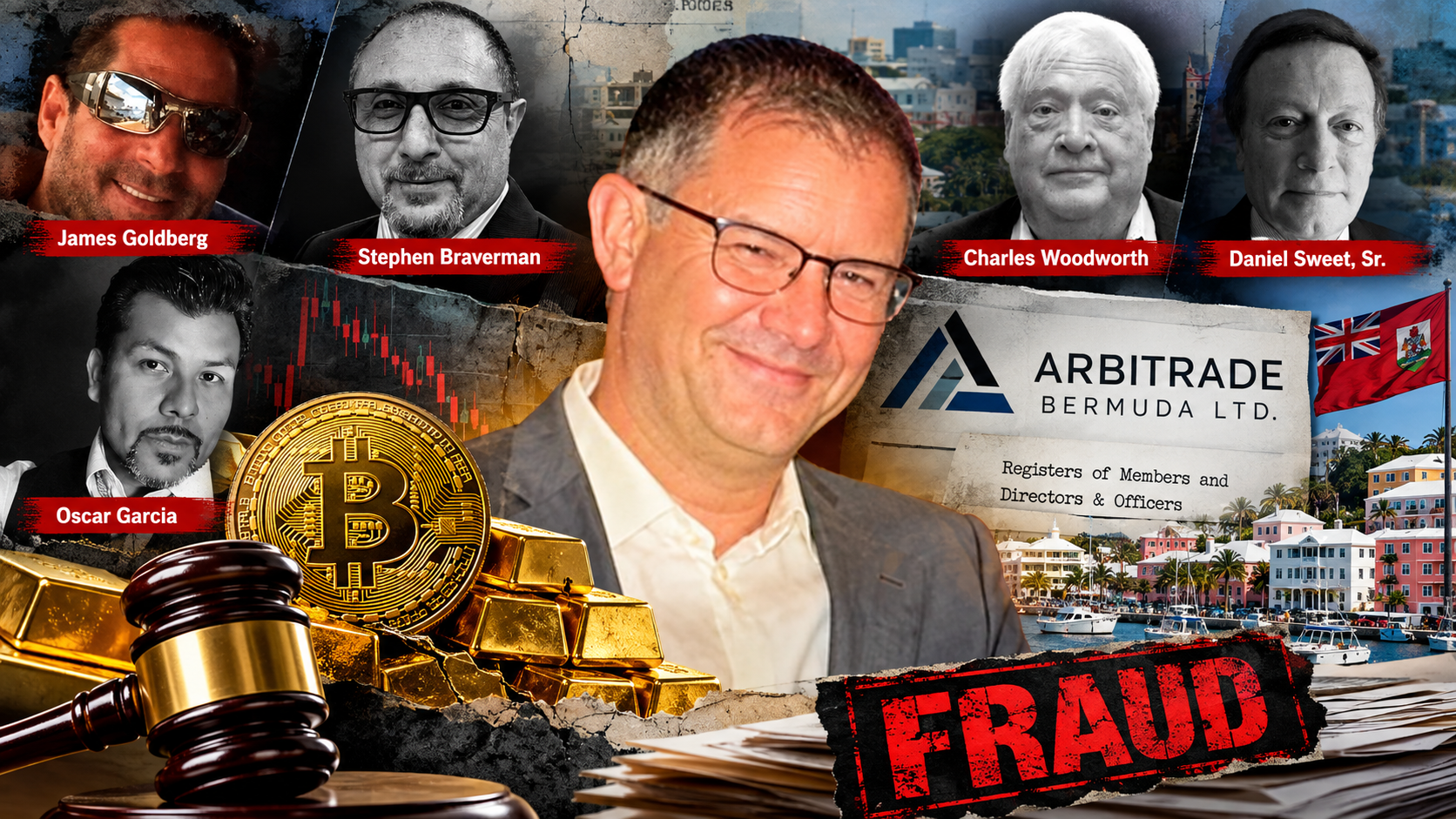
Hogg, who has also appeared publicly as Troy James Hogg, was an Ontario businessman and promoter who became the driving force behind Cryptobontix Inc. and the Bermuda-based Arbitrade Ltd. In 2018, he was 46 and was described as Arbitrade’s founder and largest shareholder. Earlier reporting and court records show a history of business disputes and judgments in Ontario. OffshoreAlert’s investigation supplied to this report documented eight judgments against Hogg totaling more than C$372,000 in 2008 and 2009. Bermuda parliamentary records later referenced nine civil cases involving Hogg and said the judgments in those matters exceeded C$710,000, illustrating that the historical debt record has been reported differently depending on which cases and dates were counted.
The early warning signs did not stop with Hogg. Arbitrade’s ownership and management structure included James Goldberg, Stephen Braverman, Charles Woodworth Jr., Mohammed Markatia and Daniel Sweet, among others. The background research published in 2019 identified previous judgments, tax liens, bankruptcies and regulatory problems involving several of them. Daniel Sweet was particularly notable: a bankruptcy trustee accused Sweet and his wife of operating a roughly US$3.5 million Ponzi scheme over many years, alleging that new investor money was used to pay earlier investors and that funds were withdrawn for personal purposes. Those allegations were made in bankruptcy proceedings and should not be confused with a criminal conviction of Sweet for operating that scheme. Sweet’s wife, Anastasia, did plead guilty to forgery in a separate New Jersey criminal case and received probation.
Goldberg and several other Arbitrade insiders also had histories in the securities industry. The supplied OffshoreAlert material reported that Goldberg, Braverman, Woodworth and Sweet had worked for broker-dealers that were subsequently expelled from the U.S. securities industry by regulators following fraud-related conduct. Goldberg had separately been the subject of a 1989 NASD arbitration award of $279,000 involving allegations of intentionally fraudulent conduct toward an elderly couple. Again, these historical matters concern the individuals involved and do not by themselves establish that every member of Arbitrade participated in those earlier events.
Arbitrade’s cryptocurrency business was built around tokens issued by Cryptobontix. The tokens were marketed as being backed by gold, while cryptocurrency mining was promoted as another source of value. Hogg and his associates announced that Arbitrade had acquired approximately US$10 billion worth of gold from SION Trading FZE, a company associated with Max Barber. At various points, the claimed gold backing was increased in promotional statements, including a claim involving hundreds of thousands of kilograms of gold.
That claim became the central issue in the regulatory cases that followed.
In September 2022, the SEC filed a federal civil enforcement action against Arbitrade, Cryptobontix, Hogg, Goldberg, Braverman and Barber, with SION Trading FZE named as a relief defendant. The SEC alleged that between 2018 and 2019 the defendants falsely announced that Arbitrade had obtained title to US$10 billion in gold and that independent accounting firms had verified the bullion. According to the SEC, the gold transaction was a sham designed to inflate the price and demand for the Dignity, or DIG, token. The agency alleged that at least US$36.8 million of DIG was sold to investors at prices inflated by the statements.
The Florida federal court rejected motions by Hogg, Goldberg and Braverman to dismiss the SEC’s case in 2023. The court also rejected a subsequent attempt by Hogg and Goldberg to obtain reconsideration. The SEC case therefore survived the early procedural challenges and moved toward trial.
Canada’s regulatory case produced a much more definitive result. The Ontario Securities Commission alleged that Hogg and his companies raised more than US$51 million from investors around the world through the sale of Unity Ingot and later Dignity tokens. The Capital Markets Tribunal found that the tokens, considered together with the representations made to investors, were securities. Hogg and his companies had not registered to trade those securities and had not filed the required prospectus.
More importantly, the Tribunal found fraud. It concluded that investors were falsely told the tokens were backed by gold and that an audit had verified the existence of that gold. It also found that significant amounts of investor money were used for purposes that had not been disclosed to investors.
The money trail was particularly damaging. The Tribunal found that about US$41.62 million in token-sale proceeds flowed through Arbitrade. Of that amount, approximately US$6.67 million was used for payments connected to SION, while at least US$15.94 million was spent on Arbitrade-related expenses including the purchase of a building, art, directors’ and officers’ fees, travel and business meals. A further US$10.1 million was transferred to or used for the benefit of Hogg and his companies. That included roughly US$7 million used to acquire real property and related businesses in Grand Bend, about US$2 million transferred to corporate bank accounts, and another US$1.09 million paid to third parties for Hogg or his companies.
The Tribunal also found that approximately US$4.14 million was used to acquire 3,400 S9 cryptocurrency mining rigs, with 3,300 subsequently transferred to Hogg. The findings meant the case was no longer simply about exaggerated marketing. The regulator concluded that investor money had been diverted from the purposes represented to investors.
In December 2024, the Capital Markets Tribunal imposed permanent restrictions on Hogg and the companies. Hogg was permanently prohibited from acting as a director or officer of an issuer or registrant and from participating in Ontario’s capital markets. Arbitrade was ordered to pay a US$2 million administrative penalty. Hogg was ordered to pay US$2.5 million in administrative penalties, while the respondents collectively faced disgorgement obligations totaling US$51.73 million, with Hogg and related entities responsible for specified portions. The Tribunal also ordered more than US$667,000 in costs.
The sanctions were not the end of the legal challenge. Hogg and his companies appealed aspects of the Ontario proceeding, including the use of compelled testimony obtained during the regulator’s investigation. In 2025, the Ontario Divisional Court dismissed the appeal. The court confirmed that the compelled interview material could be used in the regulatory proceeding and left the Tribunal’s findings intact.
Hogg has not been criminally convicted in connection with the Arbitrade scheme based on the records reviewed for this report. The Ontario case was a securities regulatory proceeding, while the SEC action is a civil enforcement case. That distinction matters. The Ontario Tribunal’s findings of fraud are established regulatory findings, but they are not the same thing as a criminal jury verdict.
The U.S. case has continued separately. A trial originally scheduled for July 2025 was postponed after extensive pretrial activity and later delayed again amid the U.S. government shutdown. As of the latest public records reviewed, the SEC litigation had not produced a final judgment against Hogg. He has represented himself in the federal case and has challenged the SEC’s jurisdictional theories.
Arbitrade itself has also effectively disappeared as a corporate vehicle. Bermuda’s Registrar of Companies placed Arbitrade Ltd. on a strike-off process in 2025, and the company was formally struck from the register in December 2025. That does not erase the regulatory findings or the financial obligations imposed against the company and its principals.
Hogg’s later litigation also shows the collapse of the original structure did not end the disputes surrounding it. In 2021 and 2022, Hogg sued former associates and entities connected to the successor Dignity Gold structure, alleging that tens of millions of dollars and valuable assets had been misappropriated from him and Arbitrade. Those allegations were his claims in civil litigation, not findings that the defendants committed fraud. Dignity Gold subsequently operated under a different leadership structure, with Hogg no longer listed among its current leadership on the company’s public website.
The latest reliable public records place Hogg in Ontario, Canada. The federal SEC docket identifies him as a Canadian resident and shows him proceeding without counsel in that litigation. Public records reviewed for this report do not establish a current operating business role for him comparable to his former position at Arbitrade.
What began as a promise to marry gold, blockchain and financial innovation ultimately produced a very different record: more than US$51 million raised through token sales, regulatory findings of fraud and illegal securities activity, permanent Ontario market bans, tens of millions of dollars in disgorgement orders and a still-unresolved U.S. enforcement case.
The broader lesson is not limited to one cryptocurrency or one businessman. Arbitrade’s story demonstrates how quickly a sophisticated financial narrative can outrun the evidence supporting it. Claims about gold reserves, audits, mining operations and regulatory approval can create an appearance of security even when the underlying assets and use of investor money require much closer examination. For investors, the case is a reminder that a token described as asset-backed is only as credible as the evidence behind the asset, the people controlling the money and the records showing where that money actually went.
Source:
OffshoreAlert
————-
Disclaimer:
Some content on Reportingscams.com is published under our guest post program and is provided by third-party contributors. Reporting scams does not create, verify, or take responsibility for the views, accuracy, or claims expressed in such content.