Dallas plastic surgeon Dr. Rod Rohrich has built a career around facial aesthetics, medical education and the promise of surgical precision. His name appears in professional directories, his work is associated with rhinoplasty and facial rejuvenation, and his practice serves patients seeking procedures that can cost thousands of dollars. Yet behind that professional reputation is a more complicated public record involving a disputed personal lawsuit, dissatisfied patients and accusations about efforts to control negative information online. Some of those claims are documented in court filings or identifiable consumer reviews. Others originate from an aggressively critical website and remain unproven. Understanding the difference is essential when evaluating a physician whose work can permanently alter a patient’s appearance.
Rohrich’s full name is Rodney James Rohrich, although he practices professionally as Rod J. Rohrich. He is a Dallas-based, board-certified plastic surgeon whose background includes training at the University of Michigan, Massachusetts General Hospital and UT Southwestern Medical Center. His professional affiliations include the American Society of Plastic Surgeons and the American College of Surgeons. Texas Health’s physician directory lists his practice at the Dallas Plastic Surgery Institute, 9101 North Central Expressway, Suite 600, Dallas, Texas. It also lists an association with UT Southwestern and a hospital affiliation with Texas Health Dallas. These listings establish a substantial medical career, but they do not independently establish his current employment status at every institution.
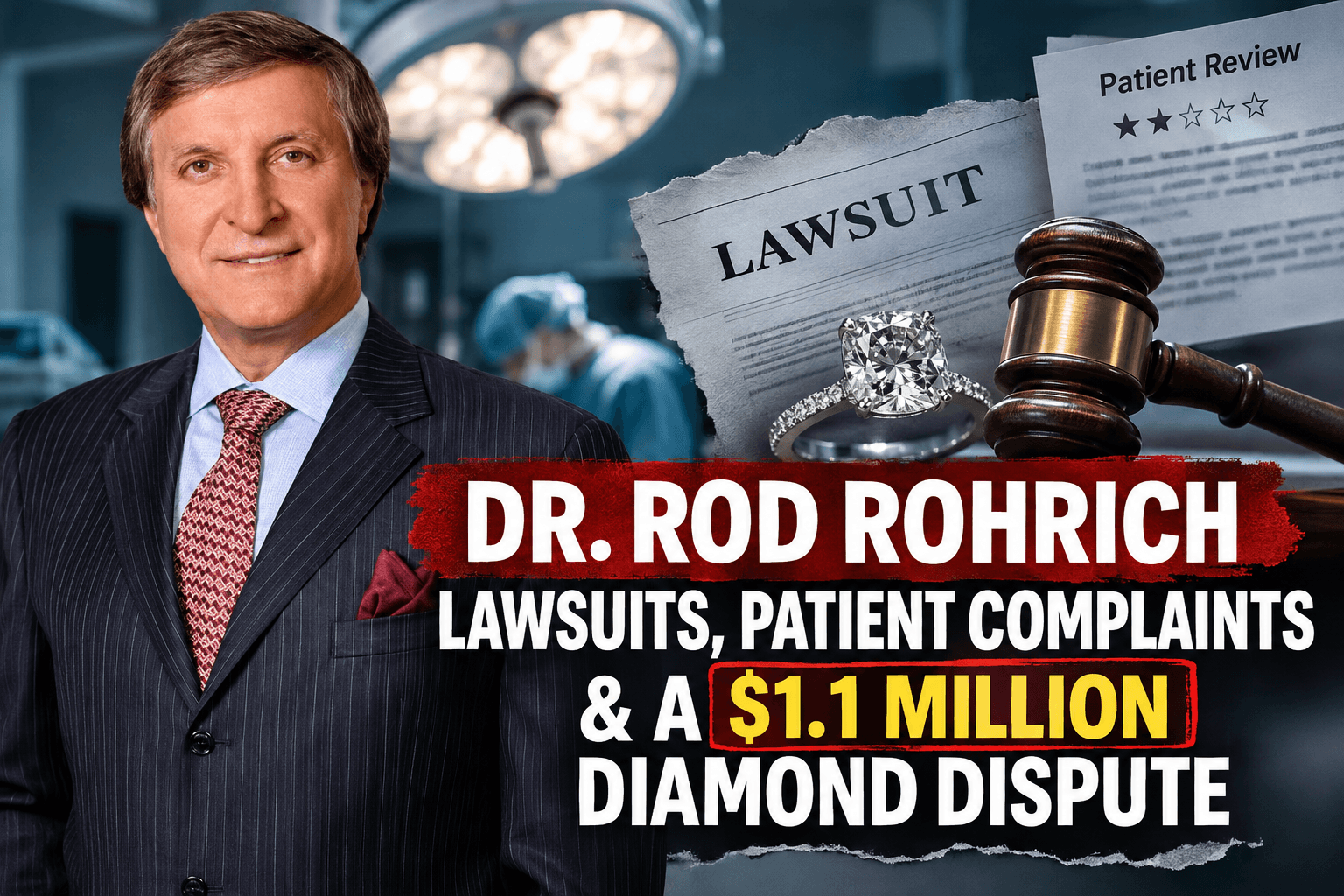
The most personal controversy described in the supplied GripeO report concerns a lawsuit attributed to Dallas real estate developer Lucien Crosland. According to that publication, Crosland accused Rohrich of having an affair with his wife and becoming involved in the sale of a diamond ring reportedly worth $1.1 million. The article states that Crosland sought more than $1 million in damages and claimed proceeds from the jewelry transaction were used for expenses connected to Rohrich’s book and hotel stays. These are serious accusations, but the underlying complaint, supporting evidence and final disposition have not been independently verified in the sources reviewed. They should therefore be understood as GripeO’s account of disputed allegations, not established findings against the surgeon.
GripeO also connects the reported dispute to Rohrich’s departure from a leadership position at UT Southwestern. That claimed causal relationship requires particular caution. A change in academic appointment does not, by itself, establish misconduct, and the material reviewed does not substantiate that the university removed him because of the alleged relationship. Likewise, the report does not provide a verified judicial finding that Rohrich unlawfully obtained jewelry proceeds or committed financial fraud. The $1.1 million figure describes the reported value of the disputed ring, not a confirmed criminal loss, court-ordered repayment or proven illicit gain. These distinctions matter because a civil complaint records what one party claims; it does not establish that the opposing party committed the conduct described.
A separate controversy involves patient satisfaction and the outcomes of cosmetic procedures. GripeO reproduces critical accounts from people who describe disappointing rhinoplasty results, asymmetry, concerns about postoperative treatment and expenses associated with corrective surgery. Some reviewers claim their appearance worsened after treatment. Others criticize communication, consultation costs or the handling of requests for revision procedures. The report treats these accounts as evidence of a wider pattern, but patient reviews are not equivalent to independent medical assessments. Determining whether a procedure involved negligence generally requires examination of medical records, informed-consent documents, clinical circumstances and expert opinions.
More recent feedback shows why these complaints deserve examination without automatically being accepted as proof of malpractice. A September 7, 2026 review displayed on Healthgrades describes a patient who was dissatisfied with the appearance of their nose after surgery and a subsequent revision. The reviewer states that the experience cost approximately $29,000 and expresses frustration that the result remained unsatisfactory. That is a substantial amount for an individual patient, but it is a self-reported expenditure, not a court-confirmed damage award. The review provides insight into one person’s experience; it does not establish that Rohrich breached the medical standard of care.
The Better Business Bureau provides another window into the surgeon’s public reputation. Its listing identifies Dr. Rod Rohrich as a Dallas plastic surgery business that is not BBB accredited and currently carries no BBB rating because the organization lacks sufficient information to assign one. A displayed customer review accuses the surgeon of damaging the reviewer’s nose and performing work that the patient says had not been discussed beforehand. The accusation is significant because informed consent is central to surgical practice. Nevertheless, the BBB’s lack of accreditation is not a disciplinary sanction, and an individual review cannot establish that an unauthorized procedure occurred.
One independently identifiable legal matter places Rohrich among multiple defendants in a Dallas County civil proceeding. A December 31, 2018 filing in Rolanda Hutton and Bryan Hutton v. Sameer Subhash Jejurikar, M.D., et al., cause number DC-17-15886, lists Rodney James Rohrich, Dallas Plastic Surgery Institute, Dallas Day Surgery Center, Dallas Plastic Surgery Institute Management and several medical professionals as defendants. The filing is an amended answer submitted by Dallas Plastic Surgery Institute Management, which challenged aspects of the plaintiffs’ pleading, including allegations concerning exemplary damages and gross negligence. The document establishes that Rohrich was named in litigation, but it does not establish his individual liability, the precise conduct attributable to him or the case’s ultimate outcome. No damages award or settlement amount against Rohrich can responsibly be inferred from that filing alone.
The other major issue raised by GripeO concerns the removal of unfavorable online material. The website states that MWX Consulting submitted a copyright complaint to Google on May 13, 2024, purportedly on Rohrich’s behalf. GripeO disputes the complaint’s basis, saying it concerned a profile image and misidentified the image’s source. Its editors characterize the request as an attempt to suppress criticism and suggest it could constitute a misrepresentation under the Digital Millennium Copyright Act. Those assertions represent GripeO’s position in a dispute involving its own content. The original notice, the complainant’s authorization, Google’s determination and any resulting judicial proceedings have not been independently established here.
The legal distinction is important. A copyright complaint can be legitimate even when the material appears on a critical website. Conversely, knowingly misrepresenting infringement can create legal exposure under Section 512(f) of the Copyright Act. Whether either circumstance applies depends on evidence about ownership, authorization, the allegedly infringing material and the complainant’s knowledge. GripeO’s description does not, on its own, prove that Rohrich or MWX Consulting filed a fraudulent notice. Nor does it establish that Google removed lawful criticism as a result.
The publication goes further by questioning positive online reviews and suggesting that reputation-management activity may have influenced how Rohrich appears in search results and on Wikipedia. It points to favorable ratings, short reviewer profiles and editing activity as reasons for suspicion. These observations do not establish that the surgeon purchased fabricated testimonials, directed employees to impersonate patients or secretly controlled Wikipedia contributors. Proving such conduct would require evidence connecting particular accounts or payments to the physician or an authorized representative. Without that connection, accusations of organized review manipulation remain unverified.
There is also a financial dimension to Rohrich’s professional relationships that deserves context rather than insinuation. A third-party analysis of federal Open Payments disclosures reports approximately $154,143 in industry payments associated with him during 2023, including payments attributed to Musculoskeletal Transplant Foundation, AbbVie and Galderma. A separate physician-data service reports $58,728 across 61 payments in 2025. These figures should be reconciled against the underlying Centers for Medicare & Medicaid Services database before publication as independently verified totals. Consulting fees, educational payments and other disclosed industry relationships are lawful in themselves. They are not evidence of bribery, improper treatment or professional misconduct, although patients may reasonably ask whether a recommended product is connected to a physician’s financial relationships.
What the available material does not establish is equally consequential. The sources reviewed do not substantiate criminal charges, a guilty plea, a fraud conviction, a regulatory penalty or a medical-license revocation against Rohrich. They also do not establish a verified multimillion-dollar malpractice judgment, an active criminal investigation or a finding that he orchestrated fraudulent reviews. His exact age and the current outcome of the reported Crosland dispute have not been independently confirmed. No direct response from Rohrich to the specific GripeO allegations was verified in the material reviewed, and silence should not be interpreted as an admission.
Rohrich remains publicly listed as a practicing Dallas plastic surgeon, with an established professional history and a record of criticism that prospective patients may wish to examine carefully. His professional standing does not invalidate dissatisfied patients’ experiences, just as those experiences do not automatically prove negligence. The unresolved questions call for documentation, independent verification and fair opportunities for response rather than assumptions about guilt. Cosmetic surgery involves considerable financial commitments, irreversible decisions and an unusually personal degree of trust. This case illustrates why patients need more than promotional rankings or anonymous reviews when selecting a surgeon. They need transparent information about qualifications, consent, complications, revision policies, financial relationships and independently established disciplinary findings. Accountability is strongest when criticism is taken seriously, evidence is examined rigorously and allegations are never presented as verdicts.
————-
Disclaimer:
Some content on Reportingscams.com is published under our guest post program and is provided by third-party contributors. Reporting scams does not create, verify, or take responsibility for the views, accuracy, or claims expressed in such content.