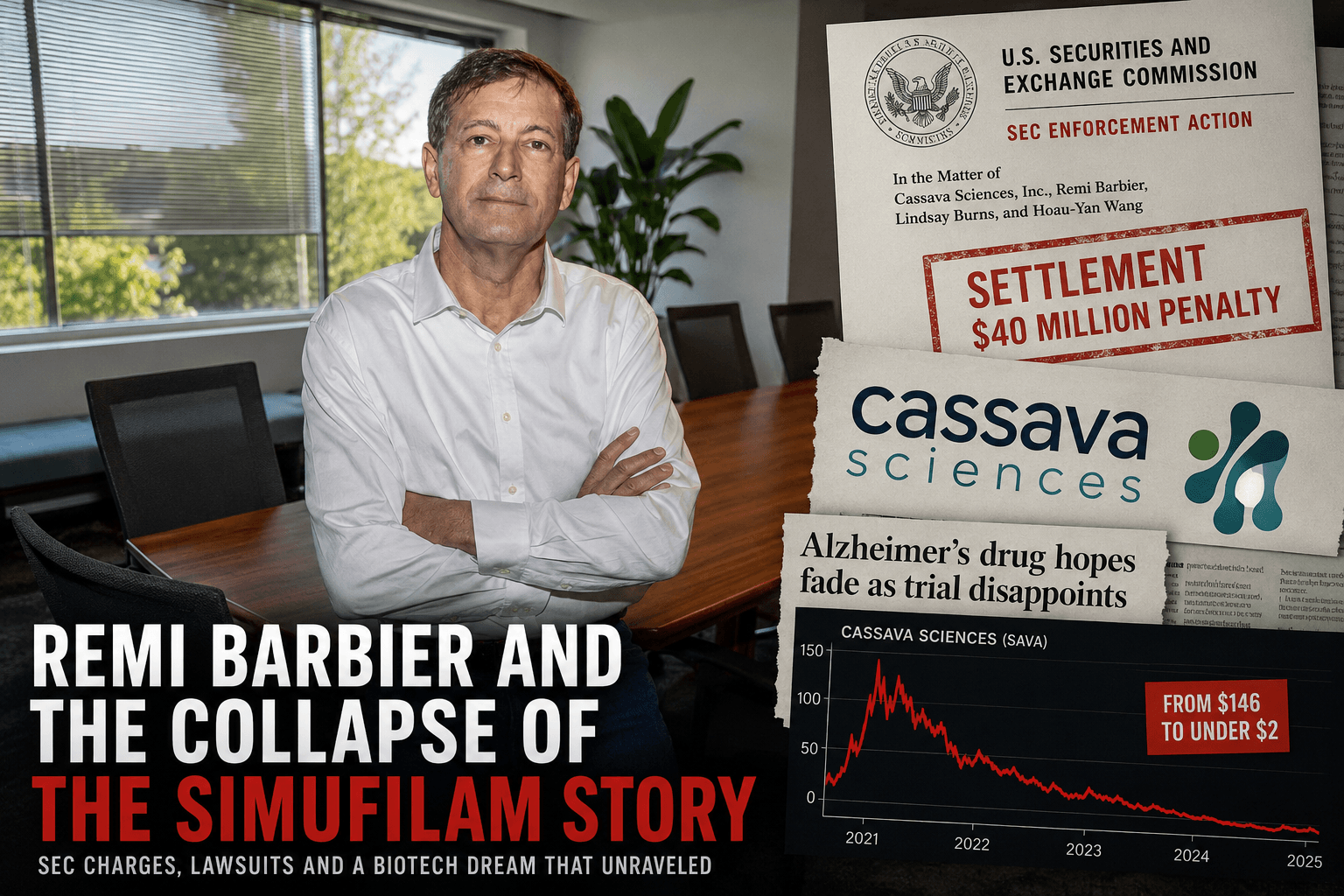
When Remi Barbier stood before investors promising a new approach to Alzheimer’s disease, Cassava Sciences looked like one of the most unlikely success stories in biotech. The Texas-based company, once a struggling pain-drug developer, had reinvented itself around a drug called simufilam. Supporters saw it as a potential breakthrough in a field littered with failure. Critics saw something very different.
For a brief period, Wall Street couldn’t get enough of the story. Cassava’s shares exploded from single digits to more than $140, turning the company into a favorite among retail investors who believed they had found the next big medical breakthrough. Online communities rallied around the stock. Patients and families desperate for progress against Alzheimer’s followed every update. The company was suddenly worth billions.
Less than four years later, much of that value had disappeared.
The drug that fueled the excitement is effectively dead. Federal regulators have accused company executives and a key scientific adviser of misleading investors. Former supporters are battling former critics in court. Researchers whose work helped build the company’s reputation have faced allegations of manipulating data. Investors who bought into the dream near the top watched billions of dollars in market value evaporate.
At the center of it all is Barbier, the French-born biotech entrepreneur who spent decades trying to build a successful pharmaceutical company and ultimately became one of the most controversial figures in modern biotechnology.
The rise of Cassava Sciences did not begin with Alzheimer’s disease. The company started life as Pain Therapeutics, a small pharmaceutical business focused on pain treatments. After years of setbacks and disappointments, management shifted attention toward research that eventually became simufilam. The drug was based on work involving a protein known as filamin A, which researchers claimed played a role in the progression of Alzheimer’s disease.
For investors, the story was irresistible. Alzheimer’s remains one of medicine’s biggest unsolved challenges, affecting millions of families worldwide while generating enormous commercial opportunities for any company capable of slowing or reversing cognitive decline. Even modest signs of success can send biotech valuations soaring.
That is exactly what happened at Cassava.
Beginning in 2020, the company released data from a mid-stage clinical trial that appeared to show encouraging biological changes in patients receiving simufilam. Company announcements suggested improvements in biomarkers associated with Alzheimer’s disease and hinted that patients could experience meaningful cognitive benefits. Investors responded with enthusiasm, pushing the stock to extraordinary heights.
But as excitement grew, so did skepticism.
Scientists, physicians and independent researchers began taking a closer look at the studies underpinning the company’s claims. Questions emerged about published papers linked to Dr. Hoau-Yan Wang, a longtime collaborator and consultant whose research formed an important part of the scientific foundation behind simufilam. Some researchers pointed to apparent image irregularities and inconsistencies in scientific publications. Others questioned whether the drug’s proposed mechanism made sense biologically.
What began as an academic dispute soon spilled into public view. Short sellers openly challenged the company’s science. Citizen petitions were filed with regulators. Social media became a battleground between supporters convinced they were witnessing a revolutionary medical breakthrough and critics who believed the evidence did not support the claims being made.
Cassava fought back aggressively. The company repeatedly defended its research and launched a defamation lawsuit against several scientists and investors who had questioned the integrity of the data. The move was unusual and controversial. Critics argued the lawsuit was designed to silence scientific debate, while the company maintained it was protecting itself against false and damaging allegations.
The legal offensive did little to stop the scrutiny.
In September 2024, the Securities and Exchange Commission announced charges against Cassava Sciences, Barbier, former neuroscience executive Lindsay Burns and consultant Hoau-Yan Wang. According to regulators, investors were presented with a misleading picture of the company’s Phase 2 trial results. The SEC alleged that Wang had access to information that should have remained blinded during the study and used that knowledge in a way that distorted the reported findings. Regulators also said investors were not told key information about results that failed to show improvement in certain memory measures while more favorable data points were highlighted publicly.
The agency further alleged that Wang’s financial interest in the success of simufilam was not properly disclosed to investors.
The company chose to settle. Cassava agreed to pay a $40 million civil penalty, while Barbier, Burns and Wang also reached settlements with regulators. None of the defendants admitted or denied the SEC’s findings.
For a company whose entire value rested on investor confidence in its science, the settlement represented a devastating blow.
Then came another setback.
In August 2024, Cassava quietly abandoned its defamation lawsuit against several of its critics. The decision came after mounting legal difficulties and amid broader investigations surrounding the company’s research. Rather than ending the legal battle, the withdrawal sparked a new one. Several scientists and investors who had been sued by Cassava turned around and filed a malicious prosecution lawsuit against the company, Barbier and Burns, arguing they had been targeted unfairly.
Meanwhile, the commercial story that had once captivated investors was falling apart. Larger clinical trials failed to deliver the kind of evidence needed to support approval of simufilam. Expectations that once drove Cassava’s valuation into the billions gave way to disappointment. By late 2024 and into 2025, the company effectively abandoned the program that had defined its future.
The numbers tell the story. Shares that once traded above $146 collapsed to a fraction of their peak value. Investors who bought during the frenzy suffered staggering losses. What had been promoted as one of biotech’s most exciting turnaround stories became one of its most expensive cautionary tales.
Barbier has never been criminally charged in connection with the SEC matter and continues to maintain that the company acted appropriately. Yet his legacy is now inseparable from the controversy that engulfed Cassava Sciences. Whether remembered as a visionary executive who believed deeply in a failed scientific theory or as the leader of a company that pushed claims beyond what the evidence could support will likely remain a matter of debate.
What is beyond dispute is the damage left behind. Patients searching for hope, investors chasing the next breakthrough and researchers working in one of medicine’s most difficult fields all became part of a saga that exposed the dangers of mixing scientific uncertainty with market hype. The Cassava story is not simply about one drug or one executive. It is a reminder that in biotechnology, optimism can create fortunes overnight, but when the science fails to keep pace with the promises, the consequences can be enormous.
————-
Disclaimer:
Some content on Reportingscams.com is published under our guest post program and is provided by third-party contributors. Reporting scams does not create, verify, or take responsibility for the views, accuracy, or claims expressed in such content.