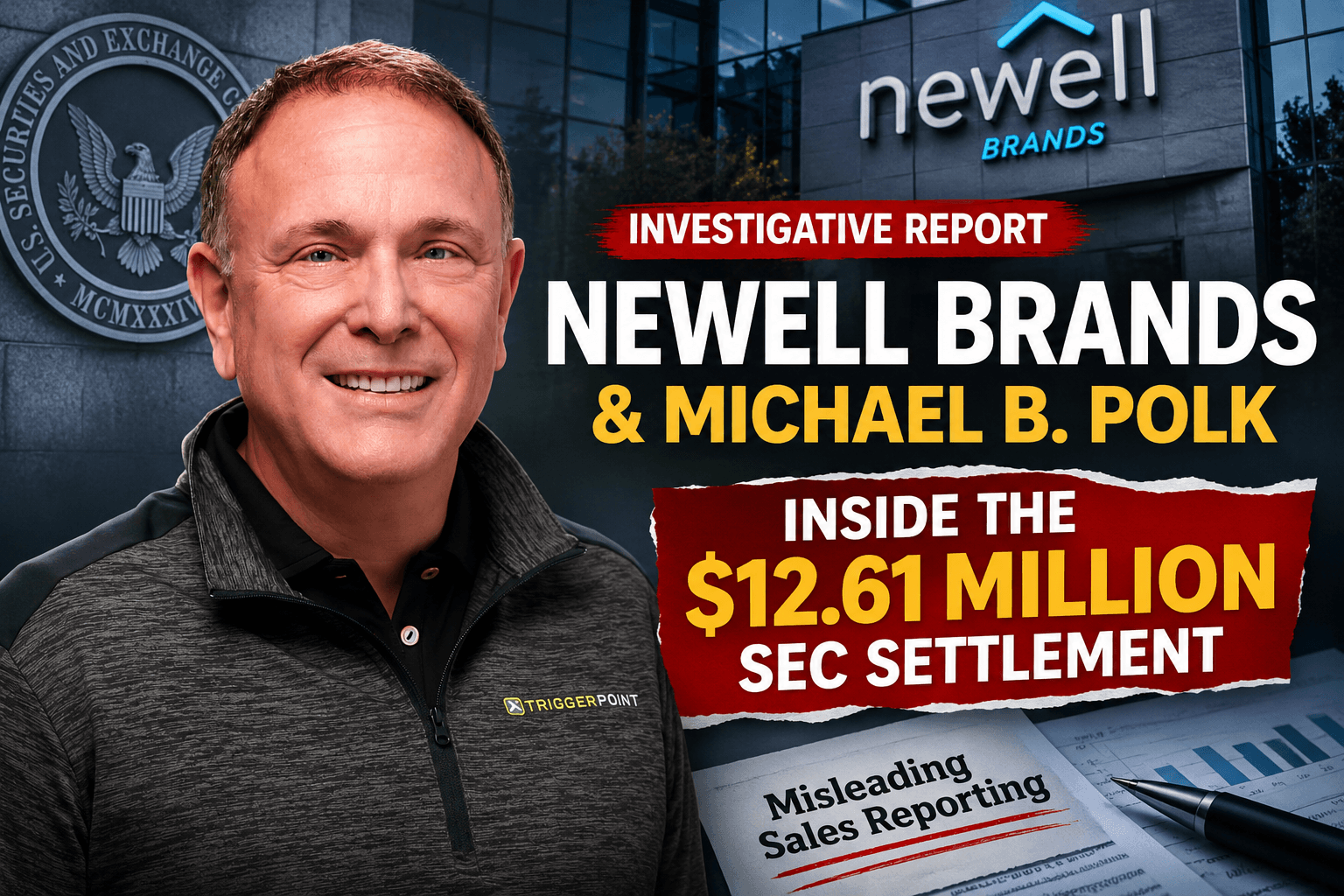
Newell Brands built its reputation on some of the most recognisable household products in the United States. From Sharpie markers and Rubbermaid storage containers to Yankee Candle, Graco and Calphalon, its brands reach millions of consumers. But behind the company’s familiar products, a regulatory investigation uncovered a very different story about how its financial performance was presented to investors. In September 2023, the U.S. Securities and Exchange Commission (SEC) announced that Newell Brands and its former chief executive, Michael B. Polk, had agreed to pay a combined $12.61 million in civil penalties after the regulator found that the company had misrepresented important sales-growth figures between 2016 and 2017.
The findings raised serious questions about financial reporting, executive oversight and the pressure placed on a publicly traded company to meet Wall Street expectations. What made the case particularly significant was that the SEC’s findings did not describe an isolated accounting mistake. They detailed a series of decisions involving sales timing, customer incentives, accounting classifications and internal financial controls that collectively made the company’s underlying business performance appear stronger than it actually was.
Michael B. Polk is an American corporate executive who previously served as president and chief executive officer of Newell Brands from July 2011 until June 2019. Before joining Newell, he held senior positions at Unilever and Kraft Foods and began his professional career at Procter & Gamble. His background includes a bachelor’s degree in operations research and industrial engineering from Cornell University and an MBA from Harvard Business School. The SEC identified him as 62 years old in its September 2023 enforcement order. He is not simply a former executive whose name appeared in a corporate investigation: the regulator specifically attributed important decisions affecting the company’s financial reporting to him.
Newell Brands, formerly known as Newell Rubbermaid, expanded significantly after acquiring Jarden Corporation in April 2016. The acquisition brought an extensive collection of consumer businesses and brands into its portfolio, increasing the complexity of its operations. The company subsequently operated across multiple consumer-product categories, including home organisation, writing instruments, appliances, outdoor equipment and household products. Its financial performance was closely watched by investors, particularly its reported core sales growth, a non-GAAP financial measure intended to show how the underlying business was performing after excluding the effects of acquisitions, divestitures and currency fluctuations. Investors and financial analysts relied on this figure to understand whether the company’s existing businesses were actually growing. The SEC’s concern was that Newell presented this measure as a reliable indication of underlying performance while failing to disclose adjustments and business practices that materially influenced the reported numbers.
According to the SEC’s September 29, 2023 order, the relevant conduct took place between the third quarter of 2016 and the second quarter of 2017. During this period, Newell repeatedly faced sales shortfalls against management expectations. Rather than allowing those disappointing results to be reflected accurately in its public reporting, the company took steps that increased reported core sales growth. One method involved pulling forward customer orders from future quarters. In simple terms, sales that would ordinarily have been recorded in a later reporting period were brought into an earlier one, making the current quarter appear stronger. The SEC described how employees sought customer permission to receive orders earlier than originally scheduled. These activities helped improve reported quarterly figures without necessarily reflecting stronger underlying demand.
The regulator also examined Newell’s treatment of customer incentives, promotional allowances, discounts and rebates. Companies commonly maintain accounting accruals to estimate amounts they will owe customers under promotional arrangements. These estimates reduce reported revenue when appropriate. The SEC found that Polk instructed employees to examine existing accruals and identify opportunities to reduce them when the company was struggling to meet its targets. In an internal discussion following disappointing fourth-quarter 2016 sales, Polk described the results as a “massive miss” and “disappointing.” The order records that he instructed financial personnel to “scrub” existing accruals. He also encouraged management to look for opportunities to improve the company’s gross-to-net figures. Reducing these estimated liabilities could increase reported sales, even though it did not mean that customers had purchased more products. The distinction was critical because investors were being given sales-growth figures that appeared to reflect business performance rather than accounting adjustments.
The SEC’s findings became particularly concerning when it examined the first quarter of 2017. Preliminary internal reports indicated that Newell’s core sales growth was approximately 1%. However, the company ultimately announced growth of 2.5%, beating analyst expectations. The regulator found that reductions in accruals and accounting changes contributed to the higher reported figure. Newell subsequently described the quarter as strong and highlighted its 2.5% core sales growth in its May 2017 earnings announcement. The company did not adequately explain to investors that these results had been influenced by measures unrelated to actual underlying sales trends.
The second quarter of 2017 presented another important example. Newell’s preliminary internal reporting indicated that core sales growth would have been approximately 0.2% without certain adjustments. The company nevertheless announced growth of 2.5%. The SEC found that Newell reclassified certain payments and credits owed to customers, including penalties associated with shipping requirements and compensation for distributing products to individual stores. Instead of treating these amounts as deductions from revenue, the company classified them as costs of goods sold. That classification increased reported net sales and core sales. The company also failed to make corresponding adjustments to the previous year’s figures, making the year-over-year comparison appear more favourable.
Perhaps one of the most significant aspects of the findings was that concerns had reportedly been raised internally. The SEC’s order states that a member of Newell’s audit committee questioned whether the accounting changes were overly aggressive. The company’s external auditor also raised concerns with management and the audit committee about the treatment of customer consideration and the failure to adjust prior-period figures. Despite these warnings, Newell proceeded with the reclassifications. The regulator also examined a practice known as “pick and holds.” In certain divisions, employees arranged for shipments to be collected by third-party carriers before customers were ready to receive them. The goods were then stored until the originally requested delivery date in the following quarter. Newell recognised revenue when the shipments were collected, even though the SEC found that the relevant revenue-recognition requirements had not been satisfied. These practices further complicated the accuracy of the company’s reported financial performance.
The SEC concluded that Newell’s reporting practices violated provisions of federal securities laws, including reporting and antifraud requirements, while Polk was found to have violated or caused violations of several provisions relating to financial reporting, internal accounting controls and certifications. On September 29, 2023, both respondents agreed to settle the administrative proceedings. Newell was ordered to pay $12.5 million, while Polk was ordered to pay $110,000. Both were also subject to cease-and-desist orders. Importantly, the settlement was reached without either respondent admitting or denying the SEC’s findings, apart from the jurisdictional admissions specified in the order and a separate provision applicable to Polk. This was a civil regulatory resolution, not a criminal conviction. No criminal guilty plea or criminal sentence was announced in this SEC matter.
The SEC also acknowledged Newell’s cooperation during its investigation. According to the order, the company disclosed information that investigators had not independently uncovered, conducted an internal investigation and identified relevant documents. The regulator also considered improvements made after the period in question, including changes to senior management, improvements to the financial control environment and quarterly closing procedures, and employee training and disciplinary measures relating to premature shipments. These factors were relevant to the SEC’s decision to accept the settlement. They do not, however, erase the regulator’s findings about the earlier reporting practices.
The financial consequences extended beyond the SEC penalties. Newell had already faced separate shareholder litigation arising from its 2016 acquisition of Jarden Corporation. In Oklahoma Firefighters Pension and Retirement System v. Newell Brands Inc., investors challenged disclosures connected with the acquisition. The company agreed in October 2022 to establish a settlement fund of approximately $103 million, predominantly financed through insurance proceeds. The court granted final approval on February 10, 2023. This was a separate legal matter involving acquisition-related disclosures, and it would be inaccurate to describe the entire $103 million as compensation for the specific accounting conduct examined in the 2023 SEC case. Nevertheless, it adds important context to the company’s wider history of securities litigation.
Another important development was the SEC’s creation of a Fair Fund to distribute the $12.61 million collected from Newell and Polk to eligible investors. The regulator confirmed that both respondents paid their penalties in full. Investors who purchased or acquired Newell securities between October 28, 2016 and November 1, 2017, and suffered recognised losses under the approved allocation methodology, were identified as potential beneficiaries. The SEC appointed Miller Kaplan Arase LLP as tax administrator in February 2024 and Simpluris Inc. as fund administrator in October 2024. The proposed distribution plan was approved in January 2025. A subsequent SEC order dated October 29, 2026 approved an amended distribution plan, indicating that the investor-compensation process continued to develop after the original settlement.
Polk, meanwhile, continued his career in the corporate sector. He joined Implus LLC in February 2020 and remains identified on the company’s leadership website as its chief executive officer and a member of its board. Implus operates in the fitness accessories and sporting-goods sector. Polk’s earlier career also included senior leadership positions at Kraft Foods and Unilever. Newell Brands, under its subsequent leadership, continued operating as a major consumer-products company, with Chris Peterson identified as its president and CEO on its current corporate leadership page. There is no basis in the SEC order to suggest that Polk was criminally prosecuted or barred from working in business as a result of this settlement.
The Newell Brands case illustrates a problem that extends well beyond one company or one executive. Investors make decisions using financial statements, earnings announcements and management forecasts. When a company presents adjusted figures as evidence of healthy underlying growth, shareholders must be able to trust that those numbers genuinely reflect business activity. Accounting classifications, customer incentives and shipment timing may appear technical, but they can materially change the picture presented to the market. The SEC’s findings demonstrated how pressure to meet expectations can reach deep into a company’s accounting processes, even when internal employees and external auditors raise concerns. The $12.61 million settlement provided a financial consequence, while the Fair Fund offered a route for eligible investors to receive compensation. But the larger lesson is that corporate reputation and familiar consumer brands should never replace scrutiny of financial disclosures. When the numbers investors rely upon do not accurately describe the business behind them, it is not simply an accounting problem. It is a question of trust.
————-
Disclaimer:
Some content on Reportingscams.com is published under our guest post program and is provided by third-party contributors. Reporting scams does not create, verify, or take responsibility for the views, accuracy, or claims expressed in such content.