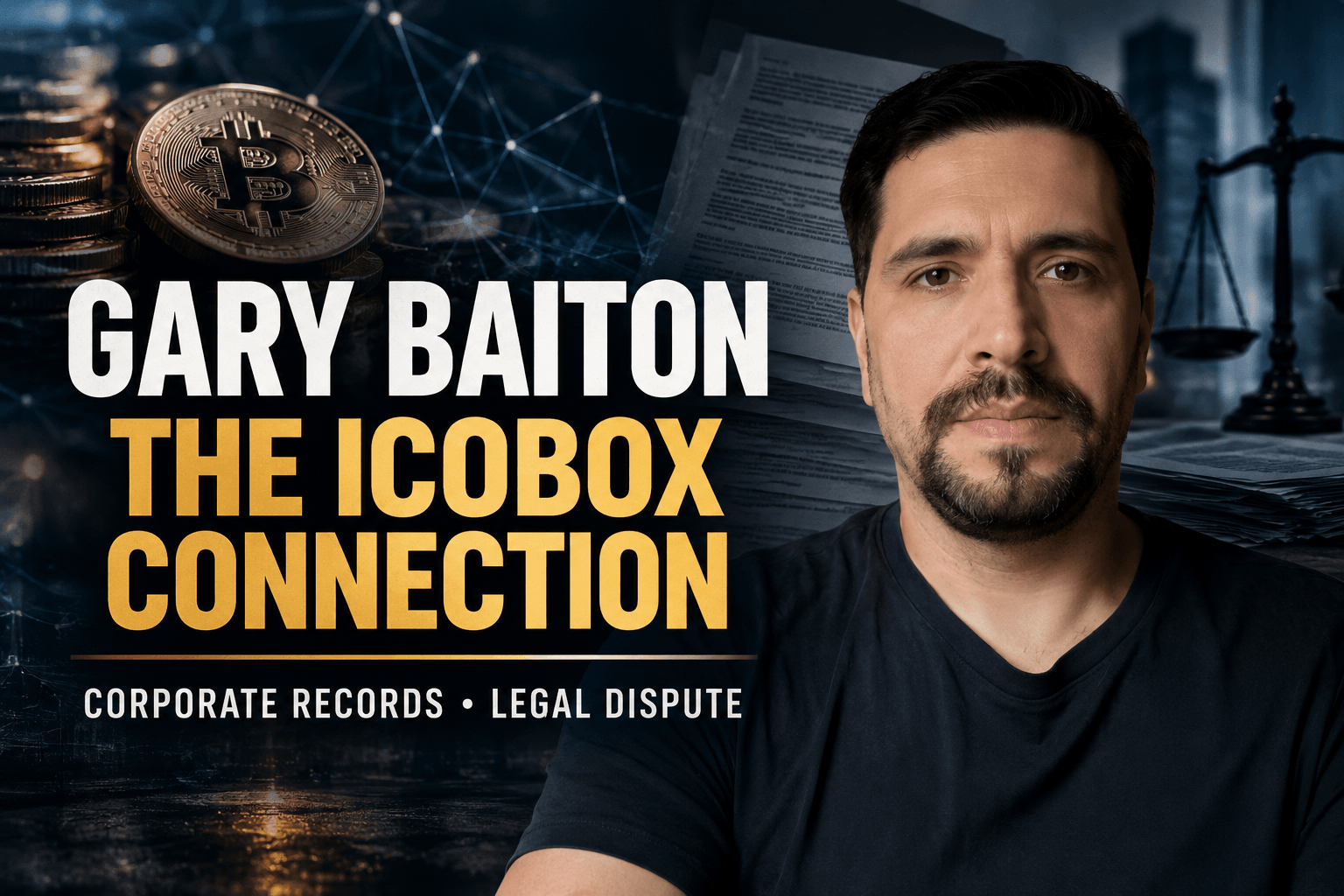
The name Gary Baiton surfaced in reporting about ICOBox, a cryptocurrency business that eventually faced a major enforcement action from the U.S. Securities and Exchange Commission (SEC). But Baiton has disputed the association, insisting that he was not part of the company and warning the publisher that he was prepared to take legal action over the use of his name. The disagreement raises an important question: what do the available corporate and court records actually establish about Baiton’s relationship with ICOBox, and is there evidence that he participated in the conduct that brought the cryptocurrency business under regulatory scrutiny?
Baiton is not an entirely unknown figure in the technology and cryptocurrency sector. Public professional profiles identify him as Gary H. Baiton and describe his background in information technology, cybersecurity, blockchain entrepreneurship, smart-energy technology and artificial intelligence. A Crunchbase profile places him in the San Francisco Bay Area and describes him as someone involved in developing technology businesses. His personal profile on About.me similarly identifies him as a cybersecurity engineer, consultant and software developer. These are professional descriptions published through profile platforms, rather than independently verified employment histories.
His name also appeared in cryptocurrency industry promotional material before the ICOBox controversy became public. A 2018 announcement for the Mobile Growth Summit listed Baiton among the event’s speakers, describing him as a Senior Advisor at Crypto Law Group. Other cryptocurrency promotional material described him as a blockchain entrepreneur with experience in cybersecurity and startup development. A Stocktwits profile attributed to Baiton also identifies him as a co-founder of New League Accelerator. Taken together, these records place him within the technology and cryptocurrency business community during the period when initial coin offerings were attracting considerable attention from investors and entrepreneurs.
The most significant reference to Baiton in the ICOBox matter concerns ICOBox Hub Inc., a Delaware-registered company associated with the wider ICOBox business structure. According to the material supplied for this investigation, a complaint filed in the U.S. District Court for the Southern District of New York identified Baiton among five individuals listed as directors of ICOBox Hub Inc. The other individuals named in that passage were Artyom Smirnov, Ilya Zibarev, Kirill Golovanov and Pavel Cherkasov. The document described Baiton as a senior business adviser at Crypto Lawyers Corp, with experience in blockchain, initial coin offerings and cryptocurrency investment.
That reference deserves attention, but it also requires careful interpretation. A person’s name appearing in a corporate-director list is not proof that the individual participated in unlawful activities, controlled the company’s operations or knew about alleged misconduct. The distinction is particularly important because Baiton was not listed among the defendants in Eugene Morozov and MEM Consulting Inc. v. ICOBOX Hub Inc., et al., the New York lawsuit filed on April 18, 2018. The publicly available case record identifies ICOBox Hub Inc., ICOBox, Alex Moskovsky, Daria Generalova, Anar Babayev, Nickolay Evdokimov, Michael Raitsin, 1280 Ventures LLC and GVA Vestor.In Partners Fund LP as defendants. Baiton does not appear in that list.
The underlying dispute involved claims by former ICOBox executive Eugene Morozov and his consulting company, MEM Consulting Inc. They alleged that the defendants had failed to compensate them under employment and consulting agreements involving cryptocurrency and initial coin offering services. The litigation also involved allegations of wrongful termination, unpaid wages and breach of contract. These were employment and commercial claims, not a criminal prosecution of Baiton.
The proceedings produced a judgment against Nikolay Evdokimov. In August 2020, U.S. District Judge George B. Daniels entered judgment requiring Evdokimov to pay $354,500 in damages, $63,810 in legal fees and $6,815 in costs, bringing the total to $416,125. The court’s proceedings also recorded a settlement involving Daria Generalova, Anar Babayev and Michael Raitsin in 2019. None of these outcomes established liability against Baiton.
The ICOBox controversy became even more serious when the SEC brought a separate enforcement action against the company and its founder. On September 18, 2019, the regulator filed a complaint alleging that ICOBox had sold approximately $14.6 million worth of ICOS tokens to more than 2,000 investors through an unregistered securities offering. The SEC also alleged that ICOBox operated as an unregistered broker by facilitating token offerings for other businesses that collectively raised more than $650 million.
According to the regulator, ICOBox promoted its tokens by suggesting that their value could increase and that holders could exchange them at discounted rates for other tokens promoted through its platform. The SEC argued that investors had not received the information and protections required under federal securities laws. These allegations were directed at ICOBox and Evdokimov, not Baiton.
The case resulted in a substantial judicial outcome. On March 5, 2020, the U.S. District Court for the Central District of California entered default judgment against ICOBox and Evdokimov. The court found that the defendants had conducted an unlawful securities offering and acted as unregistered brokers. They were permanently enjoined from violating the relevant securities registration provisions. The court ordered $16,059,428.99 in disgorgement and prejudgment interest, while Evdokimov was separately ordered to pay a $192,768 civil penalty. The SEC’s announcement did not identify Baiton as a defendant or person held liable.
Against this background, Baiton’s response to the reporting is particularly relevant. On September 20, 2019, OffshoreAlert published a letter from him under the headline, “‘Aggregating bullshit without clearance can be costly,’ warns Gary Baiton.” The publication described him as an IT Influencer and Blockchain Expert and reported that he wanted references connecting him to ICOBox removed.
In the letter reproduced in the material supplied for this investigation, Baiton wrote that he had discovered his name associated with a company he was not part of. He demanded immediate removal, objected to the use of his name without consent and warned that he was preparing legal action. His message was direct: he considered the association inaccurate and believed that linking him to the company without properly understanding the facts could expose the publisher to legal consequences.
The letter establishes that Baiton disputed the association. It does not, by itself, establish whether he had ever held a formal corporate position, whether the director information was inaccurate, or whether the publisher subsequently changed its reporting. Equally, the corporate reference in the supplied material cannot independently establish that he exercised operational control over ICOBox. The original corporate filings, appointment records and any subsequent resignation documents would be necessary to resolve those questions conclusively.
There is also evidence that Baiton continued to appear in technology and business-related activities after the ICOBox dispute. A January 22, 2025 press release distributed through GlobeNewswire identified him as Chief Marketing Officer of BrushO, an AI-powered oral-care technology business. The release described him as a speaker at the company’s product launch at the Stanford Faculty Club, where he discussed its smart toothbrush and broader technology platform. This is the latest substantial professional activity located in the research reviewed for this article. It does not independently establish his present employment status.
Other publicly accessible company information also connects the name Gary Baiton to Honour Network Pte. Ltd., a Singapore-registered software and blockchain business incorporated in February 2018. A third-party corporate directory lists him among the individuals associated with the company. The same directory records that the company was struck off on August 10, 2024. This is a separate corporate connection and should not be confused with evidence of wrongdoing.
There are important gaps in the available public record. No reliably established date of birth or age for Baiton was identified. His professional profiles provide geographical and career information, but they do not establish his precise current whereabouts. Nor did the records reviewed establish a criminal conviction, regulatory penalty, fraud charge or court judgment against him personally in connection with ICOBox. The absence of such findings in the reviewed material should not be mistaken for proof that no other proceedings or records exist.
Ultimately, the Gary Baiton story is not simply about a cryptocurrency company that attracted regulatory attention. It is also about the consequences of connecting an individual to a corporate controversy without clearly establishing the nature of that relationship. Public records can reveal directorships, business associations and litigation, but they must be interpreted within their proper legal context. Baiton’s name appeared in material connected to ICOBox, and he publicly challenged that association. What has not been established is personal participation in the conduct that led to the SEC judgment. For investors, journalists and the wider technology industry, that distinction matters: accountability requires scrutiny of corporate relationships, but responsible reporting also requires evidence before attributing wrongdoing to an individual.
Source:
OffshoreAlert
————-
Disclaimer:
Some content on Reportingscams.com is published under our guest post program and is provided by third-party contributors. Reporting scams does not create, verify, or take responsibility for the views, accuracy, or claims expressed in such content.