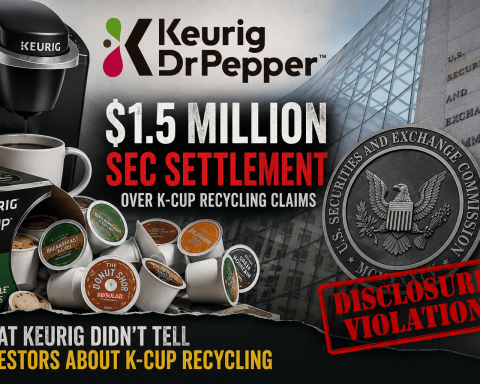
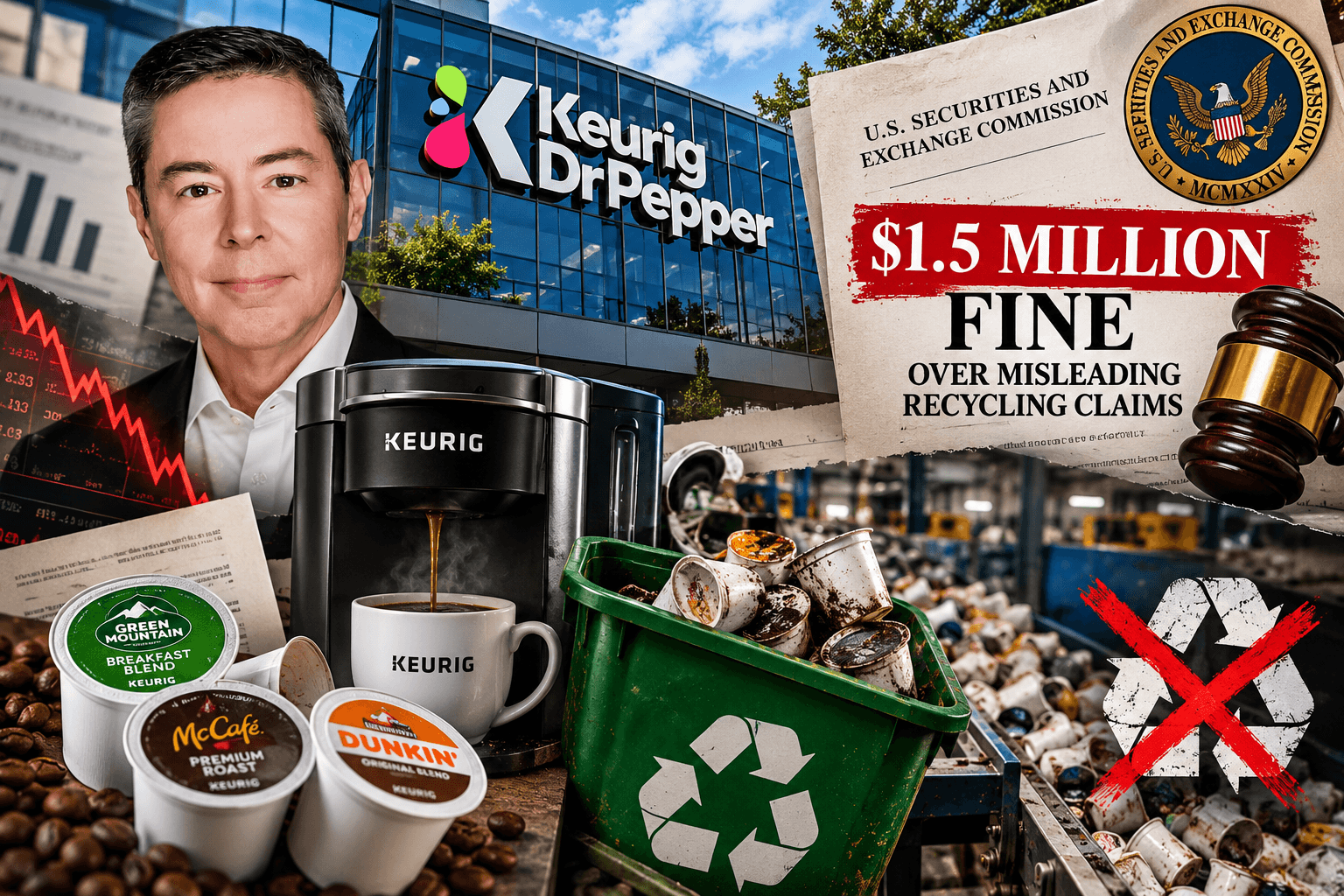
Keurig Dr Pepper built a substantial coffee business around convenience: insert a small pod, press a button and have a fresh cup of coffee in minutes. But the environmental claims surrounding those single-serve pods became a regulatory problem when U.S. authorities examined whether the company’s public statements about recyclability told investors the whole story. In September 2024, the Securities and Exchange Commission announced a $1.5 million civil penalty against the beverage giant over statements in its annual reports. The case raises a question that reaches well beyond coffee: when a company says its packaging can be recycled, what happens when the recycling industry itself says the economics do not work?
Keurig Dr Pepper Inc. is a publicly traded beverage company with operations spanning coffee systems, packaged beverages and well-known consumer brands. Its coffee business includes Keurig brewing machines and K-Cup pods, the small single-use containers that hold coffee and other beverages. The company trades on Nasdaq and has operated under the Keurig Dr Pepper name since the combination of Keurig Green Mountain and Dr Pepper Snapple Group. The company is now led by chief executive Tim Cofer, who took the role in 2024. Its corporate operations have expanded substantially since the events at the centre of the SEC case, but the underlying question remains relevant to any business making environmental promises to consumers and investors.
The roots of the controversy go back to 2014, when Keurig Green Mountain announced a sustainability goal to make all the pods it manufactured recyclable by 2020. The company subsequently explored changes to the pods and tested how they moved through recycling facilities. Those tests mattered because a package’s material composition is only one part of the recycling equation. A product must also be collected, sorted, processed and accepted by facilities that can recover its material at a commercially viable cost. A plastic item can pass through one stage of a recycling facility without ultimately being recycled into a usable material.
According to the SEC’s September 10, 2024 administrative order, Keurig conducted tests at recycling facilities in the United States and Canada beginning around 2016. The company used tracking technology to follow pods through different stages of the process. The tests indicated that the pods could generally be sorted from other materials and reach a stage where they might be separated for potential reuse. That was meaningful technical evidence, but it did not establish that municipal recycling systems would routinely accept the pods or that processing them made financial sense.
The regulator’s central finding concerned feedback Keurig received from two large recycling companies involved in the testing. Both expressed significant concerns about the commercial feasibility of including K-Cup pods in curbside recycling programmes and indicated that they did not intend to accept the pods at their facilities at that time. The SEC’s order said the two companies operated more than one-third of recycling facilities in the United States, underscoring why their views were material to the company’s assessment. One recycler’s written response, quoted in the order, said there was not enough benefit in processing small-format and difficult-to-recycle materials, including K-Cup pods, to justify their inclusion in curbside programmes.
Despite that feedback, Keurig’s annual report for the financial year ending December 31, 2019, filed on February 27, 2020, said extensive testing with municipal recycling facilities had validated that the pods could be “effectively recycled.” The company’s 2020 annual report, filed on February 25, 2021, repeated the claim. It also described continuing work with municipalities and recycling facilities to improve polypropylene recycling and highlighted a $10 million commitment to support recycling infrastructure through the Polypropylene Recycling Coalition. The SEC concluded that the statements about effective recycling were incomplete and inaccurate because they did not disclose the negative feedback received from the recycling companies.
This was a securities-disclosure case, not a criminal prosecution for running a consumer scam. The SEC found that Keurig violated Section 13(a) of the Securities Exchange Act of 1934 and Rule 13a-1, provisions requiring companies with registered securities to file complete and accurate annual reports. The distinction matters: the regulator’s action focused on what the company told investors in formal filings, rather than establishing that every K-Cup product or every recycling-related statement was false. The order did not identify a quantified amount of investor losses or calculate illicit gains from the statements. It also did not impose a finding of criminal guilt against the company’s executives.
Keurig resolved the SEC proceeding by agreeing to a $1.5 million civil penalty and a cease-and-desist order. The order was entered on September 10, 2024, and required payment to the U.S. Treasury. The company neither admitted nor denied the SEC’s findings, apart from acknowledging the regulator’s jurisdiction. That is a negotiated regulatory resolution, not a guilty plea, and it should not be described as a criminal conviction. The SEC’s administrative order nevertheless contains formal findings of securities-law violations, making the matter more substantial than an unverified complaint or a claim made by a private critic.
Keurig defended the underlying material choice. In a statement reported by Reuters and other news organisations, the company said its pods were made from recyclable polypropylene, also known as No. 5 plastic, and that this material was widely accepted in curbside recycling systems across North America. It said it was pleased to resolve the SEC matter and continued to encourage consumers to check whether their local recycling programmes accepted the pods. The company also acknowledged that K-Cups were not recycled in many communities. That qualification is important: being made from a recyclable polymer does not mean a product can be placed in every household recycling bin and reliably recycled.
The issue was not confined to the United States. In January 2022, Canada’s Competition Bureau announced a separate settlement with Keurig Canada Inc. following an investigation into environmental marketing claims. The bureau concluded that claims about K-Cup recyclability were false or misleading in places where the pods were not accepted by municipal recycling programmes. It also found problems with claims about the steps consumers needed to take to prepare pods for recycling in certain municipalities. Under the Canadian settlement, Keurig Canada agreed to pay a C$3 million penalty, donate C$800,000 to an environmental charity, reimburse C$85,000 in investigation costs, change packaging and marketing claims, and publish corrective notices. These were Canadian administrative consequences, separate from the U.S. SEC penalty.
A further Canadian consumer case followed. Buyers alleged that Keurig had misrepresented the recyclability or disposability of K-Cup pods and related brewing products. The case eventually reached a national settlement agreement dated August 11, 2025, which the Ontario Superior Court of Justice approved on December 8, 2025. The settlement provided for C$1.85 million to cover eligible consumer compensation, administration and legal costs. Crucially, the court notice states that the court made no determination on the merits of the consumer allegations and that the settlement was not an admission of liability or wrongdoing by Keurig. Eligible claims covered qualifying purchases made in Canada from June 8, 2016, through December 8, 2025, subject to the settlement’s terms and exclusions. The published claim deadline was July 8, 2026.
Taken together, the U.S. and Canadian cases illustrate different legal routes through which environmental claims can be challenged. The SEC focused on incomplete disclosures to investors; Canada’s Competition Bureau addressed claims made to consumers; and the class action sought compensation for purchasers, ultimately ending in a negotiated settlement without a judicial determination of the allegations. The financial amounts should not be conflated: the U.S. penalty was US$1.5 million, the Canadian regulatory package included C$3 million in penalties plus a C$800,000 donation and C$85,000 in costs, and the separate consumer settlement was C$1.85 million. These figures do not establish the total economic cost of the controversy, nor do they represent a verified calculation of investor losses.
The broader sustainability debate has not ended with the settlements. Keurig Dr Pepper’s current packaging and circular-economy materials describe ongoing efforts to improve packaging design and recycling infrastructure. The company has also discussed AltaRounds, a new type of coffee pod designed without conventional plastic or aluminium, alongside a corresponding brewing system. These initiatives show that packaging technology and the company’s environmental strategy continue to evolve, but they do not erase the findings relating to the earlier annual reports. Any new claims must stand on their own evidence, including the practical availability of collection and processing systems.
There is no basis in the cited proceedings to say that Keurig’s executives were criminally convicted, that the SEC established a specific amount of investor losses, or that the company admitted fraud. The documented conclusion is narrower, but still significant: the SEC found that the company violated securities-reporting requirements by presenting recycling test results without disclosing material negative feedback from two major recyclers. Canadian authorities separately challenged consumer-facing claims, and a consumer class action later settled without a court ruling on the merits. Those distinctions are essential to an accurate account of the case.
For consumers, the lesson is straightforward: the recycling symbol on a package is not a guarantee that local facilities will accept it. For investors, the case demonstrates that environmental statements can become a securities-law issue when they omit information that materially changes the meaning of a company’s claims. And for companies competing to appear sustainable, the message is even more direct: a technically recyclable material is not the same thing as a functioning recycling system. Environmental credibility depends not only on what a product is made of, but also on what happens to it after use and on whether the evidence behind corporate promises is complete.
————-
Disclaimer:
Some content on Reportingscams.com is published under our guest post program and is provided by third-party contributors. Reporting scams does not create, verify, or take responsibility for the views, accuracy, or claims expressed in such content.