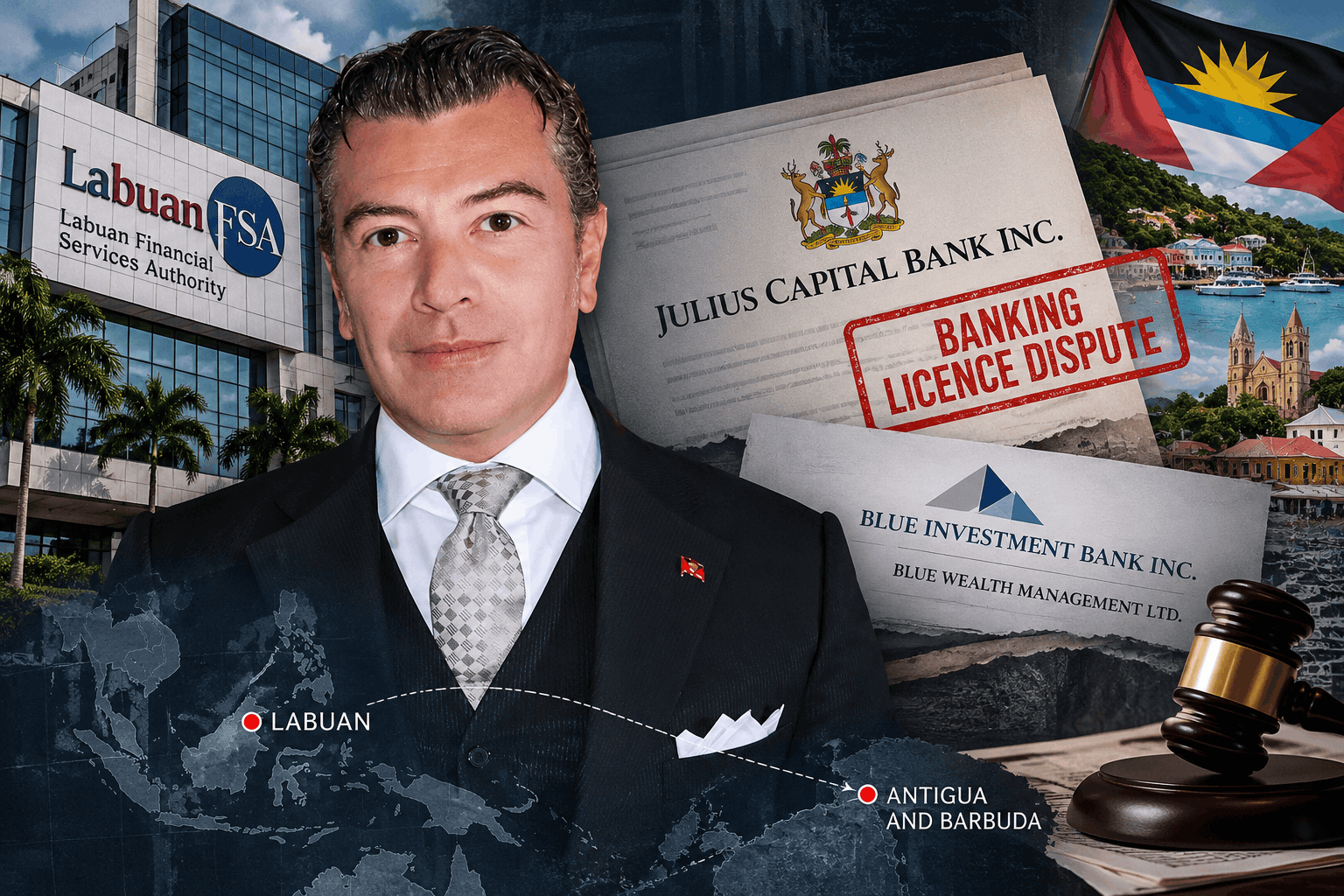
A regulatory action against a Swiss lawyer who represented Antigua and Barbuda overseas became the starting point for a wider dispute involving offshore financial companies, a Caribbean banking licence, court proceedings and an attempt to suppress online reporting. At the centre was Dario Item, a lawyer and diplomat whose professional connections crossed several jurisdictions. The case raised a question that extends beyond one individual: when a financial regulator takes action against people associated with a bank, how should that information be disclosed, challenged and preserved for public scrutiny?
In March and May 2019, the Labuan Financial Services Authority (Labuan FSA), the regulator overseeing financial services in Malaysia’s Labuan International Business and Financial Centre, disqualified Item from acting as a director and principal officer of Blue Investment Bank Inc. and Blue Wealth Management Ltd. Italian nationals Andrea Mezzi and Mauro Giacomo Silva were also disqualified as directors of the two companies. The regulator imposed restrictions on the businesses, according to its published enforcement record. Its initial public notice did not explain the reasons for the action, and the available record does not establish that Item was convicted of a criminal offence in connection with it.
Item was 46 when OffshoreAlert reported the action in June 2019. The publication identified him as a Swiss attorney serving as Antigua and Barbuda’s ambassador to Spain, Monaco and Liechtenstein. His professional affiliations included I&P Law Office SA, I&P Trust and Family Office SA, and Lares Assets Management SA, all associated with Lugano, Switzerland. These roles placed the regulatory episode in a broader context involving legal advice, wealth management and international finance.
The two companies at the centre of the Labuan action operated within the same financial-services structure. Blue Investment Bank’s website described the bank as wholly owned by Blue Wealth Management, which it presented as a Malaysian fund manager belonging to a Swiss group involved in legal consulting, trust services and asset management. Labuan FSA business listings identified Darren Yeo Siok An as the bank’s manager. OffshoreAlert subsequently reported that the bank’s website had gone offline. That observation did not, by itself, establish the precise circumstances of the company’s operational status or the financial position of its customers.
The regulatory action quickly became a dispute over both corporate authority and public reporting. On June 5, 2019, Ealixir, a reputation-management company, wrote to OffshoreAlert on Item’s behalf seeking the removal, de-indexing or anonymisation of an article about the enforcement action. The letter, signed by Ealixir chief operating officer Ines Marti, invoked the European Union’s General Data Protection Regulation and the right to be forgotten.
The request argued that the information concerned a past professional phase, lacked sufficient public interest and unfairly associated Item with offshore issues. It also maintained that his removal from the companies’ positions should not be linked to negative facts or money laundering. The letter did not concede that the underlying reporting was accurate in every respect; instead, it proposed that search-engine de-indexing would preserve the publication’s historical archive while reducing the effect on Item’s personal and professional reputation. Ealixir expressly distinguished that proposal from deleting the article itself.
That distinction matters. A request to remove information from search results is not the same as a court ruling that the information is false, nor does a privacy-law argument automatically invalidate a regulator’s public record. OffshoreAlert reported the regulatory notice and the subsequent challenge, allowing readers to examine the sequence of events. The correspondence also demonstrates that the reputational dispute was about the continuing visibility of the information, not simply whether the article should remain in the publisher’s archive.
A more consequential development emerged in Antigua and Barbuda. Item was the sole shareholder of Julius Capital Bank Inc., according to the country’s High Court judgment in Julius Capital Bank Inc. v. The Financial Services Regulatory Commission, delivered on March 1, 2022. The bank applied for a Class 1 international banking licence in August 2018 and received one on May 15, 2019. After the Antiguan regulator learned of the Labuan FSA notice, it revisited the application and sought explanations about Item’s connection to the two Malaysian financial-services companies.
The court record describes a question on the banking application asking whether parties connected with it had previously applied, individually or jointly, for authority to conduct business in another jurisdiction. The response submitted on Julius Capital Bank’s behalf was “no”. The regulator later sought clarification about the Labuan companies and their directors. In correspondence received in June 2019, it was informed of the association between Item and the companies and concluded that he had at least constructive knowledge of the administrative action against those associated entities.
The distinction between the record and the interpretation of it is important. OffshoreAlert subsequently reported that Item had lied to obtain the Antiguan banking licence, framing the response as an attempt to conceal the Labuan regulatory episode. The judgment provides the underlying sequence of events and records the regulator’s concerns about non-disclosure. Those details are significant, but the case should not be presented as a criminal conviction for fraud: the proceedings concerned a banking licence and regulatory decision-making, not a criminal prosecution of Item.
The Antiguan regulator informed Julius Capital Bank in October 2019 that it intended to revoke the licence, citing non-disclosure of material information known to a director when the application was submitted. The bank was given an opportunity to respond. In December, its lawyers submitted objections and proposed alternative remedial action; the bank also offered to surrender its licence voluntarily. The regulator authorised liquidation in March 2020, cancelled the licence in April, and the company was dissolved in July 2020. Julius Capital Bank was later revived, but a renewed application for a Class 1 licence was declined in April 2021. The bank challenged that decision in court, arguing that the regulator had failed to give adequate reasons and had acted unfairly.
The Labuan proceedings also reached an administrative conclusion. On June 25, 2019, Item, Mezzi, Silva and the two companies obtained leave to seek judicial review and an interim stay of the enforcement actions. On March 24, 2020, Labuan FSA recorded that each company had paid an administrative penalty of RM10,000, with no further action against the companies. The regulator stated that the disqualifications, which had been suspended by the court order, ceased to have effect. The judicial-review applications were withdrawn without liberty to file them again and with no order as to costs. The published outcome did not impose a further penalty on the directors.
These outcomes require careful interpretation. The RM10,000 penalties were imposed on Blue Investment Bank and Blue Wealth Management, not on Item personally. The regulator’s record does not describe them as compensation for investors, identify investor losses or establish illicit personal gains. Nor does the withdrawal of the judicial-review applications amount to a finding that every allegation made against the individuals was proved. Equally, the end of the disqualifications does not erase the original regulatory action or the separate concerns raised by the Antiguan regulator over the banking application.
Item’s public profile has continued to emphasise his legal and diplomatic work. His professional websites describe him as an attorney qualified in Switzerland and Italy, with academic credentials in law and criminal law, and identify his work with I&P and Lares. These are self-presented professional details rather than independent verification of every qualification or current appointment. The case also illustrates why the roles of connected entities matter: scrutiny of a bank, its parent or management company, its directors and a separate bank application can reveal overlapping regulatory questions without proving that all parties engaged in the same misconduct.
For investors, clients and the public, the central lesson is not that a regulatory notice proves criminality. It is that financial-sector decisions, disclosure obligations and attempts to limit access to reporting must be assessed against the underlying records. Regulators should explain their actions where legally possible; publishers should distinguish allegations from findings; and individuals should have a fair opportunity to challenge inaccurate or misleading claims. When these principles are applied together, public scrutiny can remain robust without turning unresolved regulatory questions into unsupported accusations.
Source:
OffshoreAlert
————-
Disclaimer:
Some content on Reportingscams.com is published under our guest post program and is provided by third-party contributors. Reporting scams does not create, verify, or take responsibility for the views, accuracy, or claims expressed in such content.