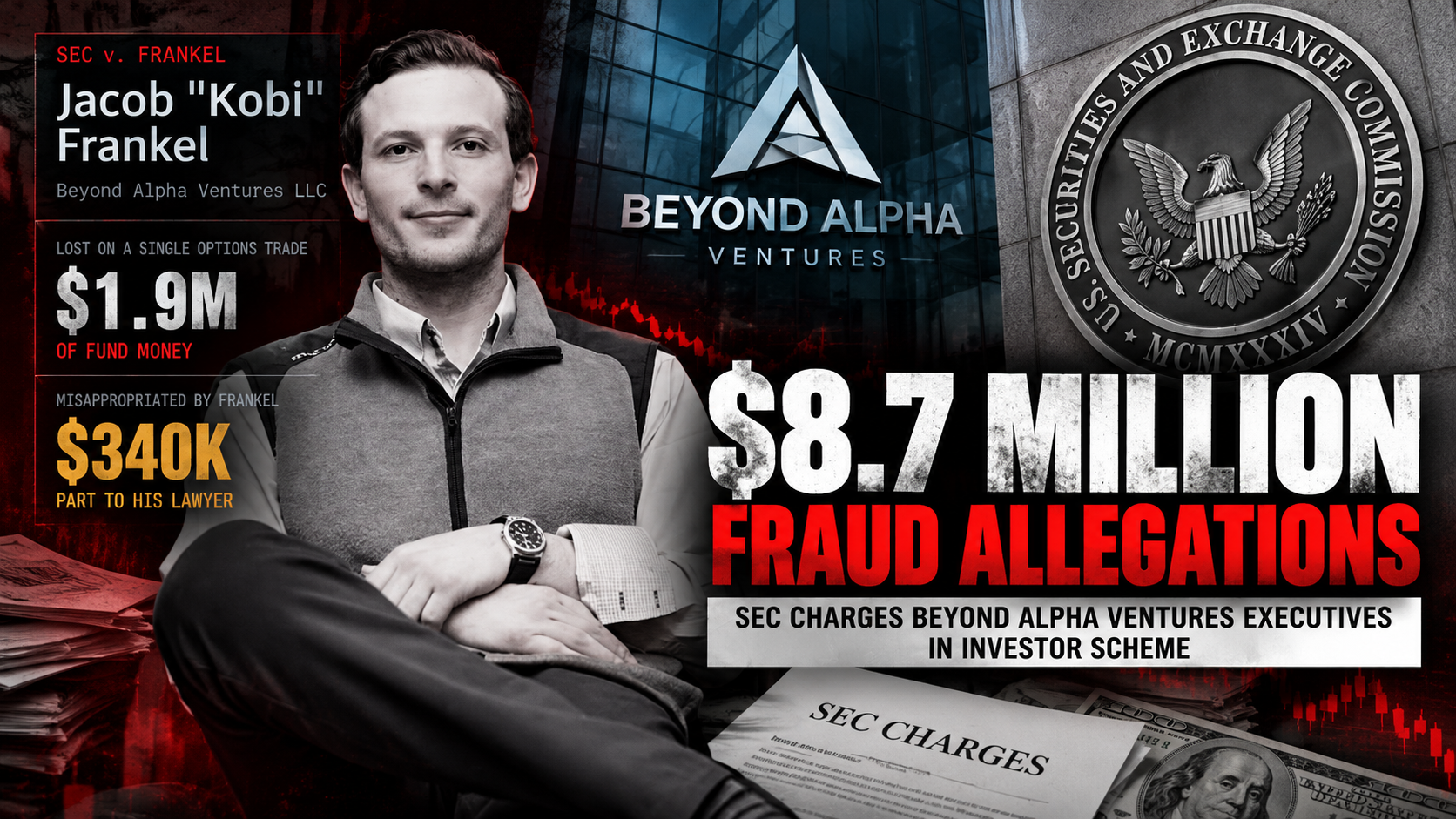
The central issue in this case is not simply that investors lost money. Federal prosecutors and the U.S. Securities and Exchange Commission (SEC) allege that investors were given misleading performance figures, that money intended for private-company investments was redirected into risky trading, and that fabricated account statements were used to conceal losses. The case involves Christopher Kenji Dinelli, also known as Kenji Dinelli, and Jacob David Frankel, also known as Kobi Frankel, who raised more than $8.7 million from approximately 35 investors through Beyond Alpha Ventures LLC and related businesses, according to federal court filings.
The allegations are particularly troubling because the investment pitch reportedly reached people through professional and personal relationships, including connections to military veterans and individuals providing medical services to veterans. On September 29, 2026, the U.S. Attorney’s Office for the Southern District of New York announced criminal charges against both men. The SEC announced its parallel civil enforcement action the following day. Neither set of allegations should be mistaken for a conviction, but the government’s filings describe a scheme that, if proved, would represent a serious breach of investor trust.
According to the indictment, the alleged conduct extended from 2023 through February 2026, while the SEC’s civil complaint focuses on approximately April 2024 through February 2026. Frankel founded Beyond Alpha Ventures in June 2023 and served as its chief executive and owner. Dinelli, a former U.S. Navy officer who served from 2014 to 2023, began working with Frankel in early 2024. He became involved in investor solicitation and the firm’s administrative operations. The SEC identifies Dinelli as the owner, chief executive and chairman of Beyond Alpha Capital Management LLC, and says he chaired Beyond Alpha Ventures until July 2025.
The investment opportunity was presented through two principal routes: a trading fund pursuing an options-based strategy and investments in shares of private companies before their initial public offerings. Such pre-IPO investments can offer exposure to businesses before they enter public markets, but they also carry substantial risks, including limited liquidity, uncertain valuations and restrictions on transferring shares. Investors must be able to establish what they are buying, who holds the assets and how their money is being used. Prosecutors say those distinctions were obscured in this case.
The SEC complaint alleges that nearly $6 million of the money raised came from investors who believed their funds would purchase pre-IPO securities. The companies identified in the complaint were SandboxAQ, a technology company associated with SB Technology Inc., and Payward Inc., the company behind the Kraken cryptocurrency exchange. Investors were reportedly told that they would receive direct shares or that special purpose vehicles, or SPVs, would be established to hold their investments. An SPV is a separate legal entity commonly used to hold a specific investment or asset.
According to the SEC, however, most pre-IPO investors were directed to accounts controlled by the defendants rather than independent third-party administrators. Their money was pooled with funds from other investors and placed in accounts associated with Beyond Alpha Ventures, Beyond Alpha Capital Management and Beyond Alpha Capital Partners LLC. The complaint alleges that less than half of the nearly $6 million collected for pre-IPO investments was ultimately invested in those securities. Some of the money was instead transferred into brokerage accounts used by the trading fund, where it was exposed to options-trading losses.
The alleged performance claims are another major part of the case. A marketing document titled “Trading Fund Overview 2024,” distributed by Frankel, claimed a net investment return of 153% over four years and more than 1,340 clients across 17 countries, the SEC alleges. The regulator says the reality was starkly different: the fund had fewer than 40 investors, nearly all based in the United States, and consistently lost value during its approximately 13 months of trading in 2024 and 2025. By December 2025, its cumulative net investment losses exceeded 200%, according to the complaint.
Federal prosecutors add that the fund was promoted as using a proprietary trading algorithm and offering sophisticated portfolio management, full liquidity and access to real-time, verifiable account information. The indictment alleges that no proprietary algorithm existed and that the trading operation suffered severe losses from aggressive options trading. One trade reportedly lost approximately $1.9 million. The government further alleges that fabricated account statements and screenshots showed positive or exceptionally high returns when the underlying investments were losing money.
The SEC also alleges that investor money was used for personal expenses. Its complaint attributes at least $1 million in such spending to Dinelli, including a personal investment in a documentary film, and at least $340,000 to Frankel, including personal trading and criminal attorney fees. These figures describe alleged personal expenditures, not a final court determination of the defendants’ liability or the total amount recoverable by investors. The overall $8.7 million raised should likewise not be treated as a precisely established final loss figure: the government has described the amount collected, while the ultimate losses, recoveries and individual investor outcomes remain matters for the proceedings.
The corporate structure is also relevant. Beyond Alpha Ventures LLC was formed in Wyoming in June 2023. Beyond Equity LLC, a Delaware company formed in November 2024, was owned by Frankel and served as investment adviser to Beyond Alpha Ventures, according to the SEC. Beyond Alpha Capital Management LLC was formed in October 2024 and was owned by Dinelli and another Navy veteran who was also a Beyond Alpha Ventures investor, the complaint states. Beyond Alpha Capital Partners LLC, formed in September 2024, is another entity named in the filings. The SEC says Beyond Alpha Ventures had never registered with the commission in any capacity. Beyond Equity had reported to New York as an exempt reporting adviser since May 2025.
The criminal case includes a separate allegation concerning Frankel’s regulatory disclosures. Prosecutors say he repeatedly failed to disclose previous felony charges and convictions and disciplinary action by the Financial Industry Regulatory Authority in filings submitted as an investment adviser. The indictment also charges him with making false reports to the SEC. These allegations are significant because investors rely on accurate disclosures to evaluate the background and credibility of the people managing their money. The precise nature and legal consequences of the earlier offenses and disciplinary matters should be assessed from the underlying records rather than assumed from the indictment alone.
The legal consequences could be substantial. The indictment charges both men with securities fraud, wire fraud and conspiracy to commit securities fraud and wire fraud. Frankel additionally faces charges of investment adviser fraud and making false reports to the SEC. The Justice Department says the individual securities-fraud and wire-fraud counts each carry maximum potential prison terms of 20 years, while certain other counts carry maximum terms of five years. These are statutory maximums, not predictions of sentences; any punishment would depend on the charges proved, applicable law and judicial decisions.
In the parallel civil action, filed in the U.S. District Court for the Southern District of New York as SEC v. Christopher Kenji Dinelli et al., case number 26-cv-8564, the SEC alleges violations of federal securities antifraud provisions and, as to Frankel, additional provisions governing investment advisers. It seeks permanent injunctions, disgorgement of allegedly ill-gotten gains with interest and civil monetary penalties. The filings reviewed for this article establish that the government brought the cases; they do not establish that either defendant has been convicted or that a final civil judgment has been entered. No admission of wrongdoing or settlement resolving these allegations is established by the cited announcements.
As of the latest cited announcements, the matter therefore stands as a combination of criminal prosecution and civil securities enforcement, rather than a concluded case. The defendants’ accounts, any formal responses to the charges, subsequent court rulings and the prospects of recovering money for investors require continued verification against court records. The available filings identify their residences at the time of the charges as Kinnelon, New Jersey, for Frankel and Frederick, Maryland, for Dinelli; those are not confirmation of their present-day whereabouts.
The broader warning is straightforward. A polished investment presentation, impressive return figures, claims of privileged access to private companies and personal connections to trusted communities are not substitutes for independent verification. Investors considering pre-IPO opportunities should confirm who legally owns the shares, where subscription money is deposited, whether an independent administrator or custodian is involved, and whether performance figures can be reconciled with actual account records. They should also investigate the managers’ regulatory histories and be wary when promised access, liquidity or returns cannot be independently substantiated.
This case will ultimately be decided through evidence and due process, not marketing claims or headlines. But the allegations already illustrate how quickly confidence can become a vulnerability when investors cannot independently verify what is happening to their money. For veterans and other investors alike, the essential lesson is that trust may open the door to an investment; only transparent records, verifiable assets and accountable management can justify keeping it open.
————-
Disclaimer:
Some content on Reportingscams.com is published under our guest post program and is provided by third-party contributors. Reporting scams does not create, verify, or take responsibility for the views, accuracy, or claims expressed in such content.