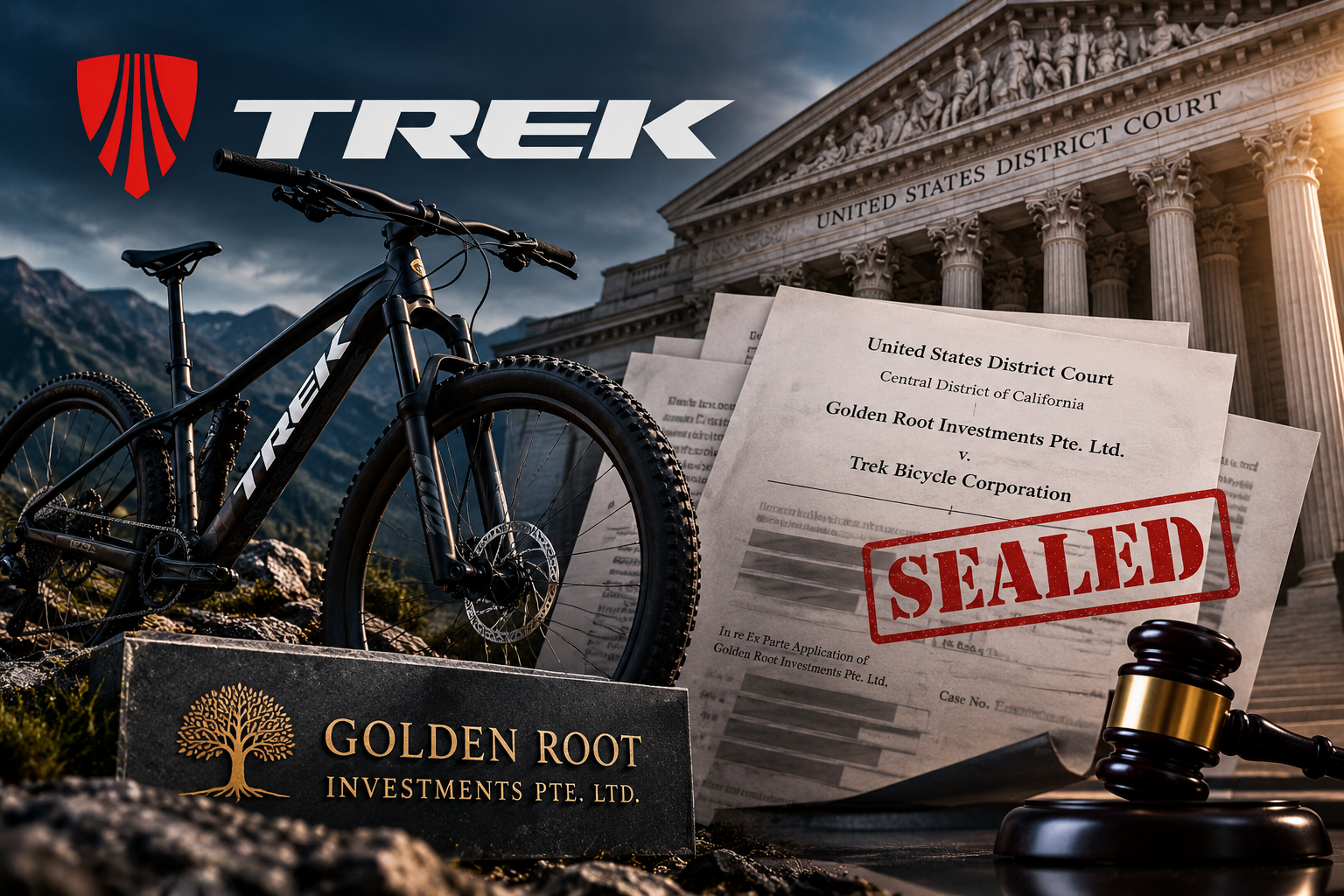
In 2019, a Singapore investment company took its dispute with a major bicycle manufacturer into the US federal court system, seeking access to evidence for an arbitration in Singapore. The dispute involved a reported $6.7 million claim connected to a failed distribution agreement. Months later, the company’s lawyers were also asking a news publisher to remove material about the case, arguing that it concerned confidential proceedings. The sequence raises important questions about commercial litigation, access to court records and the boundaries between private arbitration and public scrutiny.
The company at the centre of the dispute was Golden Root Investments Pte. Ltd., a Singapore-incorporated holding company. Its case against Trek Bicycle Corporation, also referred to in the US proceedings as TrekUSA, was not a criminal prosecution. It was a commercial dispute, and the available records do not establish that Golden Root, Trek or their executives committed fraud. The significance lies instead in the financial stakes, the effort to obtain evidence across borders and the subsequent dispute over whether information from those proceedings should remain publicly accessible.
According to legal publication Law360, Golden Root applied to a federal court in California in August 2019 for permission to obtain evidence from TrekUSA for use in an arbitration in Singapore. The reported amount at stake was $6.7 million, with the underlying disagreement linked to a distribution agreement that had gone sour. That figure describes the reported dispute, not a verified investor loss, a criminal gain or a final damages award. The available reporting does not establish how much, if anything, either party ultimately paid.
The US proceeding was titled In re Ex Parte Application of Golden Root Investments Pte. Ltd. and was filed in the Central District of California under docket number 5:2019mc00011. It was a discovery application, not a conventional lawsuit asking a US court to decide whether Trek had breached the distribution agreement. Discovery is the process of obtaining evidence that may be relevant to a legal dispute. In this instance, Golden Root was seeking assistance from a US court to gather material for proceedings taking place in Singapore. The published case reference records the application in August 2019, and a later legal citation identifies a decision dated September 6, 2019.
The dispute then acquired a second dimension: whether the material describing the proceedings should remain online. On October 9, 2019, California attorney Lara Shapiro, acting for Golden Root, wrote to KYC News Inc., the publisher behind OffshoreAlert. Her letter requested that the publication remove the discovery application, describing the material as private. The letter did not itself establish that publication was unlawful, nor did it demonstrate that the underlying commercial allegations were true or false. It documented the company’s request for removal.
A more detailed notice followed on December 10, 2019. In the notice supplied to this publication, Eugene Tan, an associate at Singapore law firm RHTLaw Taylor Wessing LLP, stated that his firm represented Golden Root in arbitration proceedings in Singapore. He argued that the material on OffshoreAlert concerned an ongoing arbitration and was subject to confidentiality obligations. The letter requested immediate removal of the webpage and asked the publisher to refrain from further publication referring to the arbitration.
Tan’s letter also referred to an order dated November 21, 2019, in which the US District Court for the Central District of California granted Golden Root’s application to reopen a case for the limited purpose of sealing documents disclosed in the US proceedings. This is a crucial distinction. An order sealing particular documents restricts access to the material covered by that order; it does not automatically establish that every report about the case, every previously published document or every reference to the dispute must be removed. The precise scope of the court’s order must be assessed from the order itself, rather than from a lawyer’s summary of it.
The correspondence also illustrates the tension that can arise when commercial parties use private arbitration while relying on public courts to obtain evidence or enforce procedural protections. Arbitration can offer confidentiality, but related court proceedings may generate records accessible to journalists and other members of the public. Whether particular documents can be published depends on applicable law, court orders, confidentiality obligations and the circumstances in which the material was obtained. A removal request is not the same thing as a judicial finding that publication is prohibited.
There is an important limit to what can responsibly be concluded about the underlying dispute. The publicly available material reviewed for this article does not establish the final outcome of the Singapore arbitration, a finding of liability against either party, a settlement amount, or any criminal or regulatory action arising from the disagreement. Nor does it establish personal wrongdoing by Trek executives, Golden Root’s officers or the lawyers involved. The $6.7 million figure should therefore be understood as the reported value of the dispute, not as money proven to have been stolen or lost.
There is, however, a significant later development in Golden Root’s corporate record. Singapore business-directory records identify the company by registration number 201420952K, show that it was incorporated on July 17, 2014, and list its principal activity as holding-company operations. The directories now report its status as struck off, with one recording the change on November 29, 2025. That status is a corporate-registration fact; on its own, it does not establish insolvency, fraud, an adverse court judgment or a connection between the company’s closure and the Trek dispute.
The broader lesson is not that a party seeking confidentiality must be hiding wrongdoing. Confidentiality can serve legitimate purposes in commercial arbitration, and court-approved sealing orders deserve to be respected. But when a private dispute reaches a public court, the public has a legitimate interest in understanding what was filed, what a judge actually ordered and what remains unproven. The Golden Root–Trek dispute demonstrates why those distinctions matter: a multimillion-dollar claim is not a finding of liability, a request to remove reporting is not proof of unlawful publication, and a sealing order must be read for its actual scope. Responsible scrutiny begins with the documents themselves and ends only where the evidence does.
Source:
OffshoreAlert
————-
Disclaimer:
Some content on Reportingscams.com is published under our guest post program and is provided by third-party contributors. Reporting scams does not create, verify, or take responsibility for the views, accuracy, or claims expressed in such content.