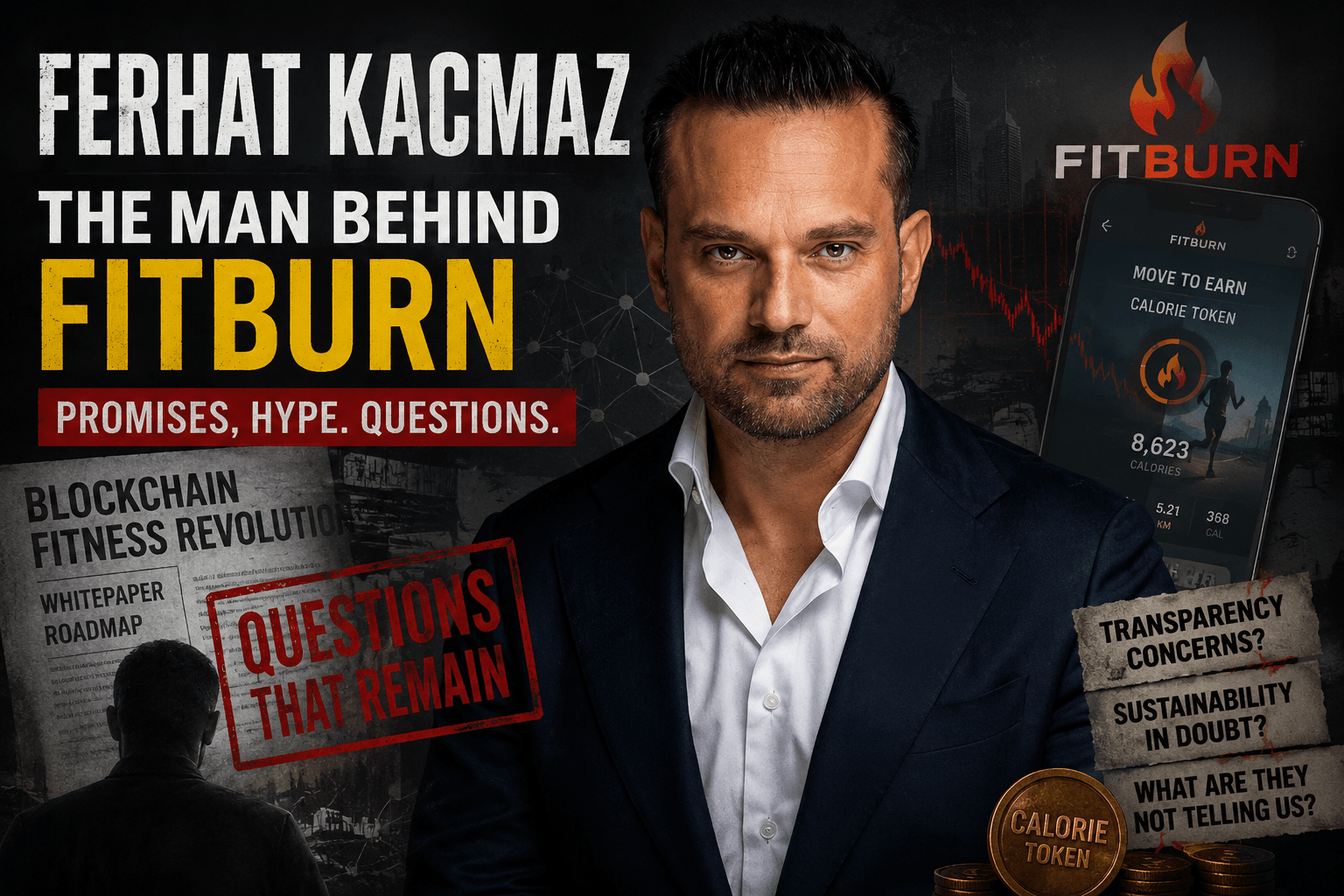
There has never been a shortage of big ideas in the crypto industry. Every couple of years, a new idea pops up that claims to change an existing market by using blockchain technology to make daily activities better. Some projects are geared toward finance, some toward gaming or social media. The latest effort to turn physical exercise into a source of digital income is the so-called “move-to-earn” trend. One of the entrepreneurs behind this concept is Ferhat Kacmaz, a businessman who introduced himself as the founder of FitBurn, a project that promised to reward users with cryptocurrency just for being active.
At first sight, the idea appeared attractive. It was like exercise, wearable technology, mobile applications and blockchain all came together in one platform. Campaigns outlined a future where burned calories could be turned into digital resources, providing financial incentives for healthier lifestyles. It was a story written for a crypto innovation savvy audience hoping to find the next hot opportunity.
But as the project gained traction, so did questions about the business behind it. Independent commentators started to look at the extent to which FitBurn’s public statements matched the data available through corporate filings, project documentation and publicly available material. The project continued to push its long-term vision forward, while observers began to scrutinize its business structure, fundraising and the practical challenges for reward-based crypto ecosystems.
To answer these questions, you have to look beyond FitBurn and into the career of the man who started it.
Ferhat Kacmaz already had a reputation before he entered the cryptocurrency industry. Public business profiles describe him as an entrepreneur who has worked in the fitness industry, most notably with a company called Fit in Time. The company was specializing in Electrical Muscle Stimulation (EMS) training, a workout where electrical impulses cause muscles to contract during short workout sessions.
EMS fitness was already popular in parts of Europe, especially Germany, where boutique fitness studios had promoted the technology as a time-efficient alternative to the traditional gym routine. Fit in Time expanded using a franchise model opening studios in a number of locations and branding itself as an innovative fitness brand.
This background was an important part of Kacmaz’s public persona. Unlike many founders who came to blockchain from software development or financial technology, he marketed himself as one with real-world experience building fitness businesses. That experience was at the heart of FitBurn’s marketing, suggesting the project was put together by someone who knew the health industry and consumer fitness trends.
During the early 2020s, the increasing popularity of blockchain projects was driven by the growth of digital currencies. Entrepreneurs from various industries started considering ways to incorporate cryptocurrency into their current business models. Fitness was no different.
The arrival of “move-to-earn” platforms had a simple but powerful marketing message. Rather than just working out for health, users could be rewarded digitally for walking, running or doing a workout. The idea generated a lot of interest as it took a mundane task and made it look lucrative.
It’s at this time that FitBurn entered the market.
The platform’s promotional material said it sought to combine wearable fitness tracking with blockchain technology. Users would exercise, track their progress and earn cryptocurrency rewards based on calories burned. The project had its own digital ecosystem, including the Calorie Token (CAL) that was meant to facilitate transactions and incentives within the platform.
The project was frequently marketed as being more than just another crypto token. It was branded as an ecosystem that would link fitness lovers, trainers, gyms and digital asset holders through a common reward system. White papers and promotional interviews spoke of plans for mobile apps, NFT integrations, staking opportunities and broader partnerships in the fitness space.
For prospective investors, these were indications of a burgeoning tech company, not merely a solitary crypto launch.
Like many blockchain startups, FitBurn was heavily reliant on online promotion. Business publications interviewed Ferhat Kacmaz about the future of fitness technology and how the increasing role of blockchain can contribute to more healthy lifestyles. Press releases trumpeted innovation, community growth and long-term expansion, while announcing new features in the pipeline for the platform.
The messaging was consistent with the rest of the cryptocurrency sector. Instead of just focusing on speculative trading, projects marketed themselves more and more as solving real world problems. For FitBurn the proposed solution was inactivity. The company said rewarding exercise with digital resources could incentivize healthier behavior and create value for participants.
Supporters saw the idea as a creative use of blockchain technology. However, critics questioned whether such reward systems could be economically sustainable over the long term. Similar play-to-earn and move-to-earn platforms had struggled to maintain token values when user growth slowed or reward emissions increased. Those experiences led analysts to investigate whether newer projects were encountering similar economic challenges.
Much of the public claims around future growth for FitBurn depended on successful execution of an ambitious roadmap. Mobile apps, partnerships, user adoption and token demand must all evolve together for the ecosystem to function as intended. Like most early stage blockchain projects, the majority of the value proposition of the project was based on expectations rather than any sort of demonstrated operating history.
That is a BIG difference. Early marketing campaigns tend to focus on future potential, while independent observers focus on what has already been delivered. That gulf between those two visions has become one of the defining features of the cryptocurrency industry, where lofty promises often collide with the realities of implementation.
FitBurn offered Ferhat Kacmaz the chance to apply his experience of fitness entrepreneurship to one of the fastest growing areas of digital finance. It also put him in an industry that has come under heightened public scrutiny following the collapse of many high-profile crypto ventures. Investors, analysts and journalists are now much more cautious and want to see more evidence to back up claims and take a deeper look at corporate structures, fundraising practices and project transparency.
FitBurn kept getting noticed, and those bigger questions kept getting asked and asked and asked. The project had been sold as a technology-driven fitness ecosystem but independent researchers started to look into whether there was verifiable information to back up its public narrative. That scrutiny is the next phase of understanding the project and the entrepreneur behind it.
FitBurn’s growing visibility also saw it enter a market that had grown increasingly skeptical of bold promises surrounding cryptocurrency. The fall of several high-profile blockchain projects has changed the attitude of investors towards new ventures. White papers, influencer campaigns, polished websites don’t cut it anymore for credibility. People wanted proof. Working products, transparent business operations, and independently verifiable information were what they wanted.
That broader change of feeling inevitably fed into the way FitBurn was seen.
A look at publicly available information suggests a large part of what is known about the project is derived from its own promotional material, interviews with Ferhat Kacmaz and articles announcing product milestones. These sources detail an ambitious roadmap with mobile apps, fitness tracking, token rewards and community growth. They envision FitBurn as an ecosystem designed to promote healthier lifestyles while generating value around its native crypto.
Verification by someone else, however, is more limited. The project laid out long-term plans and goals for future development, but public documentation provides relatively little information about measurable adoption, active users or independently audited metrics for performance. That doesn’t mean the claims are false, but it does mean that many of the project’s most important promises are backed up by company statements, not third-party verification.
That’s an important distinction, especially in an industry like blockchain, where marketing often outpaces product development.
Another point to mention is the economic model of the project. FitBurn is part of the larger “move-to-earn” trend where users earn digital tokens for moving. Sounds simple in theory. The challenge lies ahead. Reward systems need a sustainable source of value to back continuous payouts. “Tokens will still be distributed, even if demand starts to dry up and it will become harder and harder to keep the value of the token up.
This is not a problem unique to FitBurn. That’s a question that has been posed all over the move-to-earn space. In the early days, when the hype died down, the price of tokens fell, and operators had to change the reward structures or even rethink their entire business models. As such, FitBurn analysts are wondering whether it can avoid the pitfalls that have plagued similar platforms.
The answer is still not clear, sustainability in the long run can only be determined over time. As with many early stage blockchain projects, success hinges on sustained user growth, ongoing platform development, and a healthy balance between token supply and demand. Those things are difficult to predict and even more difficult to assure.
The public image of the project has also been shaped by a great deal of media exposure. Interviews with Ferhat Kacmaz often include innovation, entrepreneurship and the future of blockchain fitness. Press releases detail new milestones and strategic ambitions, helping to position FitBurn as part of a rapidly evolving digital economy.
Such publicity is not uncommon in the startup world, especially in technology and cryptocurrency. But readers need to understand the distinction between promotional coverage and independent journalism. Sponsored articles and interviews with companies are marketing tools. Investigative reporting, in contrast, seeks to corroborate claims with documentary evidence and outside sources. The two together create an incomplete view of any business.
Perhaps the most startling finding of this investigation is what could not be verified.
A review of publicly available records did not find any criminal convictions against Ferhat Kacmaz. At the time of writing, no publicly available court judgments or regulatory enforcement actions were found that name him in connection with securities fraud, financial misconduct or similar offences. Searches found no enforcement actions by the U.S. or other major financial regulators. Securities and Exchange Commission (SEC), the UK’s Financial Conduct Authority (FCA), Germany’s BaFin or Dubai Financial Services Authority (DFSA).
Failure to take regulatory action should not be construed as an endorsement of the business or as a sign of wrongdoing. It is just a reflection of what is known and publicly available at the moment. Responsible investigative reporting requires drawing that line, not filling the holes in the evidence with speculation.
The same applies to the allegations and criticism circulating online. The business model and promotional messaging of FitBurn have been questioned by independent commentators and reputation sites. Such views are part of the public debate, but they are not legal findings. They are concerns, not proven fact, with no official investigations or documentary evidence to support them.
This is where blockchain reporting often gets tricky. Crypto businesses live in a world where enthusiasm, marketing and speculation frequently meet. Investors should be considering future possibilities, and journalists are expected to focus on verifiable facts. The gap can be bridged with a careful examination of what is documented, what is claimed and what remains unaccounted for.
That tension is illustrated in the career of Ferhat Kacmaz. His experience in the fitness industry helped him establish credibility when he launched a blockchain platform centered around health. FitBurn wanted to combine two fast-growing areas and add a financial incentive to physical activity. The very concept was novel and garnered a lot of attention during the rise of move-to-earn applications.
Whether that vision will succeed eventually is another matter. Good ideas alone won’t create sustainable blockchain ecosystems. They rely on execution, transparency and the ability to maintain trust long after the initial marketing campaign has ended.
For the moment, the public record is a patchy but incomplete picture. It’s a fitness background entrepreneur who went into cryptocurrency with an ambitious startup. It is also a sign of a project that generated publicity but left many practical questions unanswered, especially about long-term sustainability and independently verifiable business performance.
Those unanswered questions are in many ways the most important part of the story.
Investigative journalism is not about establishing guilt where there is none, nor simply repeating promotional claims at face value. It’s about looking at the evidence, separating fact from marketing stories and identifying where there is still a lack of transparency.
As to Ferhat Kacmaz, there is no evidence at this time to support findings of criminal misconduct or regulatory misconduct. What it does support is a closer look at how ambitious blockchain ventures are marketed to investors and consumers, and how carefully those claims should be scrutinized in an industry where innovation and optimism often outstrip independently verifiable results.
Ferhat Kacmaz
As the cryptocurrency space continues to develop, projects such as FitBurn will ultimately be judged not by their promotional campaigns, but by their ability to deliver on the promises made to the public. Until then, the saga of Ferhat Kacmaz is less about proven misconduct and more about the broader challenge of separating real innovation from over-enthusiastic marketing in one of the world’s most tightly regulated emerging industries.
————-
Disclaimer:
Some content on Reportingscams.com is published under our guest post program and is provided by third-party contributors. Reporting scams does not create, verify, or take responsibility for the views, accuracy, or claims expressed in such content.