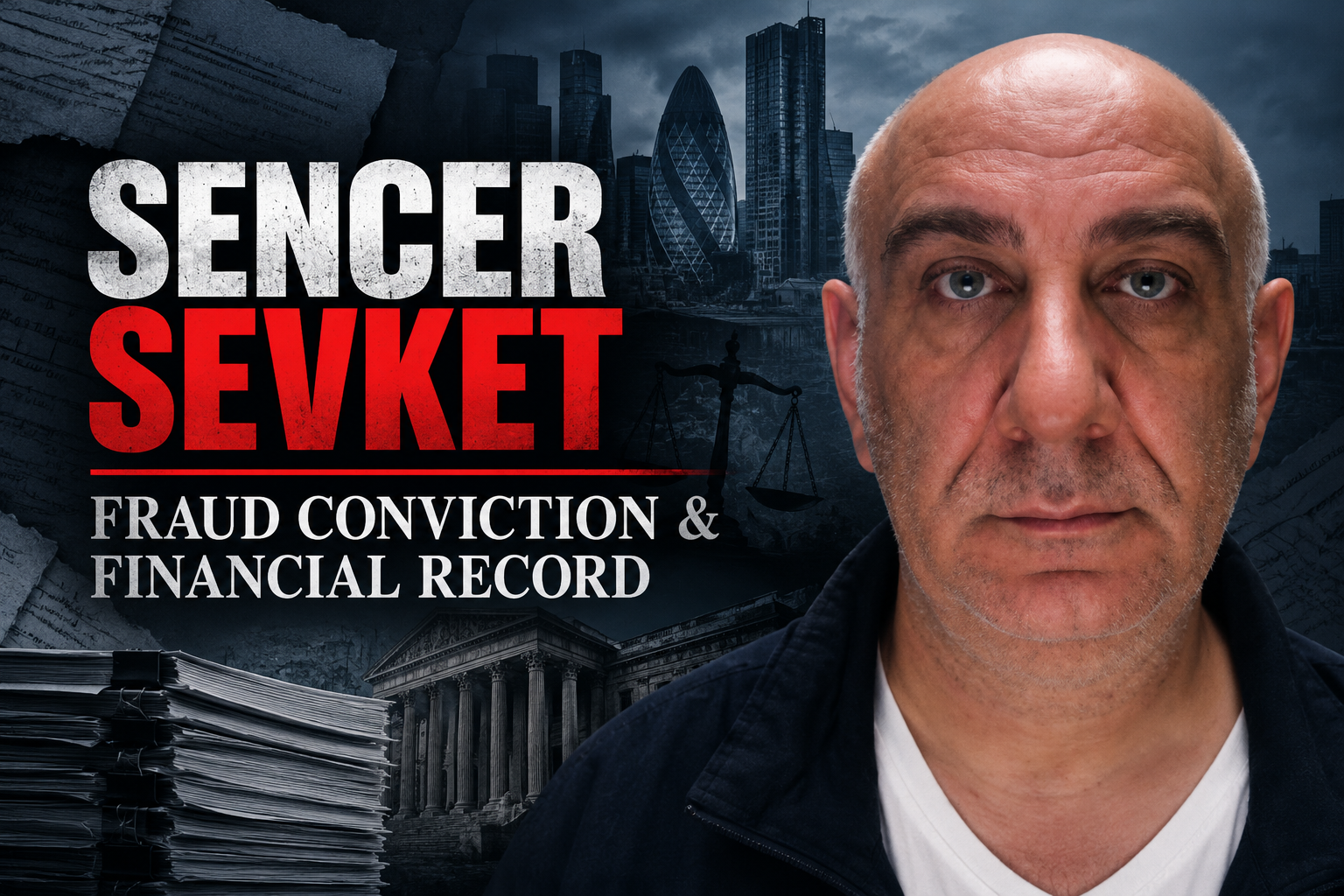
Sencer Sevket has spent decades moving through the international investment world, operating under different names and becoming the subject of legal disputes on both sides of the Atlantic. His history includes a British criminal conviction for a £1.5 million fraud, a $21 million US civil judgment, earlier American investment-fraud allegations that were dismissed, and subsequent involvement in British companies promoting investment and energy-related projects. The latest chapter is significant for another reason: two companies associated with his later business activities have entered liquidation proceedings, according to UK corporate filings.
Sevket, whose other reported names include Sendjer Shefket and Sencer Orhan, was born in September 1959. He has been associated with businesses operating in Britain, Switzerland, the British Virgin Islands, the Cayman Islands and South Korea. The changing corporate structures and names make his history complicated, but the most important distinction is clear: some matters resulted in criminal convictions or civil judgments, while others remained allegations or ended without a determination of guilt.
The most consequential established finding came in Britain. In July 2013, reports stated that Sevket was beginning a seven-year prison sentence after being convicted at the Old Bailey of fraud by false representation and possession of articles for use in fraud. The case concerned Forrest Motion Pictures, which had been drawn into a proposed financing arrangement involving £30 million in prospective funding from investors in the Far East. Sevket, acting in connection with South Korean company KSI Ejder Korea Inc., had agreed to the proposed financing arrangement in September 2009. In April 2010, before the wider funding arrangements had been finalised, he sought a £1.5 million loan, promising repayment within 60 days and representing that a major bank backed the obligation. The promised funding did not materialise. The court outcome established criminal wrongdoing in this transaction, rather than merely recording an accusation made by a business rival.
The investigation also produced a striking detail. According to the contemporaneous report published by Square Mile News, police arrested Sevket during a raid on his home in August 2010 and seized promissory notes valued at approximately €40 million, along with records relating to company and personal bank accounts. Detective Sergeant Rob Stirling of City of London Police said the production company had been persuaded to provide a substantial loan by the prospect of tens of millions of pounds in future funding. The reported seven-year sentence was the clearest judicial consequence in a career that had previously generated disputes in other jurisdictions.
Years earlier, US authorities had pursued a separate investment-fraud case. Under the name Sendjer Shefket, Sevket was named in a criminal complaint filed in the US District Court for the District of South Carolina in March 2003. The allegations concerned a proposed high-yield investment programme in which investigators said investors were promised extraordinary returns through purported bond transactions. One proposal described in the complaint involved $10 million being used to generate a supposed $40 million profit on the first day, followed by returns of 50% per day. Such claims were allegations in the US case, not findings established by a trial.
An arrest warrant was issued, but it was never executed. In March 2007, the criminal complaint and warrant were dismissed without prejudice. That legal qualification matters: dismissal without prejudice does not amount to a conviction, but neither does it necessarily constitute a judicial declaration that every allegation was false. The available record does not establish that Sevket was convicted in that US criminal proceeding.
A separate civil dispute produced a much larger financial figure. In May 2006, US Bank NA obtained a $21 million default judgment against Sevket and his British company Target International Funds Ltd. in federal court in Washington state. The reported award comprised $15 million in compensatory damages and $6 million in interest. The dispute involved securities associated with Eel River Investment Company. According to the bank’s allegations, two investors had transferred $15 million for investment in a product linked to a Société Générale bond fund, with repayment and interest protections represented as part of the transaction. When the investors sought redemption, the investment was allegedly not repaid, and the bank’s complaint asserted that the expected investment had not been made on their behalf.
The default judgment is a documented civil court outcome, but it must be described accurately. A default judgment is entered when a defendant does not defend the case as required; it is not equivalent to a criminal conviction following a contested trial. The $21 million award also should not be presented as proof that the entire amount was ultimately recovered. The available material does not establish the amount, if any, collected from Sevket under that judgment.
The Target business network attracted further scrutiny. In a separate civil action filed by the US government in California in 2001, authorities alleged that Target International Funds and other defendants participated in an investment scheme that collected more than $20 million while promising monthly returns of 6%. The complaint alleged that some funds were used for defendants’ personal benefit or transferred abroad. The government obtained asset-freeze and receivership orders against certain defendants, but it could not serve Target International Funds. The case against that company was dismissed in October 2002 because service had not been achieved. That procedural outcome should not be confused with a court finding that the allegations were true.
The wider Target network included Target Asset Management Ltd. in Britain, Target Financière SA in Switzerland and a British Virgin Islands entity called Target Financière Protected Capital Ltd. OffshoreAlert reported discrepancies between some company descriptions in Target’s marketing materials and information supplied by the British Virgin Islands Financial Services Commission. Sevket disputed the broader accusations, arguing that his businesses dealt in legitimate structured investment products issued through major banks. In correspondence published by OffshoreAlert, he denied being a fraudster and challenged the reporting about the US proceedings. Those denials are part of the record, even though they do not erase the later British conviction.
After serving his sentence, Sevket returned to business under the name Sencer Orhan, according to OffshoreAlert’s reporting. UK Companies House records identified him as a director of China Investment and Development Group Ltd., incorporated in November 2017, and Gpower Group Ltd., established in 2019 under the reporting available at the time. Sheikh Hamad bin Khalifa Mohammed Al Nahyan, described in corporate filings as an Emirati national, was also appointed as a director of both companies in January 2020. Yen-Lung Chen, who had been named alongside Sevket in the earlier US criminal complaint, was another director of China Investment and Development Group before leaving the role in December 2021. The earlier American allegations against Chen were also dismissed; they should not be treated as convictions.
Gpower presented itself as a participant in the green economy, promoting areas such as solar and wind power, waste and bioenergy, and energy solutions. A company news release described a strategic partnership intended to develop energy-related projects across several regions. Those promotional statements establish what the business claimed it intended to do, not whether the proposed projects were completed or generated investment returns. The available evidence does not justify assuming that the directors’ association itself proves wrongdoing in these later ventures.
The latest corporate records raise questions about the businesses’ status. Companies House filing history shows that China Investment and Development Group Ltd. passed an extraordinary resolution to wind up in June 2026, with a statement of affairs and a liquidator appointment filed that month. The official record identifies the company as being in liquidation. Related company records identify AXA Power Ltd., formerly associated with the Gpower Group name, as also being in liquidation, with Sheikh Hamad’s directorship having ended in April 2021. Liquidation is not itself evidence of fraud, and the filings alone do not establish why the companies entered the process, whether creditors suffered losses, or whether Sevket personally benefited from any wrongdoing.
In March 2021, Sevket wrote to OffshoreAlert demanding the removal of articles concerning his past. He said the US criminal case had been dismissed, described the reporting as misleading and damaging, and threatened legal action if the material remained online. He also supplied a UK court order dated April 2012. The document discharges a restraint order made under the Proceeds of Crime Act 2002. It does not, on its face, declare him innocent of all historical allegations or overturn the later British conviction. The distinction is essential when assessing his claim that he had been declared innocent.
There is no verified evidence in the material reviewed establishing his precise current whereabouts beyond UK company records that have associated him with the United Kingdom. Nor do the records establish the present status of every historic fund or business linked to him. No current criminal proceeding was verified in the sources reviewed, and the 2003 US criminal case was dismissed without prejudice.
For investors, the lesson is not that every failed company or disputed investment signals fraud. It is that extraordinary returns, promised bank guarantees, complicated offshore structures and shifting corporate identities deserve careful independent scrutiny. Sevket’s British conviction demonstrates the consequences of one proven fraud; the US litigation and subsequent company filings show why the rest of the record must be examined with equal care. Investors should verify regulatory permissions directly, confirm that the named investment product exists, examine audited accounts and insist on independently verifiable evidence of assets and guarantees. In cross-border finance, confidence can be manufactured through names, partnerships and impressive promises. Protection begins when those claims are checked against documents and court records.
Source:
OffshoreAlert
————-
Disclaimer:
Some content on Reportingscams.com is published under our guest post program and is provided by third-party contributors. Reporting scams does not create, verify, or take responsibility for the views, accuracy, or claims expressed in such content.