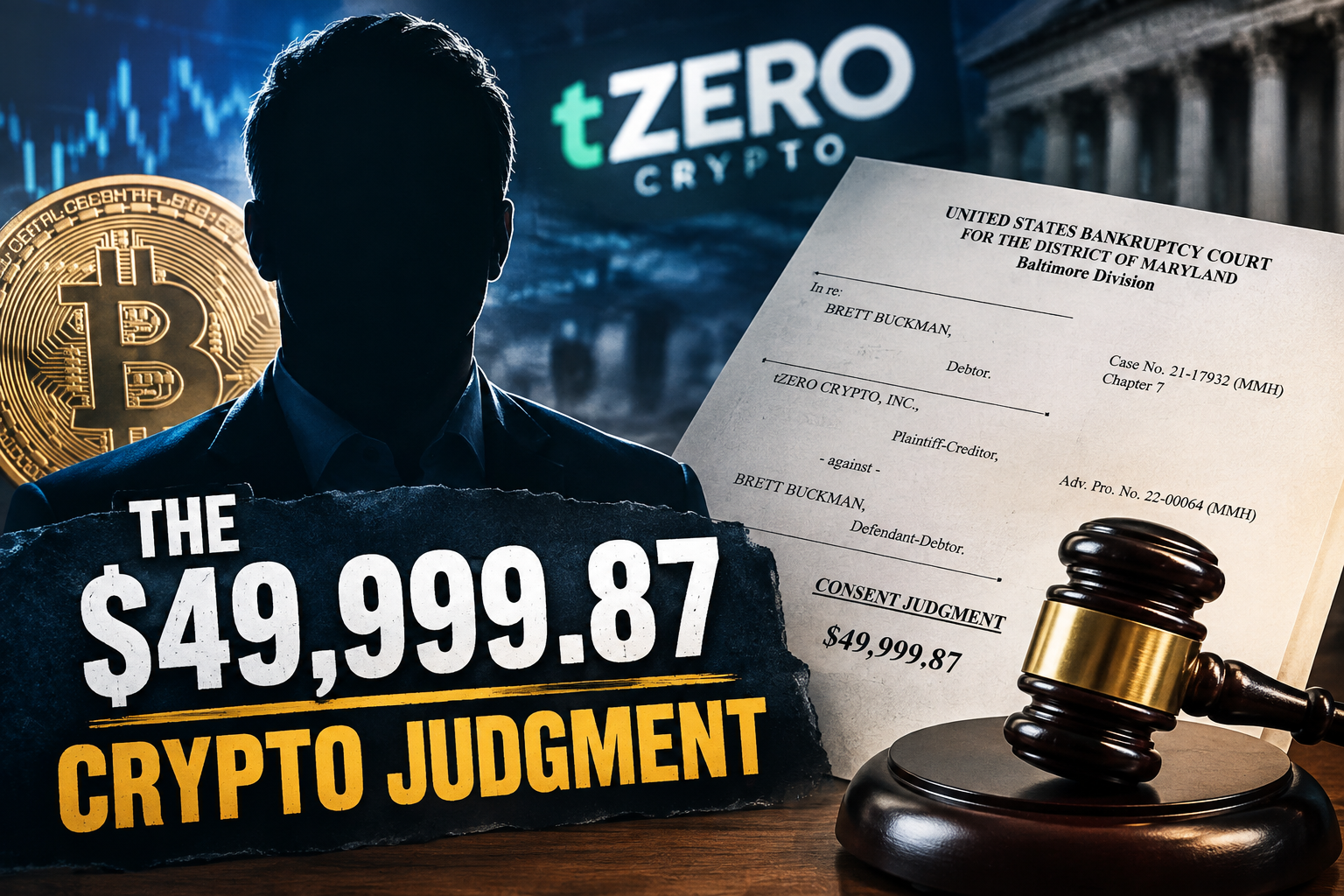
Brett Buckman’s name appears in a relatively small but consequential corner of the cryptocurrency litigation record: a federal bankruptcy proceeding in Maryland that ended with a $49,999.87 consent judgment in favor of tZERO Crypto, Inc. The case did not result in a criminal conviction, and the available court record does not establish that Buckman admitted to criminal wrongdoing. What it does establish is that a dispute involving allegations of cryptocurrency-related fraud survived into bankruptcy court and ultimately ended with Buckman consenting to a judgment for essentially $50,000.
The paper trail begins with Buckman’s Chapter 7 bankruptcy case, identified as Case No. 21-17932 in the U.S. Bankruptcy Court for the District of Maryland. The adversary proceeding brought by tZERO Crypto was numbered 22-00064. The court record identifies Buckman as the debtor and defendant, while tZERO Crypto is identified as the plaintiff-creditor. tZERO v. Buckman – Consent Judg… Public court-document indexing by OffshoreAlert describes tZERO’s March 2022 complaint as an action objecting to the discharge of a debt that involved alleged cryptocurrency-based fraud.
That distinction matters. A complaint is a set of allegations, not a judicial finding that the allegations are true. The publicly accessible material reviewed for this article does not provide enough of the underlying complaint to responsibly reconstruct the precise mechanics of the alleged cryptocurrency transaction, the representations allegedly made by Buckman, or how the $49,999.87 figure was calculated. Claims that go beyond that record would risk turning allegations into established facts.
What happened next is considerably clearer. On October 24, 2022, U.S. Bankruptcy Judge Michelle M. Harner entered a consent judgment against Buckman in favor of tZERO Crypto for $49,999.87, plus interest at the federal rate from the date of judgment. The judgment expressly states that both sides consented to its entry. tZERO v. Buckman – Consent Judg… The document bears Buckman’s consent through a signature submitted with permission, while tZERO was represented by Davis Wright Tremaine LLP. tZERO v. Buckman – Consent Judg…
That is the central legal fact in the case: Buckman did not simply have a disputed claim listed against him in bankruptcy. A federal bankruptcy court entered a money judgment by consent. At the same time, the judgment itself does not say that Buckman pleaded guilty to fraud, was convicted of fraud, or admitted that the allegations in the original complaint were true. A consent judgment is fundamentally different from a criminal conviction or a verdict following a trial.
The matter took another turn several months later. On February 27, 2023, a letter submitted to OffshoreAlert in Buckman’s name demanded removal of an article concerning the tZERO complaint and threatened legal action if it was not removed. The letter asserted that “the court has found these claims to be false” and characterized continued publication as defamation. Brett Buckman – Letter to Editor OffshoreAlert subsequently published the correspondence, reporting that Buckman had demanded removal while pointing to the consent judgment as evidence that the dispute had actually been resolved through settlement rather than a court ruling declaring the allegations false.
The wording of Buckman’s letter is significant because it provides the clearest publicly available account of his position. Rather than accepting the characterization of the underlying claims, he challenged the reporting and asserted that the court had rejected them. But the bankruptcy judgment available for review does not contain such a finding. Instead, it records the parties’ agreement to a $49,999.87 judgment. tZERO v. Buckman – Consent Judg…
There is also an important corporate development on the other side of the dispute. tZERO Crypto was a subsidiary within the broader tZERO corporate structure and operated a virtual-currency wallet and exchange business. In a later corporate disclosure, tZERO Group said it shut down tZERO Crypto in March 2023 following a strategic review. Google Cloud Storage Florida corporate records likewise show tZERO Crypto, Inc. as inactive, with its withdrawal filed in April 2023. SunBiz The broader tZERO business continues today, but its current operations are focused heavily on tokenized securities, regulated trading infrastructure and blockchain-based financial-market services rather than the former tZERO Crypto wallet and exchange operation.
The available evidence does not establish a broader network of co-defendants, executives or associates accused alongside Buckman in this particular matter. tZERO Crypto is the named creditor and plaintiff in the bankruptcy adversary proceeding, while Buckman is the sole named defendant in the public indexing of the complaint. Nor did the research locate a credible federal criminal prosecution, SEC enforcement action, CFTC proceeding, criminal conviction or guilty plea against this particular Brett Buckman connected to the tZERO dispute.
His age and present whereabouts are also not reliably established by the credible records reviewed. The bankruptcy documents place him in Bel Air, Maryland at the time of the proceeding, but that does not establish where he lives today. Internet pages using the same name make conflicting claims about his identity and even his death, but those sources are not sufficiently reliable to treat those claims as fact. The safest conclusion is that his current location and present occupation could not be independently verified from credible public sources.
The story therefore is not one of a proven criminal cryptocurrency scam. It is more precise and in some ways more revealing than that. It is the story of a disputed crypto-related claim that reached federal bankruptcy court, resulted in a $49,999.87 consent judgment, and was followed by a public demand from Buckman to remove reporting about the underlying allegations. The court record establishes the judgment. It does not establish a criminal conviction or an admission of fraud.
That distinction is exactly why the case matters. Cryptocurrency disputes can move quickly from informal transactions and digital promises into bankruptcy court, where the consequences become very real and very public. For consumers and investors, the lesson is not to treat every allegation as proven but neither should a settlement or consent judgment be mistaken for a court declaration that nothing happened. In Buckman’s case, the most defensible conclusion comes from the documents themselves: a federal court entered a nearly $50,000 judgment with his consent, while the underlying allegations were never converted into a criminal conviction or a trial verdict. That record deserves to be understood on its own terms.
Source:
OffshoreAlert
————-
Disclaimer:
Some content on Reportingscams.com is published under our guest post program and is provided by third-party contributors. Reporting scams does not create, verify, or take responsibility for the views, accuracy, or claims expressed in such content.