Bruce David McNaught built a career in Guernsey’s financial services industry, working in accountancy, company administration and fiduciary services before establishing his own accounting practice. But official regulatory records reveal a more complicated professional history: two financial penalties totalling £28,000, findings that he carried out company-formation work without the required licence, and a separate enforcement case involving serious compliance failures at a trust and company administration business where he had served as a director.
The findings do not establish that McNaught committed criminal fraud, and the Guernsey Financial Services Commission (GFSC) explicitly recorded that it had no evidence of financial loss to clients from the unlicensed company incorporations at the centre of its earlier case. The regulatory record is nevertheless significant because it concerns the standards expected of professionals entrusted with company structures, client money, corporate records and anti-money-laundering controls.
Born on 10 September 1961, McNaught is a Guernsey-based chartered accountant whose professional biography describes a career spanning several decades in the Channel Islands’ financial sector. His own business website says he studied accountancy at City of London Business School, joined Saffery Champness in London before being seconded to Guernsey in 1985, and qualified as a chartered accountant in June 1990. He later worked at Old Mutual International and joined a Guernsey fiduciary business, where he held senior responsibilities involving client relationships and money-laundering compliance.
The first major regulatory case centred on his separate accounting practice, Candie Accounting, which also traded under the name The Guernsey Accountants. According to the GFSC’s public statement issued on 9 August 2019, McNaught established Candie Accounting in February 2010 and considered himself its proprietor or principal. The business was registered as a prescribed business in October 2014, with McNaught acting as its money-laundering reporting officer.
The regulator found that, between May 2012 and February 2016, McNaught incorporated 12 Guernsey-registered companies for clients of Candie Accounting. Rather than carrying out the work through his licensed employer, he used that employer’s registration with the Guernsey Registry, including its online login details. The companies were being formed for his own accounting clients, and the GFSC concluded that the activity required a fiduciary licence that he did not hold in his capacity as Candie Accounting’s principal.
The issue extended beyond the completed incorporations. From August 2015 to March 2016, the regulator found, Candie Accounting’s website offered Guernsey company-formation services without the required authorisation. Company formation was a regulated activity, and the Commission concluded that both carrying out the incorporations as a business and offering the service without the appropriate licence contravened the Fiduciaries Law.
There were also questions about the handling of client records. The GFSC acknowledged that McNaught had carried out due diligence on the clients for whom the companies were formed and later supplied copies of the documentation. However, the material was kept at his home rather than on the licensed employer’s systems. The firm had no readily retrievable record identifying where the documents could be obtained, undermining its ability to conduct the required reviews. The Commission also concluded that using the firm’s resources in this way exposed it to anti-money-laundering and counter-terrorist-financing compliance concerns.
McNaught contacted the Commission in March 2016 after an exchange with the Guernsey Registry led him to recognise that his activities might breach the applicable regulations. He acknowledged that he had occasionally incorporated companies for Candie Accounting clients and invoiced for the work through that business rather than his licensed employer. He apologised and asked the regulator what action it wanted him to take. The employer had already begun a disciplinary investigation in February 2016, and McNaught submitted his resignation in April.
That disclosure counted among the mitigating circumstances considered by the regulator. The GFSC noted his voluntary attendance at an interview, the provision of documentation, his offer to take corrective steps and the fact that the website stopped offering company incorporation in March 2016. It also found no suggestion that an individual or corporate client had suffered financial loss as a result of the licensing contraventions, describing McNaught’s earnings from the incorporations as modest.
Those mitigating factors did not persuade the Commission that the conduct could be treated as a minor administrative error. The regulator found that McNaught had not been sufficiently familiar with the legal and professional obligations governing company formation. It also criticised his failure to be fully candid with his employer about the incorporations and the circumstances surrounding them. Inconsistencies in the accounts he provided during the investigation raised further concerns about his openness and honesty.
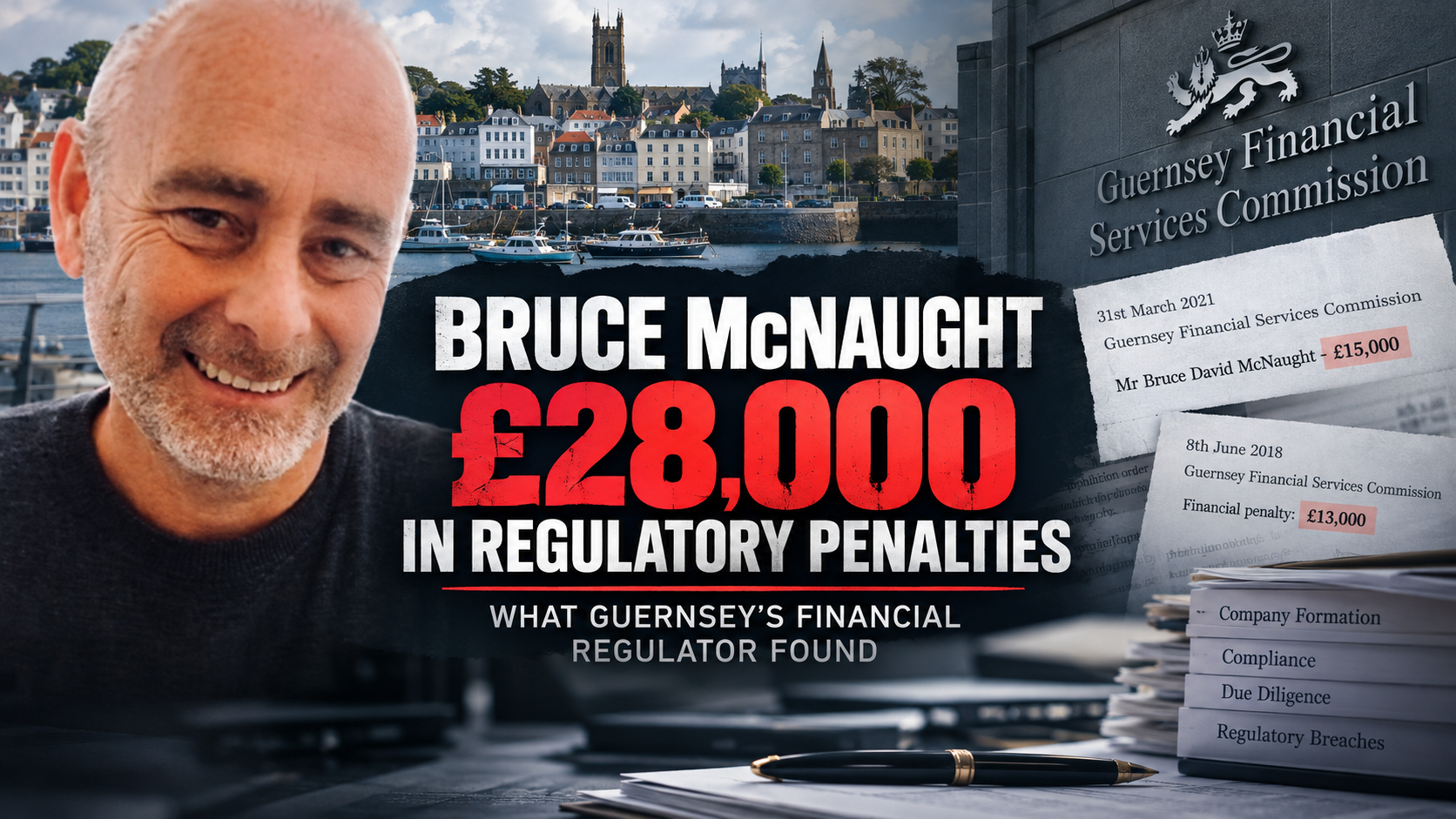
The GFSC concluded that he had failed to meet the minimum licensing criteria and was not a fit and proper person to hold specified positions under Guernsey’s fiduciary, investment, insurance and banking regulatory laws. On 8 June 2018, it imposed a £13,000 financial penalty and four-year prohibitions on a range of senior roles within regulated businesses, including director, controller, partner, manager, money-laundering reporting officer and compliance officer. The restriction period ran until June 2022.
The story did not end with that case. McNaught was later sanctioned in connection with Chamberlain Heritage Services Limited (CHSL), a Guernsey fiduciary company that administered trusts and companies and provided registered-office, nominee and corporate-director services. He had served as an executive director from May 2010 until April 2016, acted as money-laundering reporting officer during two periods, and became a controller in December 2013. The GFSC’s statement published on 24 August 2023 set out the findings arising from an investigation into serious failings across six client relationships.
The CHSL investigation identified weaknesses in customer due diligence, enhanced due diligence, ongoing monitoring and recordkeeping. In one high-risk client relationship, a company held a cash deposit of approximately US$7 million as of May 2018, while the regulator found that documentation supporting the source of wealth and source of funds was inadequate. McNaught had been a director of that client company alongside CHSL founder Christopher Henry Shaw. The regulator noted that McNaught, Shaw and another director had signed off periodic reviews in 2015, 2016 and 2017 despite outstanding concerns about due diligence. The US$7 million was the company’s reported cash holding, not a proven loss or an amount alleged to have been stolen.
Another part of the case concerned five family trust structures whose closure was requested in 2012. CHSL charged approximately £290,000 in closure fees. The Commission was concerned that the fees included money transferred to a bank account absent from CHSL’s audited financial statements, an account Shaw reportedly referred to as the “slush fund.” The regulator said 88.5% of the closure fees was distributed directly to Shaw rather than recorded as company income, while McNaught was a director and signed the company’s audited accounts during the relevant period. It concluded that Shaw and McNaught had failed to treat CHSL as a separate legal entity from its shareholders and had demonstrated shortcomings in integrity, competence and understanding of their obligations. These were regulatory findings about corporate governance and the handling of company funds; they should not be misrepresented as a criminal conviction for theft or fraud.
On 23 March 2021, the GFSC decided to impose a further £15,000 penalty on McNaught. Shaw was fined £100,000 and John Adam Robilliard £40,000. The Commission concluded that all three individuals had failed to meet the minimum criteria for licensing. It did not impose a fresh prohibition on McNaught in 2021 because the existing restrictions already ran until 8 June 2022. CHSL had changed ownership in November 2017, surrendered its licence in October 2019 and was in liquidation by the time of the 2023 statement. The Commission said it would otherwise have imposed a £100,000 penalty on the company under the circumstances described in its decision.
The combined penalties against McNaught in the two cases amount to £28,000. The available regulatory material does not establish that he was criminally convicted or pleaded guilty to fraud, and no such conclusion should be drawn from the licensing findings. The central issue is instead whether the conduct met the standards required of people managing corporate structures and handling sensitive financial relationships. The Commission’s findings indicate that it did not.
McNaught’s professional website continues to advertise accounting services through The Guernsey Accountants, including bookkeeping, financial reporting, consulting and Guernsey tax compliance. The GFSC’s public register also lists Candie Accounting Services Limited, trading as The Guernsey Accountants, as a prescribed business registered as an accountant. That registration should not be confused with a fiduciary licence or interpreted as evidence that the earlier restrictions remain in force.
A document supplied for this review adds a final detail to the timeline. In an email dated 29 June 2022, McNaught asked OffshoreAlert to remove a search result relating to him, saying that the GFSC penalty had expired on 6 June. The email records his request; it does not establish whether OffshoreAlert complied or indicate any wrongdoing in making it.
For investors, clients and the wider public, this case is a reminder that financial-services safeguards depend on more than professional qualifications or years in the industry. Licensing rules, reliable records, meaningful due diligence and independent oversight are designed to make corporate structures transparent and help prevent financial abuse. Regulatory penalties are not criminal convictions, and the absence of proven client losses in one case must be acknowledged. But when a regulator finds repeated weaknesses in licensing, oversight and corporate governance, the findings deserve careful scrutiny because trust in financial services ultimately depends on the people responsible for protecting clients and the integrity of the system.
Source:
OffshoreAlert
————-
Disclaimer:
Some content on Reportingscams.com is published under our guest post program and is provided by third-party contributors. Reporting scams does not create, verify, or take responsibility for the views, accuracy, or claims expressed in such content.