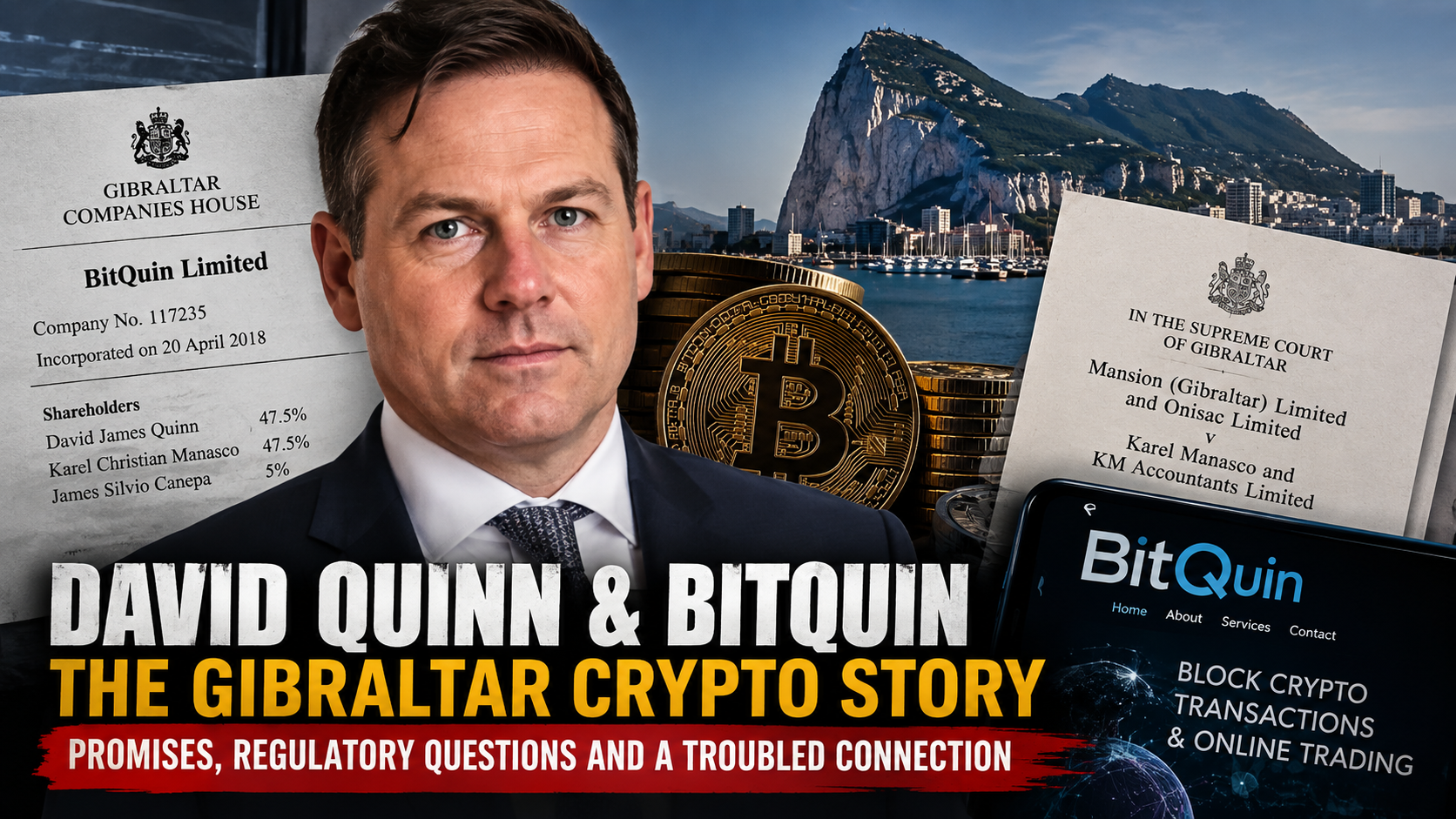
BitQuin Ltd. was incorporated in Gibraltar in April 2018 with a straightforward corporate structure on paper: 1,000 ordinary shares, with David James Quinn and Karel Christian Manasco each holding 47.5% and James Silvio Canepa holding the remaining 5%. The company’s 2021 annual return identifies Quinn as an Irish national and equity sales trader and Manasco as its CEO; both were listed as directors at the time.
The more complicated story begins with what BitQuin said it was going to do, what its directors later said it actually did, and the circumstances surrounding one of its largest shareholders. BitQuin marketed itself as a crypto trading operation handling high-value block transactions for hedge funds, institutions, private banks, family offices, high-net-worth individuals and crypto-mining businesses. Gibraltar Finance publications carried BitQuin advertising in 2018 and 2019 describing the business as offering “BLOCK CRYPTO TRANSACTIONS & ONLINE TRADING.”
Yet in April 2023, when OffshoreAlert questioned the company’s connection to Manasco, Quinn gave a strikingly different description of BitQuin’s position. In a response reproduced by OffshoreAlert, Quinn said he was BitQuin’s CEO, that Manasco did not run the company and was instead a shareholder, and that BitQuin was “not yet operational.” Quinn also said the company had generated zero revenue since inception, that an application for regulatory approval from the Gibraltar Financial Services Commission had been withdrawn, and that BitQuin had never provided regulated services without regulatory authority. Those statements came directly from Quinn and are important because they distinguish the company’s promotional ambitions from its actual operating status.
The immediate controversy was not a finding of wrongdoing against Quinn or BitQuin. It was the presence of Manasco, whose financial affairs had become the subject of major litigation. On February 21, 2023, Gibraltar’s Supreme Court issued a worldwide freezing order of up to £5 million against Manasco and KM Accountants Limited after Mansion (Gibraltar) Limited and Onisac Limited sued them over alleged misconduct during Manasco’s time running Mansion. The claimants sought £2,339,464.18 and €2,977,003.64, together with an accounting of benefits allegedly received by Manasco or related parties.
The allegations were extensive. Mansion accused Manasco of arranging bonuses of €327,033.28 and £427,500 for himself, receiving £66,236.67 in personal allowances, authorising €2,508,035.36 and £127,073.28 in payments to Marshall Islands company White Wizard Media Limited, and using company money for vehicles, luxury watches, personal expenses and a domain name. The claim also originally included an allegation involving a £150,000 Ferrari said to have been received as an inducement to act favourably toward a competitor. These were claims in litigation, not accusations against Quinn. The Gibraltar court later entered judgment on some of the monetary claims against Manasco and KM Accountants.
The BitQuin connection became particularly significant because the 2023 freezing-order proceedings disclosed that Manasco had invested £1.5 million in what the judgment described as a crypto investment scheme. OffshoreAlert investigated the possibility that the investment was BitQuin. The publication reported that Manasco was a 47.5% shareholder and director of BitQuin alongside Quinn, while Canepa held 5%. Quinn disputed the connection, saying the £1.5 million did not go into BitQuin but into an unrelated crypto business, Miracle World Ventures Limited, trading as Globix.
That distinction matters. Miracle World Ventures was not simply another name for BitQuin. It was a separate BVI company that operated the Globix or Globix Cash crypto platform. The Gibraltar Financial Services Commission issued a consumer alert in April 2023 stating that Miracle World Ventures was not authorised by the GFSC to conduct regulated activities in Gibraltar and that no application for authorisation was pending. The company had already entered liquidation in the British Virgin Islands on March 10, 2023.
The collapse of Globix subsequently became a much larger crypto-asset recovery matter. Gibraltar court proceedings involved liquidators attempting to trace approximately $42 million in digital assets believed to have been held through crypto wallets associated with the failed platform. The courts granted asset-preservation and disclosure orders as liquidators attempted to establish what had happened to the money. There is, however, no evidence in the sources reviewed that Quinn was accused of operating Globix, that he invested in it, or that he was made a defendant in the Globix proceedings.
Meanwhile, the Mansion litigation continued. In September 2024, Gibraltar’s Supreme Court entered judgment in favour of Mansion for €2,508,035.36 and £127,073.28 relating to the White Wizard Media claims after Manasco failed to comply with an unless order. Earlier, Mansion had obtained summary judgment for £66,236.67 plus interest relating to personal allowance payments and £14,755.74 plus interest concerning the GoDaddy domain claim.
The case escalated further in 2025. Gibraltar’s Supreme Court found Manasco in contempt of court following proceedings concerning breaches of undertakings and the worldwide freezing order. The court ultimately imposed a 12-month custodial sentence. In February 2026, the Gibraltar Court of Appeal recorded that Manasco’s appeals against the contempt findings and sentence had been dismissed and ordered him to pay the respondents’ appeal costs, including an interim payment of £105,660.
None of those later judgments establishes wrongdoing by Quinn. That distinction is crucial. The publicly documented court proceedings centre on Manasco and KM Accountants, not Quinn or BitQuin. Quinn’s role in the episode is instead that of BitQuin’s stated CEO and a major shareholder who publicly challenged the description of the company and threatened legal action against OffshoreAlert. In an April 5, 2023 message, Quinn told the publication that its story was incorrect, insisted that Manasco did not run BitQuin, and said, “I run the company as CEO.”
There is also no reliable evidence located in this review establishing criminal charges, a criminal conviction, a regulatory fine, or a fraud judgment against Quinn personally. No reliable source located a confirmed age or a documented alias for him either. Public corporate records identify him as David James Quinn, Irish, and an equity sales trader; his professional history places him in institutional sales and trading. A LinkedIn profile for David James Quinn places him in Gibraltar with Makor Securities, while his public professional biography now describes work in sales and trading and roles connected to Ameon Capital and Arkan Suisse.
His current public professional footprint appears to have moved beyond BitQuin. Ameon Capital currently lists David Quinn as managing partner, describing a 25-year career spanning firms including Lehman Brothers, Bear Stearns and Churchill Capital. Arkan Suisse identifies a David Quinn as its Sales & Trading Advisor and describes more than two decades of experience in institutional distribution and trading. Because the public profiles do not themselves reproduce BitQuin’s company number or another unique identifier, those current profiles should be treated as a strong but not absolute identification match rather than proof of every detail of his present activities.
BitQuin itself remains a curious footnote. Corporate databases show the company was incorporated in 2018 and had filings continuing into 2024, including changes involving directors and its registered address. Its LEI record lists the legal entity as active but the LEI registration itself as lapsed since 2024. That does not, by itself, establish that BitQuin was dissolved or struck off.
The bigger lesson is the gap between financial-sector presentation and verifiable operating reality. BitQuin was publicly marketed as a sophisticated institutional crypto-trading business, yet its own CEO later described it as non-operational, revenue-free and awaiting then abandoning a regulatory application. At the same time, one of its two principal shareholders became embroiled in a multi-million-pound court battle that eventually produced monetary judgments, contempt findings and a prison sentence. That does not make Quinn responsible for Manasco’s conduct, nor does it prove wrongdoing by BitQuin. But it does make the corporate history worth examining carefully. In financial markets, names, promotional claims and professional credentials can create an impression of scale long before a business has demonstrated what it actually does. The BitQuin record shows why investors, counterparties and consumers need to look past the pitch and establish who owns a company, who actually runs it, whether it is authorised, whether it has generated real business, and what the courts and regulators say when those claims are tested.
Source:
OffshoreAlert
————-
Disclaimer:
Some content on Reportingscams.com is published under our guest post program and is provided by third-party contributors. Reporting scams does not create, verify, or take responsibility for the views, accuracy, or claims expressed in such content.