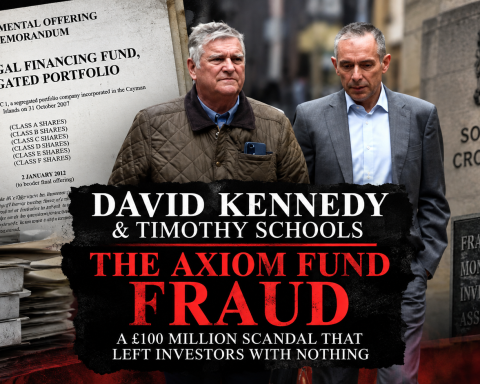
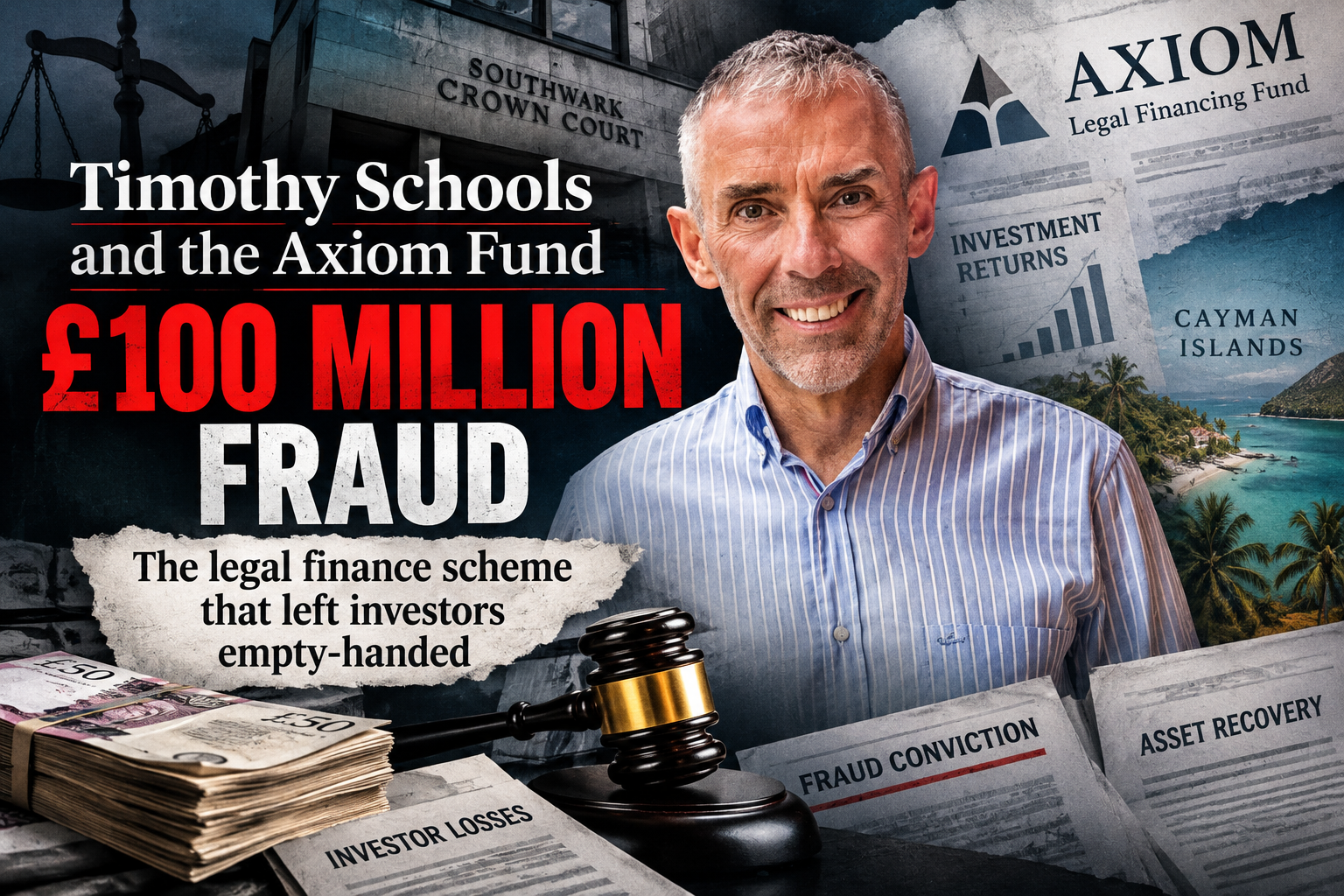
When Axiom Legal Financing Fund was being marketed to investors, the proposition sounded unusually attractive: put money into a Cayman Islands-based fund that would lend to law firms handling no-win-no-fee claims, and earn returns that promoters described as low-risk and potentially around 10% to 12% a year. By 2012, the fund had attracted more than £100 million from hundreds of investors. It eventually collapsed, leaving investors facing enormous losses and thousands of legal cases caught in the fallout. The central figure behind the scheme was British solicitor Timothy Paul Joseph Schools, also known as Tim Schools. He was born on March 19, 1961, making him 65 in 2026. He is now a convicted fraudster serving a 14-year prison sentence in the UK.
The warning signs had appeared well before the criminal prosecution. OffshoreAlert’s reporting in 2012 identified relationships between Axiom and law firms controlled by Schools, questioned the financial condition of borrowers and raised concerns about the insurance arrangements protecting the fund. The documents supplied for this investigation show that during Axiom’s first 14 months, its entire £13.1 million of lending went to two firms in which Schools had directorship or ownership connections. One was ATM Solicitors, wholly owned by Schools, which reported a £1.1 million deficit while Axiom’s audit showed it owing the fund £8.4 million in principal and interest. info
The same material raised questions about Ashton Fox Solicitors. Axiom’s audit said the firm owed £5.3 million, while Ashton Fox’s own accounts appeared to show only £2.1 million in total creditor liabilities. OffshoreAlert reported that Schools did not explain the £3.2 million discrepancy. It also reported that Schools transferred ownership of ATM to Ashton Fox around the time the Solicitors Regulation Authority began investigating him and ATM. info info
Those concerns became even more significant when regulators and prosecutors later examined the wider structure. Schools had occupied multiple roles around Axiom, including founder and investment manager, while related entities performed other functions. The original OffshoreAlert investigation identified Schools’ interests in companies including Check Mate Audits, Astoncote and Mountivation and reported that his wife Claire Schools was involved in ownership of Check Mate. The investigation also identified connections involving Schools’ brother Kevan Schools, David Rae, Gordon Walker and Jason Corbett. info info
The insurance arrangements presented another serious warning sign. Axiom’s offering documents told investors that insurance provided a high degree of protection and stated that insurers used by the fund were regulated by the UK’s Financial Services Authority. Yet OffshoreAlert reported that Frion Ltd., which provided a majority of the insurance, had only £100 in paid-up capital, had never been audited and was not registered with the FSA. The firm was also the subject of a separate $10 million fraud lawsuit brought by KAR Oil Refining, although the defendants denied the allegations. info
Schools also had a professional history that should have attracted scrutiny. In 2014, the Solicitors Disciplinary Tribunal struck him off the roll after finding ten allegations proved in relation to his management of ATM Solicitors. The case was separate from the later Axiom criminal prosecution, but the findings included failing to act with integrity, conflicts of interest and compromising the independence of himself and his firm. The High Court subsequently upheld the decision to strike him off.
The Axiom business itself continued to grow despite those warning signs. OffshoreAlert reported that Taylor Moor International had announced investments of £117 million and claimed the fund was growing by more than £8 million a month. Investors were being presented with the prospect of 10% to 12% annual returns and a low-risk proposition. The fund’s own due-diligence material claimed that borrower financial and professional histories were investigated and that firms with poor financial records, debts or potential conflicts would be avoided. info info
That picture changed dramatically when auditors uncovered the condition of the underlying loans. By 2012, Axiom was valued at roughly £120 million, but one law firm, Ashton Fox, was said to owe the fund approximately £60 million and could repay only £65,000. The fund collapsed in October 2012. Prosecutors later told Southwark Crown Court that investors lost more than £100 million and that as many as 35,000 clients had cases affected by the collapse.
The criminal case took years to reach court. In August 2020, the Serious Fraud Office charged Schools, David Kennedy and Richard Emmett over their alleged roles in diverting Axiom money. Schools denied the charges during the trial and argued that Axiom was created to address a funding gap in the legal market. He also defended particular expenditures, including a £45,000 corporate box at Blackpool FC, which he described as a business expense.
The jury ultimately rejected his defence. On August 9, 2022, Schools was convicted of three counts of fraudulent trading, one count of fraud by abuse of position and one count of transferring criminal property. Prosecutors said he personally obtained approximately £19.5 million to £19.6 million from the scheme. The money was used to finance an expensive lifestyle that included luxury vehicles, a motor boat, property and a £5 million fishing and shooting estate in Cumbria.
Judge Martin Beddoe sentenced Schools to 14 years in prison and described his offending as exceptionally serious. He also received a 15-year director disqualification. The judge said Schools had treated the operation as a get-rich-quick scheme and had shown no genuine remorse.
The other defendants followed very different paths. Richard Emmett, whose firm had received Axiom funding, was acquitted of all charges. His lawyers said he had always protested his innocence. David Kennedy, a former financial adviser and Schools’ business partner, initially escaped conviction when a jury failed to reach a verdict on the charge against him. The SFO subsequently retried him. In May 2024, Kennedy was convicted of fraudulent trading, and he was sentenced to eight years in prison. The SFO said he had diverted more than £5.8 million from Axiom and used it for personal benefit, including property and a Swiss ski resort chalet.
The financial consequences have continued long after the criminal convictions. At a confiscation hearing in January 2025, the court found that Schools’ benefit from his general criminal conduct exceeded £146 million. Yet the amount immediately available for confiscation was only £1,083,067.38. The High Court later noted that investigators could identify no bank balance in Schools’ name exceeding roughly £50 and that many of the assets that could be traced were held through family members and associates.
That gap between the scale of the criminal benefit and the assets available for recovery explains why the case remains active. In 2025, the SFO obtained its first unexplained wealth order against Claire Schools, Schools’ former wife, concerning Hope Springs House, a Lake District property valued at around £1.5 million. The High Court found reasonable grounds to suspect that her known legitimate income was insufficient to purchase the property. Claire Schools cooperated with the proceedings, and the property was subsequently sold. The SFO recovered £1.1 million from the sale in September 2025.
David Kennedy’s assets have also been pursued. In December 2025, the SFO secured a £928,479 confiscation order against him, covering assets including property, a Spanish bank account, a pension and vehicles. He was still serving his eight-year sentence at that point.
There is also continuing civil litigation connected to the collapse. Axiom’s receivers pursued claims against financial institutions, including Royal Bank of Scotland International. The Privy Council ultimately upheld the dismissal of a claim exceeding £60 million against the bank. Separate investors have pursued compensation claims concerning the sale of Axiom through offshore investment and insurance platforms, including proceedings involving Friends Provident International and Utmost International.
The case matters because Axiom was not simply a failed investment with poor returns. The criminal courts established that Schools fraudulently diverted investor money for his own benefit. The later confiscation proceedings demonstrated another problem common to major financial fraud cases: proving the crime is only part of the battle. Finding the money after it has moved through companies, offshore structures, trusts and family relationships can be considerably harder.
Schools’ present physical location is not reliably disclosed in public sources, but the latest authoritative material reviewed for this article confirms that he remains subject to the 14-year sentence imposed in 2022 and that the SFO’s asset-recovery work has continued. The trail from Axiom’s confident promises of secure, high-yield returns to criminal convictions, prison sentences and millions of pounds in recovery proceedings is a reminder of how quickly a financial product can look different once its underlying transactions are examined. The most important lesson is not simply that investors lost money. It is that the warning signs were visible in corporate structures, borrower relationships, regulatory records and financial statements long before the scheme finally collapsed.
Source:
OffshoreAlert
————-
Disclaimer:
Some content on Reportingscams.com is published under our guest post program and is provided by third-party contributors. Reporting scams does not create, verify, or take responsibility for the views, accuracy, or claims expressed in such content.