For years, the modern internet economy has produced a familiar kind of financial celebrity. A relatively unknown individual acquires an audience online, develops a confident public persona, adopts the language of entrepreneurship and technology, and eventually begins selling something more consequential than education or motivation. The transition from influencer to financial authority can happen quickly. The consequences when things go wrong can be considerably more complicated.
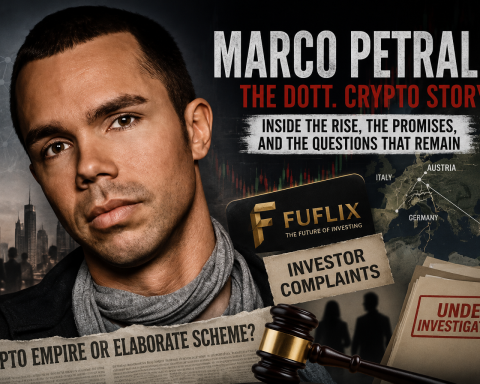
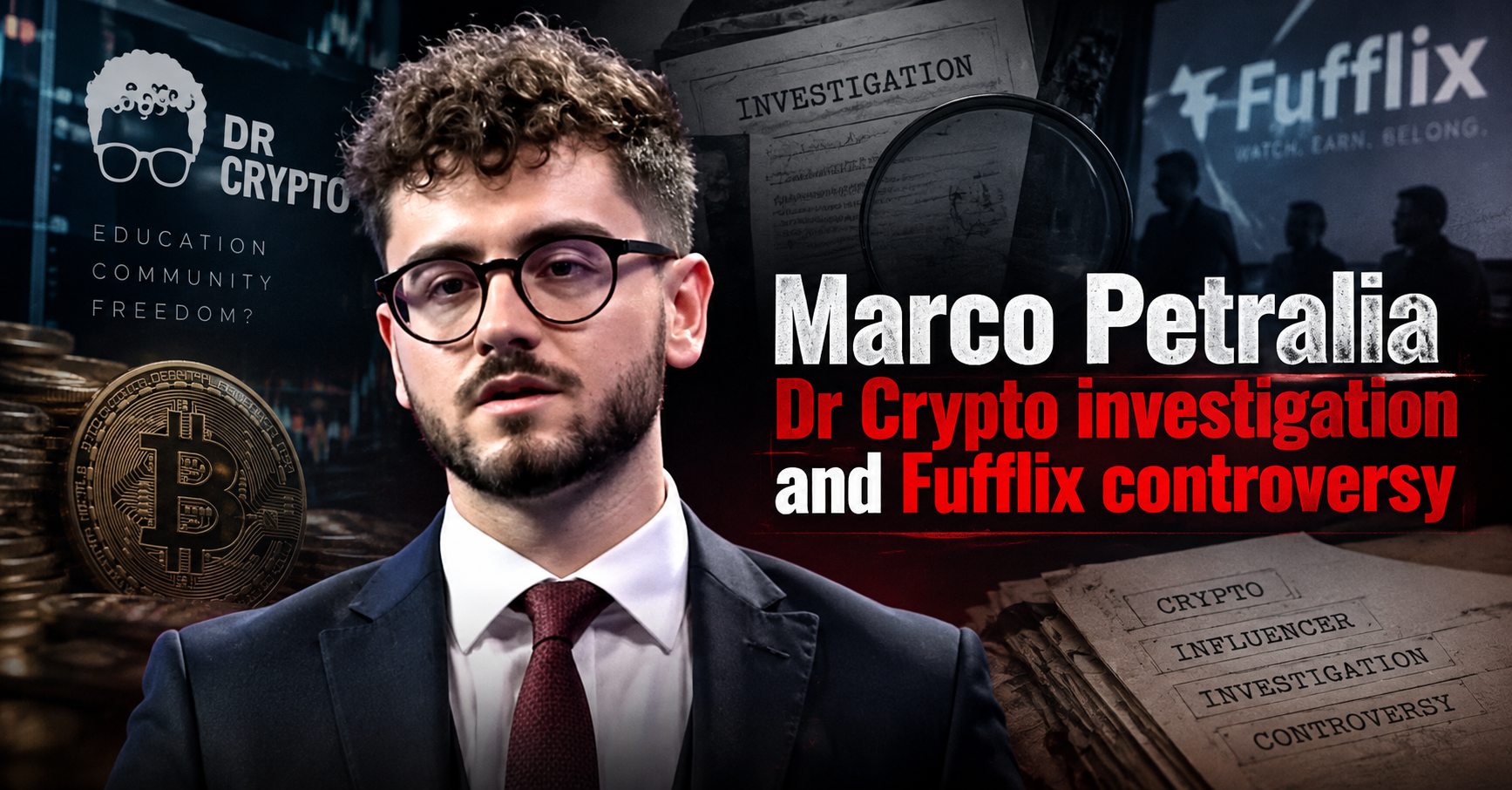
Marco Petralia, an Italian entrepreneur who has been publicly associated with the nickname “Dr. Crypto” or “Dott. Crypto,” is one such figure whose name has become increasingly connected with allegations surrounding cryptocurrency promotion, copy trading, investment claims and former collaborators who say the business behind the public image was not what it appeared to be.
The questions surrounding Petralia are particularly significant because they do not emerge from a single complaint or isolated internet dispute. His name appears across a broader collection of adverse material, including consumer allegations, investigative reporting, commentary surrounding the Italian platform Fufflix and claims made publicly by a former collaborator. A separate review of UK corporate records also shows Petralia holding directorships in several British companies that have since been dissolved.
The available evidence, however, requires careful handling. A serious allegation is not the same as a criminal conviction. Consumer complaints do not automatically establish fraud. A former employee’s testimony may raise important questions, but it still represents an account that requires corroboration. And, as of the sources reviewed for this article, no publicly confirmed criminal conviction or final court judgment establishing that Marco Petralia committed fraud was identified.
That does not end the story. In some ways, it is where the investigation begins.
The Rise of “Dr. Crypto”
According to the Investigations.org report, Petralia emerged publicly in Italian-speaking cryptocurrency circles around 2018, when he began promoting himself as a cryptocurrency expert and advisor under the “Dott. Crypto” brand. The report describes his public trajectory as moving from cryptocurrency education and advisory activity toward the promotion of structured investment opportunities and trading-related services.
The distinction between those activities matters. Giving general information about cryptocurrency is one thing. Providing regulated financial advice, managing money, promising returns or arranging investment products can raise entirely different legal and regulatory questions depending on the jurisdiction and the precise nature of the service being offered.
Investigations.org alleges that businesses associated with Petralia operated across multiple jurisdictions, including Italy, Germany, Austria and the United Arab Emirates. The report identifies a wider network of alleged associates and corporate structures, while acknowledging that beneficial ownership and the exact relationships between some entities were not independently verified through public registries.
The geographic spread is important for another reason. Cross-border financial businesses can be perfectly legitimate, but international structures also make accountability more difficult for customers who want to understand who is actually responsible for a product or service. A person in Italy may encounter a trading promotion connected to a company elsewhere in Europe, while payments, technology or marketing operations may be handled through additional jurisdictions.
The result is a structure in which the public-facing personality can be very visible while the underlying corporate machinery is much harder to understand.
That issue sits at the centre of the controversy surrounding Petralia.
Fufflix, Copy Trading and the Allegations of Unrealistic Returns
The most serious allegations connected with Petralia concern cryptocurrency and copy-trading activities promoted through businesses and networks associated with his name.
The Investigations.org report describes Petralia as an alleged central figure connected with Fuflix, which it characterizes as a cryptocurrency and streaming-related venture that later became the subject of adverse commentary and investor complaints. According to the report, complaints began appearing in 2022 concerning alleged difficulties withdrawing money and obtaining responses from support systems, followed by the reported collapse or cessation of the platform’s operations.
The report further alleges that some programs associated with Petralia displayed characteristics commonly associated with high-risk investment schemes, including promised returns, referral incentives and allegations that customers were unable to access their funds after the business deteriorated. These are serious claims, but they remain allegations in the absence of a final criminal judgment establishing their truth.
What makes the allegations particularly notable is the way they intersect with a broader pattern seen repeatedly in speculative financial markets.
Copy trading, when legitimately operated, allows one trader’s transactions to be replicated in another account. It is not inherently fraudulent. But the concept can become dangerous when marketing focuses on extraordinary returns while downplaying risk, losses and the possibility that investors can lose substantial amounts of money.
In the cryptocurrency era, promotional claims can spread especially quickly. Screenshots of profitable trades can circulate on Telegram or social media. Testimonials can be presented as proof of success. A handful of successful transactions can be displayed without a complete picture of losing positions.
The most significant recent allegations concerning Petralia emerged publicly in October 2025, when Italian publication YOUng reported on statements made by Ismael, also referred to as Emmanuel, Onofaro, during a Fufflix broadcast.
The article identified Onofaro as a former collaborator of Petralia. According to his account, he had been recruited to become the public face of a business operation and to conduct live broadcasts and training sessions despite having limited expertise in cryptocurrency trading. He alleged that he had been provided with materials and instructions concerning how to present himself and communicate with prospective clients.
These claims have not been established by a court judgment, and readers should understand them as allegations made by a former collaborator. Nevertheless, the account is detailed enough to raise significant questions about the business practices described.
According to YOUng’s report, Onofaro alleged that trading activity displayed through official Telegram channels was selectively presented. He claimed that losing trades were removed while profitable trades remained visible, creating what he described as a misleading picture of performance. The article also reported his allegation that manipulated images of dashboards and charts were distributed to customers.
If independently substantiated, such conduct could be highly significant. Selectively displaying profitable outcomes while concealing losses can create a fundamentally distorted impression of investment performance. But the key word is “if.” The allegations require independent documentary corroboration, and the article should not present them as judicially established facts.
The claims made by Onofaro went further.
According to the October 2025 report, he alleged that promotional messaging used slogans suggesting stable monthly income, dramatic capital growth and a combination of trading expertise, artificial intelligence and blockchain technology. The article also reported allegations that potential participants were encouraged to borrow money in order to obtain capital for investment.
Those allegations strike at one of the most dangerous features of speculative investment marketing. An investor can theoretically recover from losing discretionary capital. Losing borrowed money is an entirely different problem.
The YOUng article also reported Onofaro’s claim that he was eventually asked to tell customers that he had become a millionaire through trading, despite his assertion that this was not true. According to his account, this demand contributed to his decision to leave the operation.
Again, these are allegations made by a former associate, not findings of a court. But they raise a straightforward investigative question that deserves scrutiny. To what extent was the public image surrounding the business based on independently verifiable trading performance, and to what extent was it based on marketing narratives designed to create the appearance of extraordinary success?
The Corporate Record Leads to the United Kingdom
While much of the controversy surrounding Petralia has focused on cryptocurrency and trading promotions, official UK corporate records reveal another part of the story.
According to the UK government’s Companies House records, a Marco Petralia born in July 1997, identified as an Italian national and resident in Portugal, has held four recorded company directorships. All four companies shown on the Companies House appointment record are listed as dissolved.
The companies listed include Advanced Finance Global Ltd, Advanced Finance Strategies Limited, Advanced Finance Growth Limited and Techtrade Finance Solutions Ltd. The Companies House record identifies Petralia as having been appointed director of Techtrade Finance Solutions Ltd in March 2023 and as a director of the three Advanced Finance companies in February 2025.
The names of those companies are striking because they use financial terminology that can suggest investment or financial services. But a company’s name alone does not establish what business it actually conducted, and a dissolved company is not automatically evidence of wrongdoing. Companies are dissolved for many legitimate reasons.
Still, the pattern is relevant to understanding Petralia’s business history.
Techtrade Finance Solutions Ltd was incorporated in the United Kingdom on March 31, 2023 and dissolved on July 9, 2024, according to official Companies House records. Its registered nature of business was listed as information technology consultancy activities, rather than regulated investment management or financial advice.
The other companies listed under Petralia’s name on the official appointment record were also subsequently dissolved.
That corporate history does not prove misconduct. It does, however, add to a larger picture of business activity involving changing entities, multiple jurisdictions and limited publicly visible continuity.
For an investigative journalist, the next stage would be to obtain and review every available incorporation document, confirmation statement, filing history and dissolution record connected with those companies. Those records could help establish whether the companies conducted meaningful commercial operations, whether they generated revenue, who their counterparties were and how they connected, if at all, to Petralia’s cryptocurrency activities.
The public appointment record also identifies Portugal as Petralia’s country of residence. That is one of the few relatively concrete clues in official corporate records concerning his more recent geographic connection.
The Investigations.org report, meanwhile, places alleged business activity across Italy, Germany, Austria and Dubai, while acknowledging significant gaps in the public record concerning ownership and the current status of entities said to be connected with Petralia.
The Former Collaborator Who Broke Away
The October 2025 account involving Onofaro is arguably one of the most important developments in the public record because it does not come from an anonymous online complaint.
According to YOUng, Onofaro publicly described himself as having worked inside an operation associated with Petralia. He said he had been recruited to act as a frontman and trainer and claimed that his role involved presenting an image of success and expertise to potential customers.
His allegations, if corroborated, could help explain a recurring question in modern financial promotions. Who is actually making the decisions, and who is simply being used as the face of the business?
Onofaro alleged that presentation materials were tightly controlled and that he was expected to deliver a narrative created by others. He also claimed that the business operation demanded extensive work without providing him with the compensation he expected.
The most consequential aspect of his testimony concerns authenticity.
According to the YOUng report, Onofaro claimed he did not understand the true source of the business’s profits and did not know what products or services generated its underlying revenue. He alleged that Petralia was continuing to look for a new public-facing personality for the business after their relationship ended.
These claims cannot be treated as established facts without additional evidence. A rigorous investigation would seek the original broadcast, communications between the parties, employment agreements, payment records, Telegram archives, promotional presentations and testimony from additional former workers or customers.
But the allegations nevertheless create a clear investigative trail.
If the public representation of trading success was accurate, there should be independently verifiable trading records capable of demonstrating long-term performance, including winning and losing positions.
If the testimonials were genuine, there should be identifiable customers willing to confirm their experiences and the circumstances under which they were recruited.
If the business had genuine recurring revenue, corporate records and financial documentation should help establish its source.
And if former associates were merely repeating promotional scripts created by someone else, the question becomes who created those scripts and on what evidence the underlying claims were based.
What Is Actually Proven, and What Remains Alleged?
The most important conclusion from the available record is also the most legally cautious one.
Marco Petralia has clearly become the subject of serious allegations involving cryptocurrency promotion and trading-related business activity. His name is associated with the “Dr. Crypto” identity, adverse consumer commentary, the Fuflix controversy and a detailed account from a former collaborator published in 2025. Official UK corporate records also establish that a Marco Petralia with the same nationality and date-of-birth information held directorships in four British companies, all of which are listed as dissolved.
Those are documented elements of the public record.
What the available sources reviewed here do not establish is equally important.
The Investigations.org report itself states that no publicly confirmed criminal conviction has been identified in connection with the allegations it discusses. It also acknowledges uncertainty concerning formal criminal proceedings, total investor losses, the exact scope of alleged regulatory scrutiny and Petralia’s current activities.
I also did not identify a publicly available final court order or regulatory enforcement decision in the reviewed material that establishes Petralia’s liability for investment fraud, a Ponzi scheme or another financial crime.
That means an article describing him as a “convicted fraudster” or definitively stating that he “ran a Ponzi scheme” would go beyond the evidence currently established by the sources reviewed.
The stronger and more accurate formulation is that Petralia has been the subject of allegations and adverse reporting involving copy trading, cryptocurrency promotion and claims of misleading marketing practices, while former collaborators and consumer sources have raised questions that warrant independent examination.
That distinction protects the integrity of the reporting as much as it protects the legal rights of the subject.
The Regulatory Questions
The controversy surrounding Petralia also raises an important regulatory issue.
When does cryptocurrency education become financial promotion? When does a trading course become investment advice? When does a platform that allows customers to copy trades enter regulated territory?
The answer depends heavily on the facts and the jurisdiction involved.
The Investigations.org report alleges that activities associated with Petralia may have involved financial services or investment products without appropriate authorization in relevant European jurisdictions. However, the report does not provide a publicly available regulator order establishing that Petralia personally violated a specific licensing requirement.
That is a crucial gap.
Regulatory status should not be inferred solely from the absence of a name in a public database, because the precise legal identity of a business, the nature of its product and the applicable regulatory category all matter. An accurate investigation should identify the specific entity that offered a particular service, the dates on which it operated and the legal framework applicable at the time.
The same caution applies to the report’s references to potential regulatory scrutiny. An allegation that authorities are examining a business is not the same as a formal enforcement action, and a preliminary inquiry is not the same as a final finding of misconduct.
For that reason, any future update to this investigation should include direct searches of regulatory databases and, where possible, written requests to relevant authorities in Italy, Germany, Austria, the United Kingdom and the UAE.
The questions should be specific. Has any entity controlled or directed by Marco Petralia been the subject of a formal warning? Has any authority opened a confirmed enforcement proceeding? Has any regulator issued a consumer warning concerning a company or trading service linked to his name? Has any court issued an order involving the recovery of investor funds?
Those questions remain more valuable than speculation.
The Missing Money Question
One of the most difficult aspects of the Marco Petralia story is the absence of a reliable public figure for total alleged losses.
The Investigations.org report describes complaints and allegations involving investors who allegedly lost access to funds after cryptocurrency-related operations collapsed or ceased functioning. But it does not provide a verified aggregate amount showing how much money customers allegedly lost.
This matters because financial controversies can become distorted when individual stories are transformed into unsupported claims about the total scale of a scheme.
At present, based on the sources reviewed for this investigation, there is no reliable publicly established number that can safely be presented as “the amount Marco Petralia scammed.”
That does not mean losses did not occur. It means the total needs to be established through evidence.
A serious investigation would attempt to build that figure from the ground up by collecting customer statements, payment receipts, cryptocurrency wallet transactions, bank transfers, invoices, screenshots of balances and withdrawal requests.
Blockchain analysis could potentially become especially important. If customers sent cryptocurrency to identifiable wallets connected with a particular business, investigators could trace incoming transactions and subsequent movements of funds. The challenge would be proving ownership and control of those wallets.
Without that evidence, assigning a dramatic monetary figure would be journalism by assumption rather than journalism by proof.
Where Is Marco Petralia Now?
The available public record offers only limited certainty about Petralia’s present activities.
Companies House lists Portugal as the country of residence for the Marco Petralia associated with the four British directorships.
Beyond that, the picture is less clear.
The Investigations.org report states that Petralia’s public activity appeared to diminish after the Fuflix controversy and subsequent adverse reporting, while acknowledging that his current location and business activities could not be fully established from available open sources.
The 2025 YOUng article suggested, based on the account of former collaborator Onofaro, that business activity connected with Petralia was continuing and that a search for a new public-facing representative may have been underway. That claim, however, comes from the former collaborator’s account and should be independently verified before being treated as fact.
The most defensible conclusion is therefore that Petralia’s exact current activities are not fully established by the publicly reviewed record.
The Bigger Story Behind Marco Petralia
The Marco Petralia case is ultimately larger than one entrepreneur or one cryptocurrency controversy.
It illustrates the investigative challenges created when financial promotions move across borders, when public personalities are separated from the companies behind them and when customers encounter sophisticated marketing without having access to independently audited performance records.
The public record surrounding Petralia contains several elements that merit continued scrutiny. There is the “Dr. Crypto” brand. There are allegations involving copy trading and claims of unrealistic returns. There is the controversy surrounding Fuflix. There are the detailed allegations made publicly by a former collaborator in 2025. And there are four dissolved UK companies connected to a Marco Petralia identified in official records as an Italian national and resident of Portugal.
At the same time, the record contains important limits.
No publicly confirmed criminal conviction was identified in the reviewed sources. No final court judgment was located establishing that Petralia operated a Ponzi scheme. No reliable public figure was found for total investor losses. And the precise status of any regulatory inquiry remains unclear.
Those gaps should not be filled with assumptions.
The strongest version of the Marco Petralia story is not one that turns every allegation into a fact. It is one that follows the evidence, identifies what can be documented and makes clear what remains unproven.
For now, the central question is straightforward. How much of the public image built around “Dr. Crypto” was supported by independently verifiable trading performance and legitimate commercial activity, and how much depended on carefully constructed marketing narratives?
The answer may lie in documents that are not yet fully public. Former customers may hold transaction records. Former associates may possess internal communications. Corporate filings may reveal relationships not immediately visible in public summaries. Cryptocurrency wallets, if reliably linked to particular entities or individuals, may provide an auditable trail of financial movements.
Until those records are assembled and independently tested, Marco Petralia remains a figure surrounded by serious allegations and significant unanswered questions rather than a person whose criminal liability has been conclusively established in the public sources reviewed for this investigation.
That distinction is not a weakness in the story.
It is the story.
————-
Disclaimer:
Some content on Reportingscams.com is published under our guest post program and is provided by third-party contributors. Reporting scams does not create, verify, or take responsibility for the views, accuracy, or claims expressed in such content.