Jonathan Curci’s name sits at an uncomfortable intersection of Swiss corporate records, two FINMA warnings, an investment-solicitation case in the Philippines and a dispute over how those events should be attributed to him. The public record does not establish that Curci himself committed fraud or was convicted of a financial crime. It does, however, document that he held senior positions at two companies that later attracted regulatory warnings, while he has repeatedly argued that the timing matters: he says he had left the companies before the regulatory action and, in the case of GDM Finance, had himself raised concerns about unauthorized activity.
Curci is a Geneva-born Swiss national whose current registered residence is Chêne-Bougeries, near Geneva. Swiss commercial-register aggregators continue to show him holding corporate positions in 2026. Current records identify him as the sole administrator of Anagen SA, a company whose stated purposes include finance, investment and business consulting; as a board member of Fidu-Finance SA; and as a board member of JadePay AG. He was also an authorized signatory of Alchemy Pay AG, a Swiss company whose stated purpose includes buying and selling digital currencies, although the latest available register information reviewed here still lists him in that role.
His professional background is considerably broader than the regulatory controversy. An older published biography described him as a lawyer and international-law specialist, formerly associated with Lalive and Partners, with academic credentials from the University of Geneva and the Graduate Institute of International and Development Studies. That biography said he was 36 at the time it was written. No reliable current birth date was located, so a present-day age should not be stated as fact.
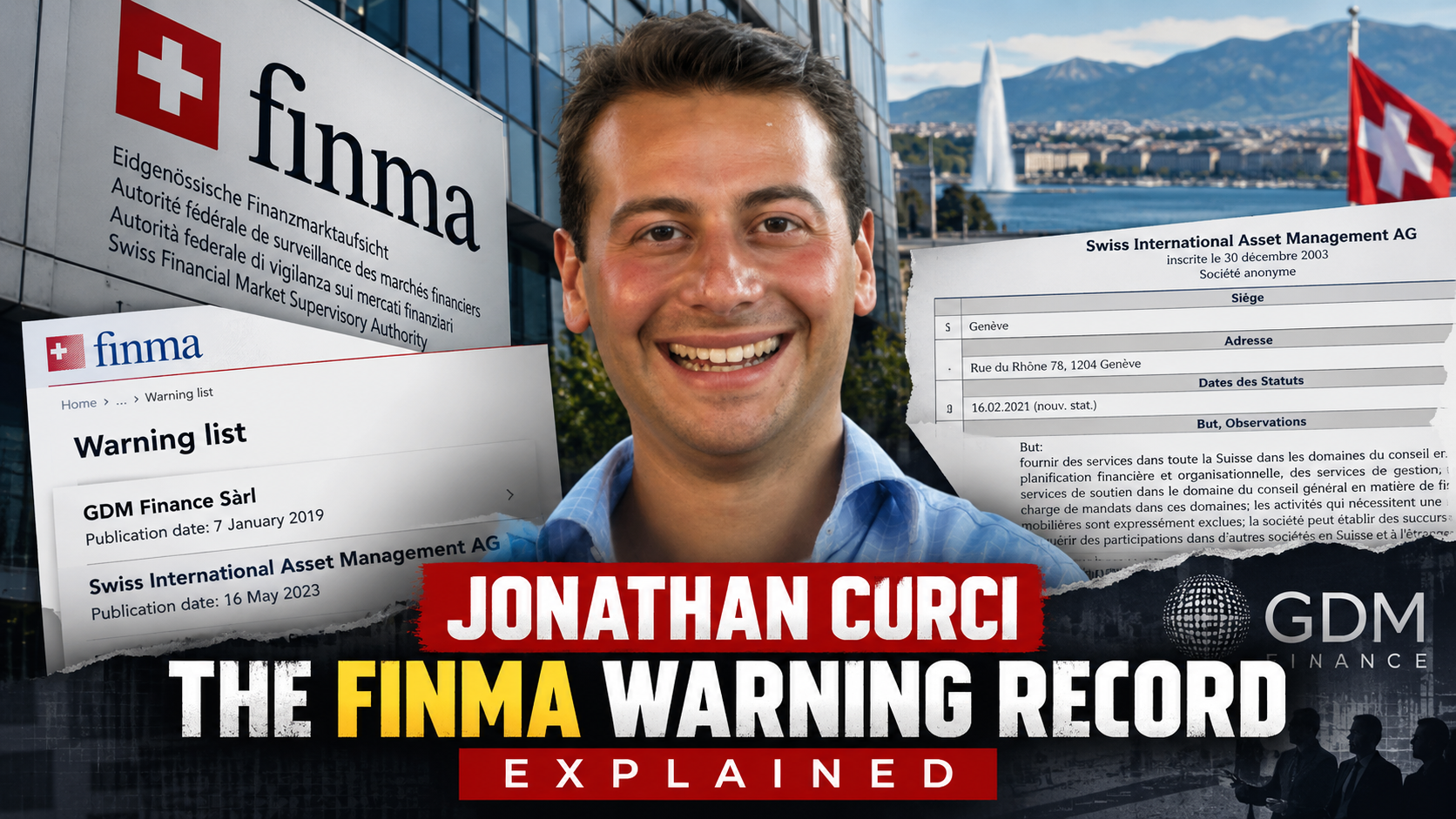
The central controversy begins with GDM Finance Sàrl. FINMA placed GDM Finance on its warning list on January 7, 2019. The regulator’s entry identified the company as being based in Meyrin and listed its website as gdm-finance.ch. FINMA’s warning list is specifically used for companies and individuals suspected of carrying out financial-market activities without the required authorization. FINMA itself cautions that inclusion on the warning list does not automatically establish that an activity was illegal, although it signals that the provider lacked the relevant authorization.
The GDM matter went considerably further in the Philippines. In November 2018, the Philippine Securities and Exchange Commission and police arrested promoters who were soliciting investments for GDM Finance. According to the SEC, a November 24, 2018 presentation in Pasig promoted GDM as an investment opportunity involving New York Stock Exchange preferred shares and promised returns of between 2.5% and 4.5% per week. The SEC said GDM had neither the required authorization to operate as a lending or financing company nor the necessary permit to sell securities in the Philippines. Sixty-four other people were present at the solicitation session, according to the SEC release.
The criminal case later produced convictions, but an important distinction is often lost when the GDM story is summarized. The people convicted were six promoters: Anita Egana Armada, Milany Peligro Cabrera, Josephine Delgado Maranan, Nanette Diaz Tongco, Gerald Lansangan Samson and Jacinto Lucio P. de Catalina. Pasig City Regional Trial Court Branch 158 found them guilty of violating the Philippine Securities Regulation Code and imposed a ₱100,000 fine on each, with subsidiary imprisonment. The SEC said the prosecution established that the securities were unregistered and that material information concerning their status had not been disclosed to prospective investors.
There is no evidence in the sources reviewed that Jonathan Curci was one of those six convicted individuals. In fact, documents published in connection with the later dispute contain evidence pointing in the opposite direction. A letter dated August 8, 2018, reproduced by OffshoreAlert, stated that Curci had been registered that April as GDM Finance’s director with sole signing authority. The letter was addressed to Antonius Kristanto, David Kane and Joe Almond and complained about GDM’s online presence. Curci’s letter said the company’s website had not been authorized by him and contained what he described as false and unauthorized information.
That document is significant because it shows Curci was not merely a name appearing in a corporate database after the controversy. He was formally connected to GDM during part of the period in question, but he also appears to have been raising objections about the company’s activities before the Philippine arrests and before FINMA’s January 2019 warning. That does not, by itself, resolve what Curci knew about GDM’s broader operations or whether his objections were acted upon. It does establish that his position was more complicated than simply being an executive of a company later accused of unauthorized investment solicitation.
A similar issue arose years later with Swiss International Asset Management AG. The Geneva commercial-register extract supplied by Curci shows the company was founded in 2003, had its registered office at Rue du Rhône 78 in Geneva and had a stated purpose covering wealth and investment advice, financial planning and management services. The extract lists Jonathan Curci among its administrators with individual signing authority.
FINMA placed Swiss International Asset Management AG on its warning list on May 16, 2023, identifying the same Rue du Rhône address and the website swissam.ch. OffshoreAlert characterized the warning as relating to suspected unauthorized financial-market activity.
Curci objected strongly to being associated with that warning. In an August 5, 2023 letter to OffshoreAlert, he said he had nothing to do with the company since 2021 and argued that FINMA’s warning had been issued roughly two years after his departure. He also claimed that the website identified by FINMA was not created by the company and said he had participated in an inquiry concerning the people who created it. He threatened legal action in Florida if his name was not removed from the publication.
The corporate record attached to that letter supports an important part of his chronology. The registry extract identifies Curci as an administrator and records a March 11, 2021 publication followed by later corporate changes. It therefore provides documentary support for his claim that his formal relationship with the company changed in 2021. OffshoreAlert itself described him as having ceased being a director 17 months before FINMA’s May 2023 warning.
Swiss International Asset Management subsequently went into liquidation. Its legal name changed to Swiss International Asset Management AG, in Liquidation, in October 2023, and the entity was dissolved in January 2024 according to LEI records; a Swiss registry-derived source records the company as deleted in June 2026.
The broader picture is therefore one of repeated corporate proximity to financial entities that attracted regulatory scrutiny, but not a documented criminal conviction against Curci himself. GDM Finance generated a FINMA warning and a separate Philippine enforcement case that resulted in six promoter convictions. Swiss International Asset Management received a FINMA warning and later entered liquidation. Yet the available material does not establish that Curci was convicted, fined, ordered to pay restitution or personally found liable for either company’s conduct.
That distinction matters. FINMA explains that its warning list is not equivalent to a criminal judgment and that inclusion does not necessarily mean an entity’s activities were illegal. Final rulings, bans and other enforcement measures are separate categories. Likewise, the Philippine convictions cited above concern named promoters rather than Curci.
The other fact that complicates any simple narrative is what Curci did while associated with GDM. His August 2018 correspondence shows him objecting to the company’s website and describing activities he believed were unauthorized. Whether those objections represented a genuine attempt to distance himself from improper conduct, an internal corporate dispute, or something else cannot be established from the public record reviewed here.
Today, Curci remains active in Swiss corporate life. Current registry data place him in Chêne-Bougeries and show continuing roles across finance, fiduciary services, payments, digital currency and healthcare-related companies. JadePay AG, for example, is active and lists him as its board member; Alchemy Pay AG lists him as an authorized signatory; Fidu-Finance continues to list him as its sole manager; and Anagen made him its sole administrator in March 2026. He was also removed from the board of Swiss Quantum Finance AG in July 2026, demonstrating that his corporate network continues to change.
The record therefore does not support the simplest accusation, but neither does it make the regulatory history irrelevant. Curci’s career illustrates why corporate titles, regulatory warnings and personal liability must be separated carefully. A director’s name appearing in a company’s records does not automatically make that person responsible for every subsequent act of the company. At the same time, repeated senior roles in financial and investment-related businesses mean the dates, responsibilities and circumstances of each appointment deserve scrutiny.
For investors and consumers, the practical lesson is straightforward: a company’s registration in a respected financial centre is not the same thing as regulatory authorization. FINMA itself advises the public to verify whether a provider is actually authorized before entering a financial relationship. The Curci record shows why that distinction matters and why the difference between an allegation, a regulatory warning, a criminal charge and a conviction should never be blurred.
Source:
OffshoreAlert
————-
Disclaimer:
Some content on Reportingscams.com is published under our guest post program and is provided by third-party contributors. Reporting scams does not create, verify, or take responsibility for the views, accuracy, or claims expressed in such content.