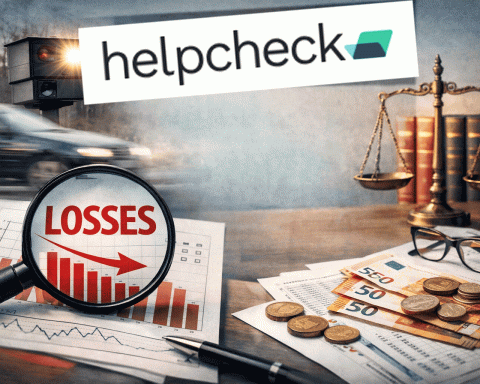
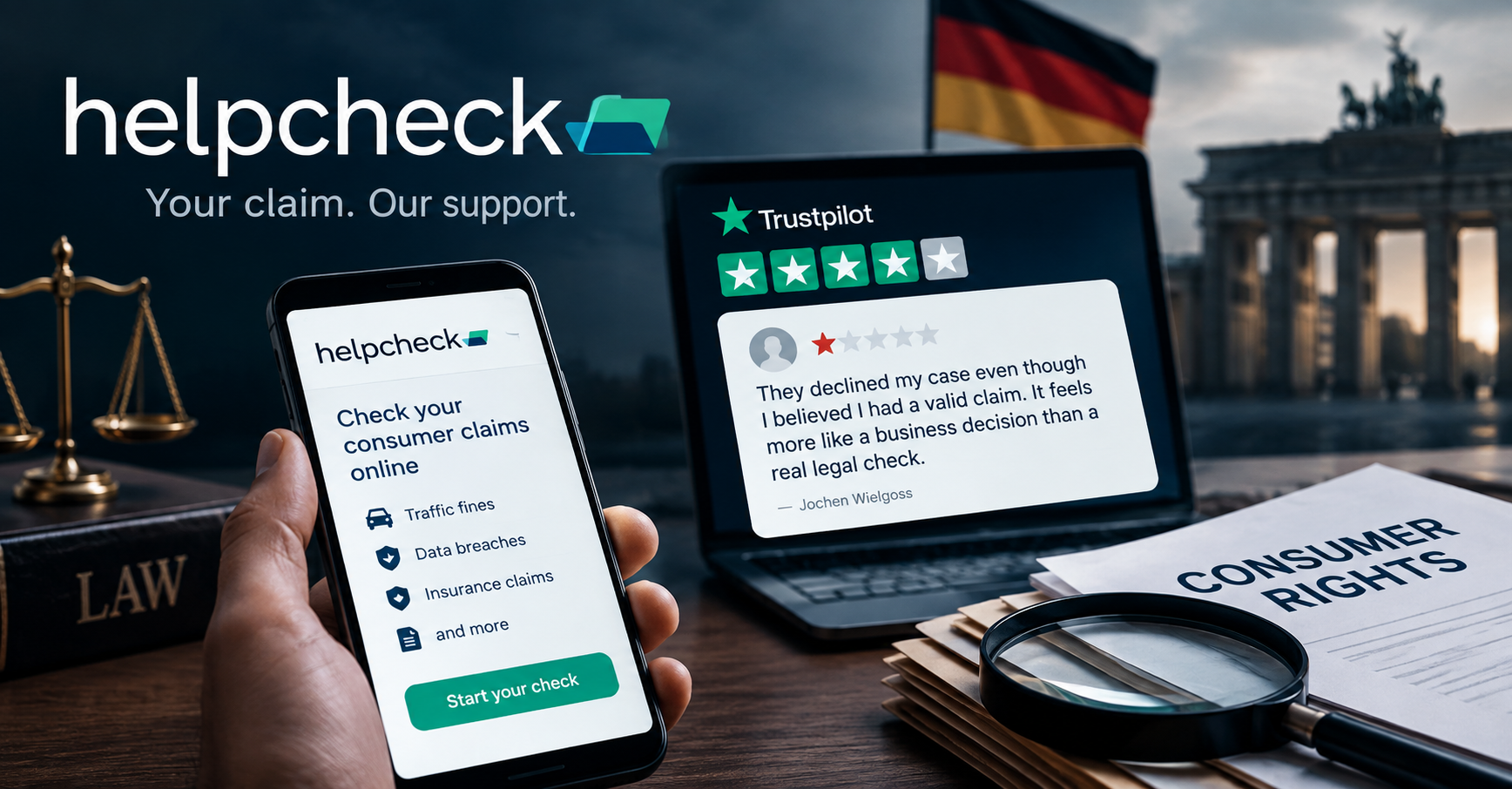
For consumers facing a disputed traffic fine or attempting to challenge an old insurance contract, HelpCheck presents itself as a digital route into the legal system. The Düsseldorf-based platform promises to make consumer claims easier to understand and pursue, working alongside specialist lawyers and offering online checks designed to determine whether a case may have legal potential.
But a closer look at customer reviews reveals a more complicated picture. While the overwhelming majority of reviews are positive, a small number of dissatisfied customers have raised questions about how HelpCheck selects cases and whether the commercial conditions behind its services are always clear to consumers from the beginning.
The company is not an anonymous online operation. HelpCheck GmbH is a registered German company, incorporated in 2016 and listed in the Düsseldorf commercial register. Its official website identifies Phil Sokowicz and Dr. Frank Breitschwerdt as managing directors. The company is also registered as a debt-collection service provider under Germany’s Legal Services Act and is supervised within the applicable regulatory framework.
HelpCheck describes itself as a consumer-rights platform that works with specialist partner lawyers. Its services have included assistance with traffic fines and insurance-related claims, allowing consumers to submit documents digitally and receive an assessment of whether further legal action may be worthwhile.
A Strong Overall Review Record
At the time of review, HelpCheck’s Trustpilot profile showed a strong overall rating. The company had accumulated more than 150 reviews, with the overwhelming majority awarding four or five stars. Trustpilot’s profile also indicated that HelpCheck had responded to all of its negative reviews, although the platform noted that the company generally takes more than a month to respond.
The specific page provided by the reviewer contains numerous positive accounts from customers who praised HelpCheck’s communication, the simplicity of its online process and the perceived professionalism of its staff.
Several reviewers described submitting life-insurance or pension-insurance contracts for examination. Some said that even when HelpCheck ultimately declined to pursue their cases, they appreciated receiving a free assessment and professional advice. Others reported successful outcomes or said they received more money than initially expected after pursuing claims connected with insurance contracts.
One reviewer described the process as transparent and said the company had kept them informed throughout the handling of their case. Another praised the speed of HelpCheck’s communication and the straightforward process for submitting documents online. These accounts help explain why the company has maintained a strong overall rating on the platform.
But the same page also contains a sharply different experience.
When a Consumer’s Case Does Not Fit the Business Model
A one-star review posted by a customer identified on Trustpilot as Jochen Wielgoss raised concerns about HelpCheck’s willingness to pursue cases for consumers who do not have legal-expenses insurance.
The reviewer said HelpCheck declined to continue handling his insurance-related claim because, according to the response he received, his application did not qualify for either the company’s “Kostenairbag” or its “Sofort-Kauf” model.
The message reproduced in the review stated that HelpCheck and its responsible partner law firm assess the anticipated costs, chances of success and potential financial benefit of individual cases. According to the quoted response, a case may need to meet a minimum financial threshold because the costs of potential court proceedings could otherwise be too high.
The customer strongly disagreed with that decision. He questioned why HelpCheck would not proceed with a claim that he personally believed had merit and argued that the company’s marketing gave the impression that consumers with potentially defective insurance contracts could pursue claims more broadly.
That criticism reflects an important distinction that consumers may not immediately recognise. A legal claim having possible merit is not necessarily the same as a case being commercially viable for a claims platform or litigation-financing model.|
The Cost of a “No Financial Risk” Service
HelpCheck’s own current website provides a clearer picture of how that commercial model works.
For certain life-insurance cases, HelpCheck offers a model it calls the “Kosten-Airbag.” If a case qualifies, the company says it will bear the legal and court costs. In return, HelpCheck receives an agreed percentage of the additional financial benefit obtained through the claim if the case succeeds.
According to the company’s published information, the success fee under this model is currently 39.75 percent of the achieved additional benefit. For customers who have legal-expenses insurance, HelpCheck publishes a lower success fee of 29.75 percent of the additional benefit.
This commercial structure provides important context for the negative Trustpilot review.
The dissatisfied customer argued that HelpCheck appeared unwilling to pursue his case without legal-expenses insurance unless there was a realistic prospect of resolving the matter without costly litigation. He suggested that this created an incentive for the company to focus on cases with sufficient financial value and manageable costs.
That is the reviewer’s interpretation, not an established finding of wrongdoing. However, HelpCheck’s own published eligibility information confirms that the economics of a case are relevant to whether the company will finance legal proceedings.
In other words, HelpCheck’s model is not simply based on the question of whether a consumer may believe they have a valid legal argument. The expected financial benefit, litigation costs and prospects of success can also determine whether a case qualifies for the company’s no-cost-risk service.
The Question of Consumer Expectations
This difference between legal eligibility and commercial eligibility appears to be at the centre of the criticism.
HelpCheck’s marketing promotes free checks and the possibility of pursuing certain consumer claims without the customer carrying the immediate financial risk. For many consumers, that can be an attractive proposition, particularly when they would otherwise be unable or unwilling to finance a potentially expensive legal dispute.
However, a no-cost-risk model does not mean that every submitted case will be accepted.
The Trustpilot review suggests that at least one consumer felt this distinction was not sufficiently clear when he first approached the company. He believed his contractual documents contained legal defects but later discovered that HelpCheck’s funding model would not support further action in his circumstances.
Whether that experience resulted from unclear communication or simply from a disagreement about the merits and economics of the case cannot be established from a single review. But it illustrates a broader issue facing LegalTech companies and litigation-financing platforms.
Consumers may approach such services believing that a free legal check is primarily an assessment of their legal rights. In practice, the platform may also be assessing whether the potential claim fits its own commercial and financing criteria.
That distinction can be critical.
Other Reviews Tell a Very Different Story
It would be misleading to focus exclusively on the negative review.
The same Trustpilot page contains numerous positive accounts. Some customers praised HelpCheck even when their contracts were ultimately rejected for further action, saying they valued the free examination and the company’s communication. Others said the process was straightforward, professional and transparent.
This suggests that customer dissatisfaction is not necessarily driven by every rejected case. Instead, expectations may depend heavily on how clearly consumers understand the reasons for acceptance or rejection and what role financial viability plays in the company’s decision-making process.
A separate recent criticism on HelpCheck’s Trustpilot profile raised another consumer concern involving the company’s traffic-fine checker. The reviewer complained about being required to provide a telephone number before seeing the result and subsequently receiving contact attempts. HelpCheck responded that the telephone number could be used to provide a personal assessment and said it regretted any impression that the customer had been contacted without sufficiently clear consent.
Again, this does not establish misconduct. But it demonstrates that questions surrounding case intake, customer contact and the commercial purpose of free online legal checks have appeared in customer feedback.
A Legitimate Legal Business With a Model Worth Understanding
There is no indication from the sources reviewed here that HelpCheck has been found guilty of fraud or subjected to a major public regulatory enforcement action connected to the complaints discussed in these reviews.
The company is registered in Germany, publicly identifies its management and provides information about its regulatory registration as a debt-collection service provider.
Nevertheless, the negative reviews highlight an issue that consumers should understand before submitting a case.
HelpCheck’s service may involve more than determining whether a consumer has a potentially valid legal argument. In cases involving the company’s financing or success-fee models, the potential value of the claim, expected costs and likelihood of success can also influence whether HelpCheck and its partner lawyers decide to proceed.
For consumers, the most important questions may therefore be straightforward. Does the free assessment evaluate only the legal merits of the case, or also its commercial viability? What happens if a potentially valid claim does not meet the platform’s financial thresholds? And how clearly are those criteria explained before a customer submits personal information and documents?
HelpCheck’s Trustpilot record shows that many customers have had positive experiences with the platform. But the small number of critical reviews provide a useful reminder that high overall ratings do not eliminate the need to examine how a business model works behind the marketing language.
For anyone considering HelpCheck, understanding the company’s success fees, case-selection criteria and relationship with partner lawyers may be just as important as reading its headline promises about simple, digital and low-risk access to legal claims.
————-
Disclaimer:
Some content on Reportingscams.com is published under our guest post program and is provided by third-party contributors. Reporting scams does not create, verify, or take responsibility for the views, accuracy, or claims expressed in such content.