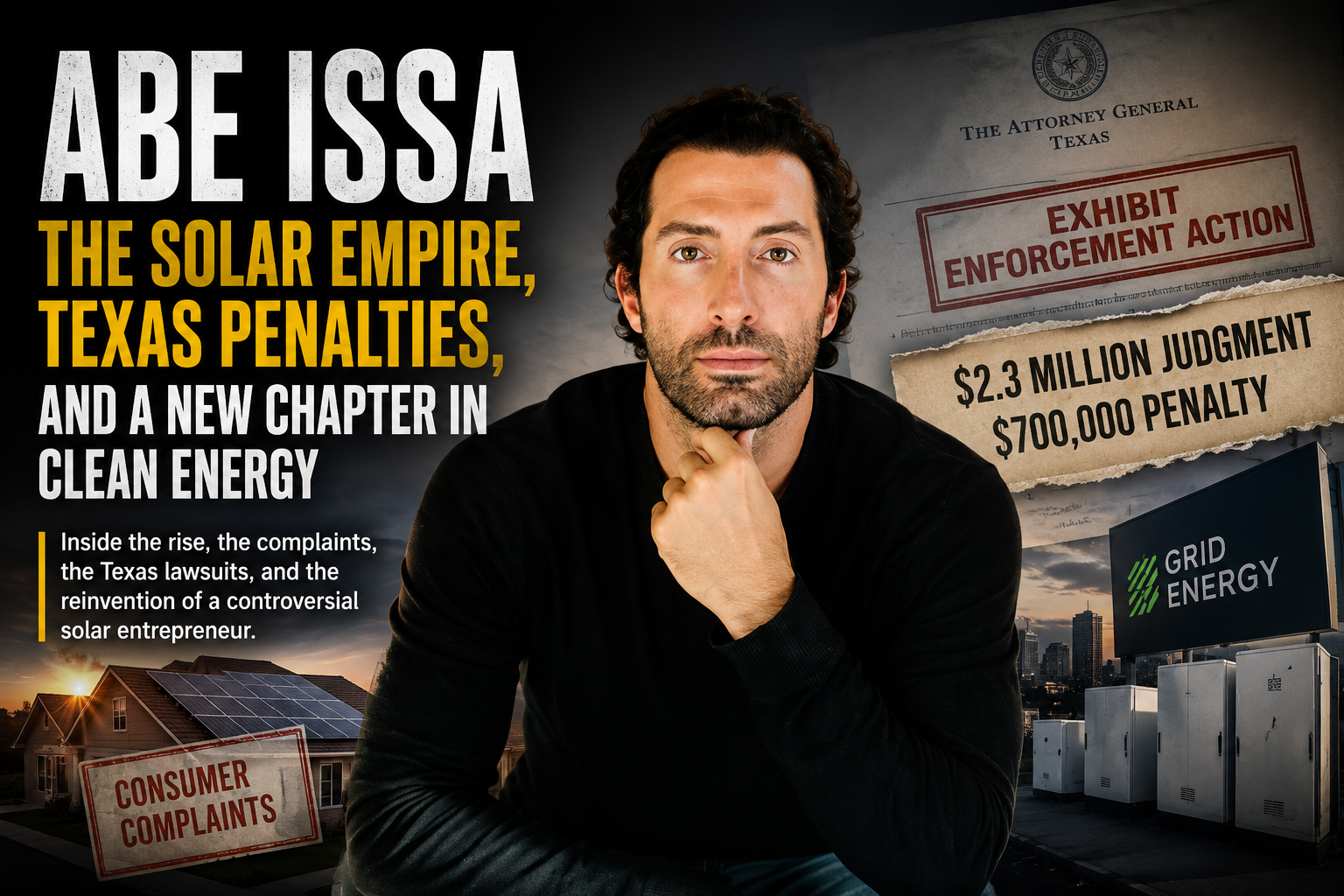
Abe Issa built his public identity around a familiar American entrepreneurial story. He was a young businessman who moved from real estate into energy, embraced the emerging residential solar market and positioned himself as a technology-minded entrepreneur who could help homeowners cut electricity costs while accelerating the transition to cleaner energy. Today, his public-facing businesses describe him as the founder of Grid Energy and a chairman or investor involved with several clean-energy companies. His professional profile continues to emphasize innovation, sustainability and growth.
But the record surrounding Issa’s earlier solar businesses tells a considerably more complicated story. Public records and mainstream reporting show that companies associated with him became the target of two Texas Attorney General lawsuits in 2018. One resulted in a $2.3 million judgment involving several of Issa’s earlier companies, including $1.9 million designated for affected consumers. A second action involving newer companies associated with Issa resulted in a $700,000 payment to the state and the imposition of detailed compliance requirements.
That history matters because Issa has not disappeared from the energy business. He has moved forward under new corporate and commercial identities, and his current public profile is again built around clean energy, smart homes, energy storage and grid technology. Grid Energy describes him as its founder and portrays the company as a developer of energy-storage systems, grid-management technology and solar solutions.
The central question, therefore, is not whether Abe Issa has been successful at building companies. The public record makes clear that he has. The more important question is what happened during the earlier solar expansion, what regulators found, how consumers were affected, how the businesses changed, and whether the lessons of that period remain relevant to the companies and brands associated with Issa today.
This distinction is important. A regulatory settlement is not the same thing as a criminal conviction, and consumer complaints are not automatically proof of wrongdoing. The strongest evidence in this case comes from government enforcement and court-related outcomes, while some newer allegations circulating online remain unproven. Any serious account of Issa therefore has to separate established regulatory action from allegations, complaints and internet commentary.
From real estate to solar
Issa’s own biography says he entered business through real estate. According to his public profile, he earned a finance degree from Texas Christian University and between 2005 and 2010 was involved in redeveloping more than 500 homes and commercial properties in Texas. He subsequently moved toward energy efficiency and renewable energy, eventually building companies around residential solar and related home-improvement services.
By the middle of the 2010s, the story surrounding Issa was overwhelmingly positive. Global Efficient Energy had expanded rapidly and attracted attention from business publications. Issa was presented as a rising entrepreneur and was recognized by Inc. magazine among its “35 under 35.” His companies promoted energy efficiency and solar power at a moment when residential renewable energy was entering a period of rapid growth.
The business model was straightforward on paper. Sales representatives approached homeowners with promises of energy savings and improvements to their homes. Solar panels, insulation and other energy-efficiency products could be bundled into projects that were financed over time. The appeal was obvious. A homeowner could make an environmental investment while supposedly reducing the monthly cost of electricity.
But residential solar is unusually dependent on the quality of the sales process. The customer is often asked to sign a long-term financing agreement based on projections about future electricity production and savings. If the projections are inaccurate, the customer can be locked into years of payments while the promised savings fail to materialize.
That was precisely where the problems surrounding Issa’s earlier businesses began to emerge.
The complaints behind the collapse
By 2016, the image had changed dramatically. The Dallas Morning News reported that Global Efficient Energy had gone from a rapidly expanding company to one that had received an F rating from the Better Business Bureau. The newspaper described a pattern of complaints involving high-pressure sales representatives, aggressive claims about savings, projects that were delayed or poorly completed and customers who said the promised financial benefits never appeared.
The newspaper reported that some sales pitches had promised customers savings of roughly 40 percent. Complaints alleged that sales representatives made extravagant claims about how much homeowners could save through combinations of solar power, insulation and other improvements. When the promised savings failed to appear, some customers said they struggled to obtain answers or resolve the problem.
Issa did not simply deny that problems existed. In a 2016 interview with The Dallas Morning News, he acknowledged that sales practices had become a problem and said he had instructed salespeople to stop promising that electric bills would fall dramatically. He attributed some of the problem to independent sales representatives working on commission and acknowledged that the company had not exercised enough control over them.
That admission is significant because it provides a direct statement from Issa rather than an allegation made by a critic. It also foreshadowed the regulatory requirements that would later be imposed on his newer businesses.
The underlying issue was not simply whether solar technology worked. Solar panels can generate electricity and can reduce utility purchases under the right circumstances. The regulatory and consumer controversy instead centered on how the products were sold, what customers were told, what savings were represented and whether the completed projects delivered what customers had been led to expect.
The Texas Attorney General steps in
The most consequential part of Issa’s history came in 2018, when the Texas Attorney General’s office brought two separate actions involving companies associated with him.
According to The Dallas Morning News’ 2020 Watchdog investigation, the first lawsuit targeted Global Efficient Energy, Energy Stars, Global NRG, Fort EPC and Solar Pow. The companies entered into an agreement under which they were prohibited from doing business in Texas and agreed to a $2.3 million judgment. Of that amount, approximately $1.9 million was designated for consumers who had been harmed.
This was not simply an adverse review or a private customer dispute. It represented government enforcement action culminating in a formal monetary judgment and restrictions on the companies’ ability to operate in the state.
The second Texas action concerned newer companies, including EnviroSolar, E-Grid Tech, EnviSolar, Next Step Energy and KMA Investments. According to the Dallas Morning News account, Issa agreed to pay the state $700,000 and accepted stringent compliance requirements governing the way customers would be sold solar and energy products.
Taken together, the two actions involved approximately $3 million in monetary obligations. But the money is only part of the story. The compliance requirements are perhaps more revealing because they show what regulators considered necessary to prevent the same problems from recurring.
The newer businesses were required to establish stronger sales controls, including procedures designed to make sure customers understood the terms of their purchases and financing. The company told the Dallas Morning News that every customer would go through quality-control procedures and that sales calls would be recorded to confirm understanding of financing and project details.
In other words, the response was not merely “pay a fine and move on.” The regulatory response sought to change the sales process itself.
That distinction is critical when evaluating the allegations against Issa. It is much stronger to say that Texas authorities obtained monetary judgments and imposed restrictions and compliance obligations than to casually describe Issa as having committed “fraud” or being a “criminal.” The public material reviewed for this article supports the former characterization. It does not establish a criminal conviction against Issa personally.
What the regulatory record says about the sales model
The allegations surrounding the earlier companies followed a recognizable pattern. Consumers said they were promised savings that did not materialize. Others complained about contracts, refunds, installation quality and the difficulty of getting problems resolved.
The Investigations.org report reviewing Issa’s history identifies four recurring complaint themes: disputed savings projections, difficulties cancelling contracts, aggressive door-to-door solicitation and systems allegedly producing less than customers expected. The report also emphasizes that complaints are not themselves adjudicated findings and that some of its more specific claims require independent verification.
That caveat matters. Consumer complaint websites can reveal patterns, but they cannot substitute for a court judgment or regulator finding. At the same time, dismissing complaints altogether would also be misleading when the complaints form part of a larger record that eventually resulted in government enforcement.
The Dallas Morning News reporting provides an important bridge between the two. Its 2016 article described the complaints before the 2018 litigation, while its 2020 Watchdog report documented the government’s enforcement actions afterward.
The sequence therefore looks less like an isolated dispute and more like a business that experienced rapid expansion, accumulated consumer dissatisfaction, attracted government scrutiny and ultimately entered settlements and judgments requiring both financial payments and changes in operating practices.
The corporate name problem
One of the most interesting aspects of the Issa story is the number of companies associated with different phases of the business.
The Better Business Bureau’s profile for Fort EPC lists Global Efficient Energy LLC and several alternate names, including Energy Stars, Global NRG, Worth Electric and Solar Power. It also identifies Abe Issa as owner and lists EnviroSolar as a related business. The BBB profile now carries an out-of-business alert.
Florida corporate records provide another piece of the puzzle. A state filing identifies Global Efficient Energy LLC as a foreign limited liability company, lists Abe Issa as manager and records the entity as inactive after being revoked for failure to file an annual report.
None of this, by itself, establishes that corporate restructuring was designed to evade liability. Businesses routinely close, merge, rename entities or reorganize operations for legitimate reasons. The Investigations.org report itself warns that a complete corporate genealogy requires additional state-by-state secretary-of-state research.
Still, corporate continuity is an important investigative question. When a company becomes associated with significant consumer complaints and regulatory action, journalists should establish exactly which entity contracted with customers, which entity employed salespeople, which entity received payments, which entity performed installations and which entity assumed obligations after a reorganization.
That work is particularly important in the solar industry because a homeowner may sign a financing agreement with one company, purchase equipment from another and deal with an installer operating under yet another brand.
For Issa, the public record clearly shows multiple names across different stages of his business career. It does not, however, establish that every company bearing a connection to him is legally the same enterprise.
The 2020 Watchdog reckoning
In January 2020, Dallas Morning News columnist Dave Lieber published a Watchdog article with a striking description of Issa’s trajectory, portraying him as a former “shining star” of the solar industry who had become tied to penalties. The article contrasted his earlier awards and business recognition with the enforcement history involving his companies.
By then, the regulatory history was no longer theoretical. The newspaper reported the $2.3 million judgment involving the earlier companies, the $1.9 million consumer allocation and the separate $700,000 payment associated with the newer companies.
The article also reported that Issa could not be reached for comment despite attempts to contact him, although representatives of the newer business defended its compliance program. Those representatives said customer agreements were reviewed and sales calls were recorded.
The contrast was hard to miss. A businessman once celebrated for rapid growth now operated under a system of compliance controls that had been imposed after regulatory intervention.
That contrast is arguably more revealing than the headlines themselves. The case illustrates a recurring problem in fast-growing consumer industries: awards, revenue growth and expansion can create a perception of success that says little about whether individual customers are being treated fairly.
The move toward EnviroSolar and clean energy branding
Issa’s career did not end with the Texas enforcement actions. His public biography describes a transition toward broader clean-energy ventures. A 2021 company-issued announcement said EnviroSolar had been founded by Issa in 2016 and described the company as a provider of solar, smart-home and security solutions. It also said the company had expanded nationally and employed thousands of people. Those claims came from the company itself and should therefore be treated as corporate promotional statements rather than independently audited facts.
The same promotional material shows how Issa’s public narrative evolved. The emphasis moved beyond selling individual solar installations toward sustainability, technology, electric vehicles and broader clean-energy solutions. That evolution is commercially understandable. It also makes the distinction between the old and new businesses important.
There is a temptation in online commentary to treat every later Issa company as simply another name for Global Efficient Energy. The available evidence does not justify that blanket conclusion.
What can be established is that Issa continued operating in the clean-energy sector after the Texas actions and became associated with new companies and investment activities.
Grid Energy and the new chapter
Today, Issa’s public identity is closely tied to Grid Energy. The company’s website identifies him as its founder and describes a business focused on energy storage, intelligent grid management and solar solutions. Issa’s own website similarly describes him as founder and chairman of several clean-energy portfolio companies.
The modern business narrative is considerably more sophisticated than the door-to-door residential solar model that generated controversy a decade ago. The language now centers on grid modernization, energy storage, technology and expanding access to clean energy.
In August 2024, Business Wire carried an announcement concerning Intelli Smart Homes’ appearance on the Inc. 5000 list. The announcement described Issa as founder of Grid Energy and an investor and adviser to Intelli Smart Homes. It said Intelli Smart Homes had achieved 250 percent three-year growth and operated smart-home services in 16 states.
Issa’s own website continues to promote the same growth narrative. It describes Grid Energy as a clean-energy company creator and says its portfolio companies have received Inc. 5000 recognition.
That means the story is not one of an entrepreneur who vanished after regulatory trouble. It is a story of reinvention.
And that makes the old regulatory record more relevant, not less.
The newer DMCA allegations
There is another, much more recent controversy that requires especially careful treatment.
Several websites have alleged that copyright takedown notices were used to suppress negative material about Issa in 2025. CyberCriminal.com says it identified a series of alleged DMCA notices associated with companies including Warner International Ltd. and lists several Lumen Database notice numbers and dates between March and May 2025.
Other websites have gone further, alleging that entities used in the notices were fabricated or that copied articles were used to create the appearance of copyright ownership. Those allegations are serious, but the material available publicly does not establish that Issa personally created, authorized or submitted the notices.
That distinction should be maintained in any publication.
The existence of a DMCA notice is verifiable. The identity of the person behind a notice is a separate factual question. Establishing personal responsibility would require evidence such as filing metadata, correspondence, corporate records, sworn testimony, admissions or other primary documentation linking Issa to the alleged conduct.
The Investigations.org report also treats the newer digital-reputation claims cautiously and identifies limitations in its source verification.
For a journalist, the appropriate formulation is therefore that third-party investigators have alleged an organized takedown campaign involving material about Issa, while publicly available evidence reviewed here does not establish personal criminal responsibility by Issa for those notices.
That is materially different from stating that Issa committed fraud or perjury.
What is proven and what remains allegation
The evidence surrounding Issa falls into several distinct categories.
The strongest category is government enforcement. Two 2018 Texas Attorney General actions involving companies associated with Issa resulted in a $2.3 million judgment concerning the older entities and a $700,000 payment and compliance requirements involving newer entities. Those outcomes are reported by The Dallas Morning News and form the core of the documented regulatory record.
The next category is consumer complaints. Those complaints describe alleged misleading savings projections, contract problems, installation disputes and difficulty obtaining refunds. The complaints are relevant because they preceded and accompanied regulatory intervention, but individual complaints should not be treated as judicial findings.
The third category is corporate restructuring. Public records confirm multiple entities and names associated with the businesses. What remains unresolved is the full legal and financial genealogy of those companies and the precise relationship between every successor entity and the earlier businesses.
The fourth category is the 2025 DMCA controversy. There is evidence that takedown notices were filed and that online investigators have linked them to material concerning Issa. But the available evidence does not establish beyond dispute that Issa personally directed or filed the alleged notices. That remains an allegation requiring further primary-source investigation.
Finally, there are numerous websites that describe Issa as a “scammer,” “fraudster” or similar terms. Those descriptions should not be repeated as established fact unless supported by a court finding or authoritative regulatory determination. Several of these sites rely heavily on one another, making source independence particularly important.
The chronology tells the story
The timeline is revealing. Around 2012, Issa’s solar operations were expanding in Texas. By 2015, he was receiving recognition as a rising entrepreneur. By 2016, major media were documenting serious consumer complaints and the collapse of Global Efficient Energy’s BBB standing. In 2017, complaints continued. In 2018, Texas authorities initiated major enforcement actions. By 2019, monetary penalties and compliance requirements were in the picture. In January 2020, the Dallas Morning News published its Watchdog account bringing the history together.
The next phase involved continued energy-sector activity under newer brands and companies. Issa’s public profile gradually shifted away from the controversy surrounding the old residential solar operation and toward clean technology, smart homes, energy storage and grid modernization. His current business materials emphasize these newer activities.
This chronology matters because it prevents two opposite mistakes.
The first mistake would be to portray Issa as a businessman who was always a fraud. The available record does not establish that.
The second would be to portray the regulatory history as irrelevant because Issa later moved into new clean-energy ventures. That is also too simplistic.
A more accurate conclusion is that Issa built a significant solar-sales operation, that the operation became the subject of extensive consumer complaints, that Texas regulators brought two major actions against associated companies, that those actions resulted in substantial monetary obligations and operating restrictions, and that Issa subsequently continued building businesses in the broader clean-energy industry.
Where Abe Issa stands now
As of the latest publicly available information reviewed for this article, Issa remains publicly active in the U.S. clean-energy sector. His professional profile identifies him with Grid Energy Group, and Grid Energy’s website continues to identify him as founder. His personal website describes him as founder and chairman of clean-energy portfolio companies.
There is no reliable public evidence in the sources reviewed here establishing that Issa is currently serving a criminal sentence, has been criminally convicted in connection with the solar controversy or has been prohibited personally from working in the clean-energy industry.
That point is worth emphasizing because online accusations frequently blur the distinction between corporate enforcement and personal criminal liability.
The Texas cases were serious. They involved companies associated with Issa, millions of dollars and restrictions on business activity. But describing the matter as a criminal conviction against Issa would overstate the record.
The same caution applies to the newer allegations about online reputation management and DMCA notices.
The unanswered questions
The most important unanswered questions are now less about whether Issa’s old businesses faced regulatory trouble. That is established. The deeper questions concern continuity.
How much ownership and control did Issa retain across the different entities? Which assets, employees, contracts and customer relationships moved from the old companies into newer businesses? Were outstanding consumer obligations transferred, settled or abandoned? What exactly happened to the approximately $1.9 million intended for consumers under the Texas judgment? And how much of the newer corporate structure is legally connected to the entities that faced enforcement?
Those questions require primary-source corporate filings, court records, settlement documents and, ideally, interviews with former employees, regulators and affected customers.
The Investigations.org report itself identifies several of these information gaps. It specifically notes that the complete corporate genealogy requires additional secretary-of-state research, that certain penalty details require regulator-by-regulator confirmation and that current operational status cannot be independently verified from all available records.
Those limitations should remain part of the story rather than being hidden.
The larger lesson
Abe Issa’s story ultimately illustrates a broader problem in the consumer clean-energy market.
Solar power is often sold through a promise about the future. The customer signs today based on projections about electricity prices, system production, tax incentives, financing costs and long-term savings. That creates a powerful information imbalance between salesperson and homeowner.
The Texas enforcement actions show what can happen when aggressive sales growth outruns compliance controls. The regulatory response attempted to address that imbalance by requiring greater transparency and documentation.
Issa’s later career shows the other side of the story. Entrepreneurs can survive regulatory setbacks, reorganize their businesses and build new companies around emerging technologies. A regulatory settlement does not necessarily end a business career.
But neither does a new brand erase an old record.
For customers, investors and business partners evaluating Issa today, the sensible approach is neither to accept promotional claims at face value nor to accept internet accusations as established fact. The relevant history is more nuanced. Issa is an experienced entrepreneur with a long record in energy and technology, but companies associated with him also faced substantial regulatory enforcement over consumer sales practices.
That history is part of the public record.
The challenge now is determining whether the businesses built after that period represent a genuine change in operating practices or simply the next chapter under a different corporate identity.
For an investigative journalist, that is where the story should continue.
Editorial note: This article distinguishes documented government enforcement, court-related outcomes and established corporate records from consumer allegations and newer online claims that remain unproven. The $2.3 million judgment and $700,000 payment described above concern companies associated with Abe Issa; they should not automatically be characterized as a personal criminal judgment against Issa. The 2025 DMCA allegations likewise require further primary-source verification before personal responsibility can be attributed to him.
————-
Disclaimer:
Some content on Reportingscams.com is published under our guest post program and is provided by third-party contributors. Reporting scams does not create, verify, or take responsibility for the views, accuracy, or claims expressed in such content.