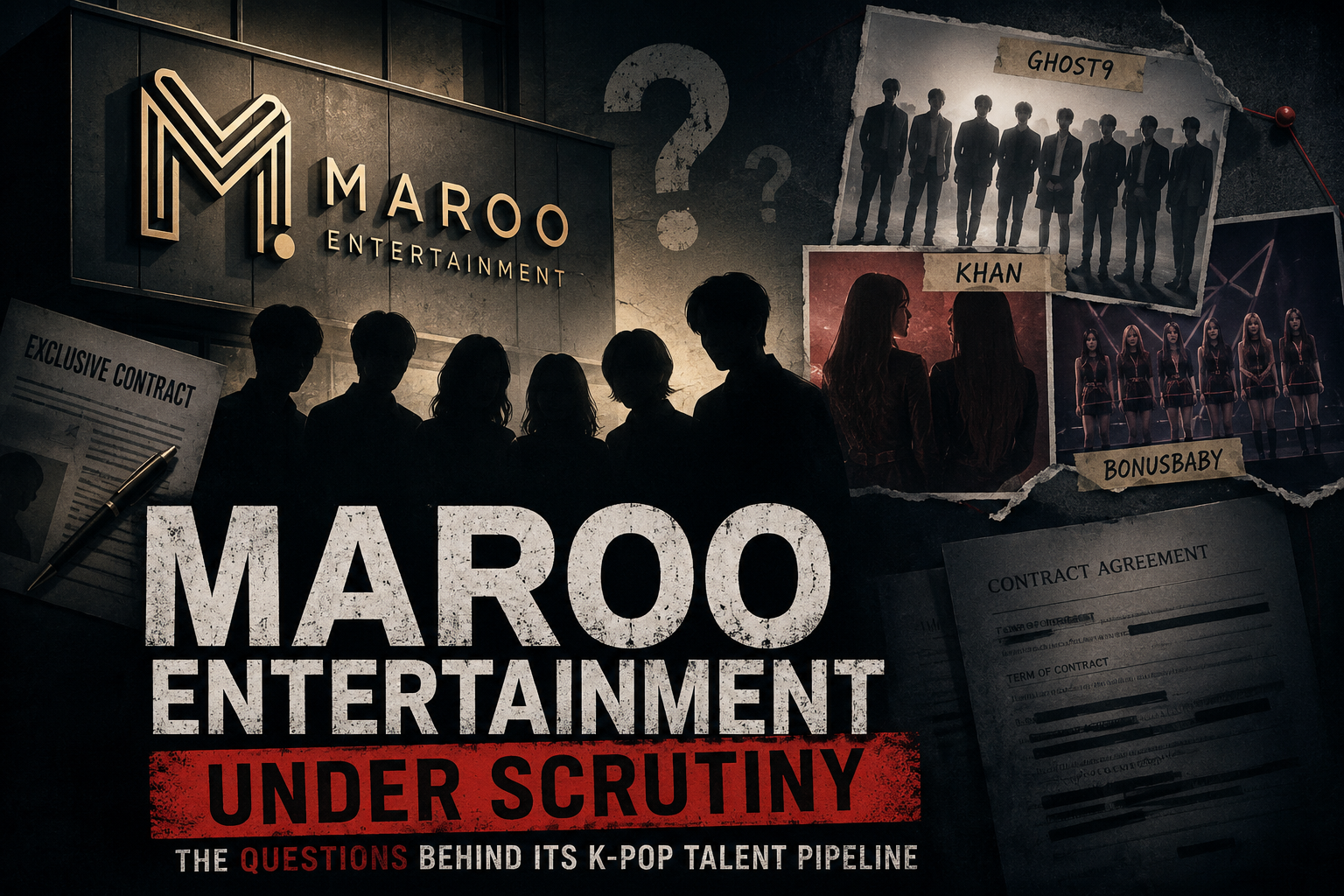
Maroo Entertainment is not one of the names that immediately dominates conversations about South Korea’s entertainment industry. It does not have the global scale of HYBE, SM Entertainment or JYP Entertainment, nor does it possess the seemingly endless roster associated with the country’s largest agencies. Yet for more than a decade, Maroo has occupied an important place in the industry’s second tier, repeatedly introducing trainees, actors and idol groups to the public and promising them a path toward professional careers. The company has also managed artists who became widely recognizable, most notably Park Ji-hoon, whose rise through Produce 101 Season 2 turned him into one of the show’s biggest stars. But alongside those successes is another, less flattering story: a succession of projects that stalled, groups that disappeared after remarkably short careers, contract questions, and growing criticism from fans about the way the company has managed the people who placed their careers in its hands.
None of those issues, individually, proves misconduct. The Korean entertainment industry is notoriously unforgiving, and failed groups are hardly unusual. What makes Maroo worth examining is the repetition. Over the years, the company has repeatedly demonstrated an ability to put talent on a stage, but the more difficult question is what happens after the debut, after the survival show, and after the initial publicity disappears.
The company officially became an independent legal entity in July 2010, although its roots in the Korean music business go back further. Over the following years, Maroo assembled a roster that included singers, actors and aspiring idols. It launched 1PS in 2014, MyB in 2015 and BONUSbaby in 2017 before later debuting KHAN, TEEN TEEN and GHOST9. It also signed established names including Kim Jong-kook and actor Ha Seok-jin at different points in its history. On paper, that record suggests a company actively searching for talent across multiple corners of the entertainment business.
The company’s most significant breakthrough came through Park Ji-hoon. Before Produce 101 Season 2 had even finished, Maroo confirmed that it had already signed the trainee to an exclusive contract. The announcement triggered an immediate reaction because fans were accustomed to trainees operating under trainee agreements rather than entering a full exclusive arrangement before their debut was secured. Reports at the time described the contract as having a seven-year term, while Maroo defended its approach by explaining that, unlike larger agencies that train large numbers of people and select only a handful for debut, it preferred to sign trainees it genuinely intended to debut. The company declined to disclose the detailed terms.
That distinction matters. There was no finding in those reports that Maroo had done anything illegal, and the company explicitly described the arrangement as a standard contract for an agency of its size. But the controversy revealed an uncomfortable imbalance that exists throughout the idol industry: the trainee may be young, inexperienced and desperate for a debut, while the agency controls the contract, training, promotion and access to the market. When the company holds that much leverage, even a contract described as “standard” can become a source of concern when its duration and scope are not transparent to the public.
Park Ji-hoon’s story ultimately became a success story for Maroo. He finished second on Produce 101 Season 2 and joined Wanna One, while his popularity exploded during the program. In that sense, Maroo’s decision to sign him early proved commercially valuable. But Park’s success also created an unusually favorable comparison point for everything that followed. A company can point to a major star as evidence that its talent-development model works. The harder question is whether the same system consistently produces sustainable careers for the people who do not become national sensations.
That question becomes particularly uncomfortable when looking at Maroo’s girl groups. BONUSbaby debuted in January 2017, but by September 2018 the company announced that member Kongyoo would leave to focus on her studies and that the group would enter a hiatus. Maroo said the decision followed discussions with Kongyoo and cited the members’ future plans and studies among the factors behind the hiatus. The announcement was not presented as a scandal. It was a routine corporate statement explaining a change in an artist’s career. Yet BONUSbaby would never develop into the sustained group that its debut suggested it might become. Its profile was later removed from Maroo’s website, and the group is generally regarded as having ended after its prolonged inactivity.
KHAN offers an even more revealing case because one of its members later spoke publicly about what happened. Euna Kim and Jeon Min-ju, both former members of The Ark, debuted as KHAN under Maroo in May 2018. The group had an unusually strong creative pedigree for a small agency project: its debut song was written by Black Eyed Pilseung. Yet the expected follow-up never arrived. In a later interview, Euna Kim explained that the group had initially expected to prepare another release almost immediately after debut. Instead, difficulties finding the right follow-up song and concept caused the comeback to be repeatedly delayed. Eventually, the delay became an indefinite hiatus.
The financial consequences of that inactivity were particularly striking. Euna said she had little money during the period and wanted to work, but that the company would not allow her to take a part-time job because of concerns about the company’s image. She eventually went to the United States and decided to remain there. That account does not by itself establish a contractual violation, but it provides something that fan complaints often lack: a first-hand description from an artist of what prolonged inactivity meant in practical terms. A comeback being delayed is not simply a marketing problem when the artist’s income, employment options and future are tied to the agency’s decisions.
The same pattern appears in the company’s later idol projects, although the circumstances differ. TEEN TEEN debuted in 2019 with three trainees who had appeared on Produce X 101. GHOST9 followed in September 2020, initially built around a larger lineup that included members associated with the earlier project. GHOST9 did achieve considerably more visibility than some of Maroo’s earlier groups, but its members have also become a recurring subject of online discussion about the company’s management.
One particularly revealing example came from GHOST9 member Prince. In 2024, his social-media videos attracted attention because he joked that his personal content was performing better than the material produced by his company. The comments were humorous and should not be treated as a formal allegation of misconduct, but they resonated with fans precisely because they fit an existing narrative about Maroo’s promotional shortcomings. By late 2025, online discussions around Prince had expanded further, with fans highlighting his jokes about the company’s finances, his living and working conditions and issues surrounding his work visa. These are social-media claims and should be treated as such, not as independently established corporate facts.
Still, the persistence of the criticism is significant. An entertainment agency survives on perception as much as contracts. Fans are often the first people to notice when promotional schedules disappear, social-media accounts go quiet, artists stop appearing in official content or promised projects fail to materialize. Their commentary cannot substitute for court records or regulatory findings, but it can point journalists toward patterns that deserve verification.
This is also where the recent JTBC investigation into so-called “academy-style entertainment agencies” becomes relevant but only as industry context. JTBC reported on a company that allegedly recruited aspiring actors through audition advertisements before presenting them with two-year contracts and demanding ₩4.4 million in supposed joint investment and education fees. One applicant told the broadcaster that, after paying, he received primarily acting instruction rather than the career opportunities he believed he was signing up for. The report also said that three civil cases had resulted in first-instance judgments ordering the company to return the money and that police had begun investigating the business.
There is an important line that should not be crossed here: the JTBC report does not identify Maroo Entertainment as the company involved, and there is currently no reliable evidence establishing that connection. The ₩4.4 million figure, the two-year contract and the academy-style structure therefore cannot legitimately be presented as a Maroo scandal. Doing so would turn an investigative article into an unsupported accusation.
The relevance is instead about the broader power structure of entertainment recruitment. An audition is presented to an aspiring artist as an opportunity. A trainee contract is presented as an investment in a future career. An agency promises training, management, promotion and access to opportunities that an individual could not obtain alone. The aspiring artist, meanwhile, is usually the party with the least information and the least bargaining power. That is precisely why questions surrounding contracts, training, promotion and career development matter so much when assessing smaller entertainment agencies.
Maroo’s own history illustrates the difference between signing talent and successfully developing it. The company has repeatedly found contestants through major audition and survival programs, turning television exposure into recruitment opportunities. Park Ji-hoon became a major success. TEEN TEEN was formed from Produce X 101 contestants. GHOST9 was built partly around contestants already known to survival-show audiences. That model can produce immediate attention because the agency is not starting with completely unknown faces. But television exposure is temporary. Once the show ends, the agency has to convert that attention into music, promotion, appearances and a sustainable fan base.
That conversion is where Maroo’s record becomes harder to defend purely on the basis of individual success stories.
The company’s corporate history also changed significantly in 2022. IHQ acquired a 47.14 percent stake in Maroo Entertainment, bringing the agency into a larger media and entertainment ecosystem. The transaction offered the possibility of stronger infrastructure and broader access to media resources. For a company whose critics had repeatedly focused on management and promotional limitations, outside investment could have represented a reset.
But ownership changes do not automatically erase an agency’s past. The central question remains whether artists experience a meaningful improvement in the way their careers are managed.
That is ultimately why Maroo’s story deserves scrutiny. It is too easy to portray the company either as a villain or as an unlucky small agency. The evidence supports neither extreme. There are no grounds here to claim that Maroo operated the business described in the JTBC investigation. There is also no basis for treating Reddit discussions as proof of systematic abuse. But there is enough documented history to ask harder questions about the company’s approach to talent development.
Park Ji-hoon’s seven-year exclusive contract created questions about how early and how tightly young talent could be bound to an agency. BONUSbaby’s abrupt transition from debut to hiatus demonstrated how quickly a group’s prospects could disappear. Euna Kim’s account of KHAN showed the personal consequences when a comeback remained indefinitely delayed. And the continuing online criticism surrounding GHOST9 suggests that concerns about Maroo’s management have not entirely disappeared with time.
The uncomfortable conclusion is not that Maroo failed to create stars. It did create stars.
The uncomfortable conclusion is that creating one successful artist does not answer what happened to everyone else.
An entertainment company is not judged solely by the moment a trainee becomes famous. It is judged by what it does with the people who never become famous immediately, the groups whose first release underperforms, the artists waiting for their second album, and the trainees whose television exposure gives them an opportunity that may disappear within months.
Maroo has spent years selling the possibility of that opportunity.
Its record raises a more difficult question: how many careers did that opportunity actually become?
That is the question worth investigating now — not through fan rumors, not through guilt by association with unrelated companies, and not by recycling old controversies, but through contracts, corporate records, court documents, artist interviews, release histories and the company’s own explanations for every stalled career.
Because the real story behind a K-pop agency is rarely the debut.
It is what happens when the cameras stop rolling.
————-
Disclaimer:
Some content on Reportingscams.com is published under our guest post program and is provided by third-party contributors. Reporting scams does not create, verify, or take responsibility for the views, accuracy, or claims expressed in such content.