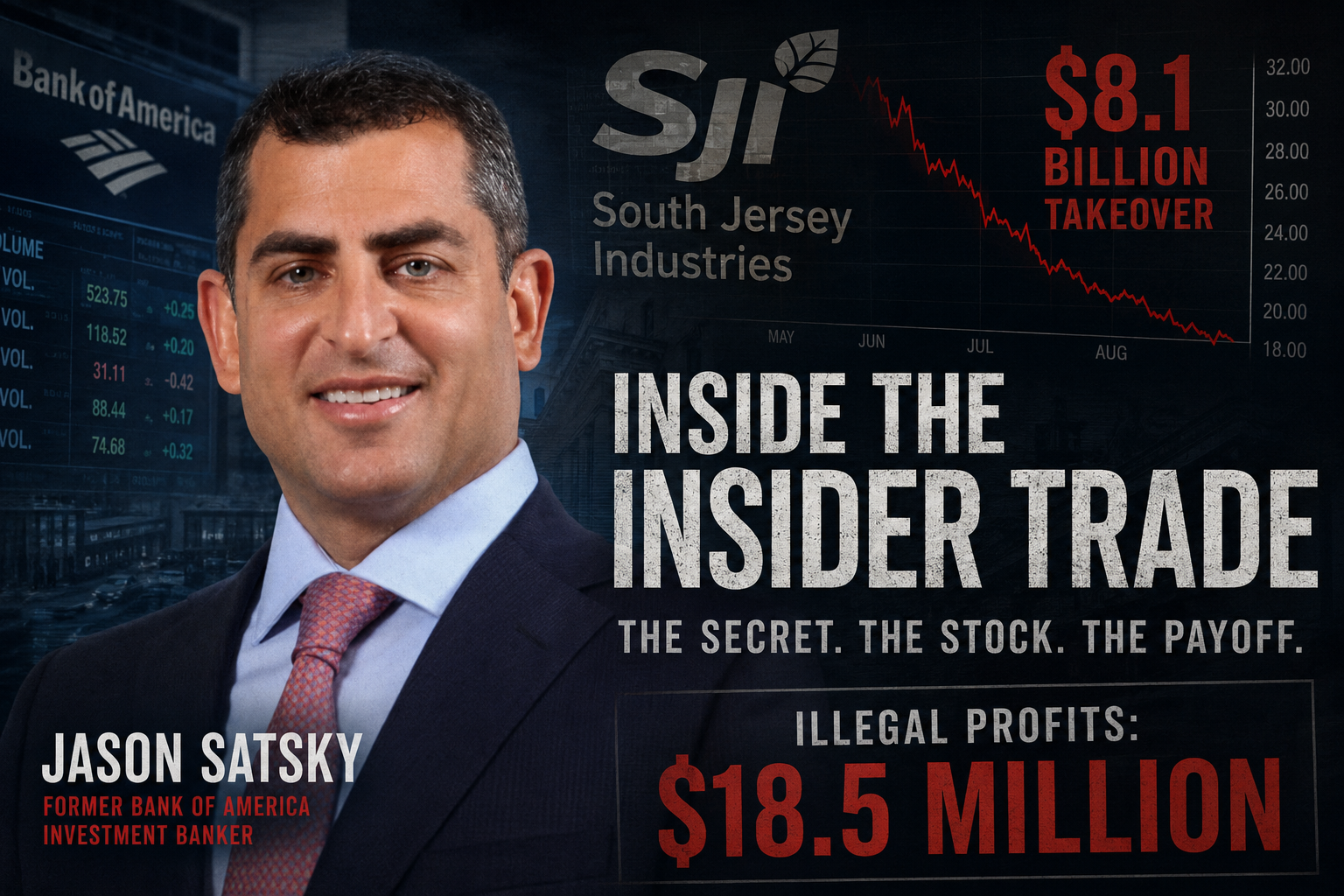
The case against former Bank of America investment banker Jason Satsky and his longtime friend Gavin Wolfe is built around a deceptively ordinary setting: a college basketball game, a few conversations between longtime friends and a stock purchase that would eventually generate millions of dollars.
According to the U.S. Securities and Exchange Commission, those details form the backbone of an insider-trading case involving South Jersey Industries, an $8.1 billion takeover and roughly $18.5 million in trading gains. The SEC filed its civil complaint in Manhattan federal court on August 21, 2026, accusing Satsky and Wolfe of violating federal securities laws. Neither man has been found liable, and both have denied the allegations.
Satsky, whose full name is Jason Mitchel Satsky, was a senior Wall Street investment banker with decades of experience in the energy and infrastructure sector. He worked at Salomon Smith Barney, Wasserstein Perella and Credit Suisse before joining Bank of America in 2012. At Bank of America, he eventually became global head of power, utilities and energy infrastructure investment banking. The SEC says he was the lead banker advising South Jersey Industries on a potential sale. FINRA records show that Satsky is no longer registered as a broker and was last registered with BofA Securities through March 2025.
Wolfe, identified in public records as Gavin H. Wolfe, followed a similarly established path through energy investment banking. The SEC says he was a registered representative from 1993 through 2016 and worked alongside Satsky as a managing director in the global energy and power group from 2012 until his retirement from investment banking in 2016. He subsequently managed his own investments and businesses, including Evergreen Capital and related entities. Public professional profiles identify him as managing partner of Wolfe Holdings, an affiliate of Evergreen Capital.
The age information is unusually inconsistent across the public record. Reuters reported Satsky as 59 and Wolfe as 55, figures repeated by several outlets. The SEC complaint, however, lists Wolfe as 59 and Satsky as 55. Because the regulator’s filing conflicts with the contemporaneous Reuters reporting, the safest description is to note the discrepancy rather than present either figure as indisputable.
The transaction at the center of the case began taking shape in September 2021. The SEC says South Jersey Industries’ chief executive personally contacted Satsky on September 29 to hire his investment bank to advise on a possible sale. By October, the bank was preparing deal documents and discussing a potential sale process. On October 22, internal communications described a broad sale process, a potential launch in late 2021 or early 2022 and an expected deal size of roughly $7 billion.
That information was not supposed to leave the deal team. The SEC claims Satsky nevertheless shared material nonpublic information with Wolfe, a friend and former colleague of more than two decades. Their relationship went well beyond business. The complaint describes professional investments, introductions, employment assistance involving their children and other personal favors. Wolfe even wrote to Satsky in February 2021, “You are family, Jason,” according to the filing.
One relationship described by the SEC is particularly striking. Wolfe had contacts at a university where his own children had attended, while Satsky wanted his son admitted there. The complaint says Wolfe helped with the application and ultimately sent a recommendation letter to a university official. The two men had also exchanged other favors, including employment opportunities for family members. The SEC argues that this history provided Satsky with a personal reason to benefit Wolfe.
The alleged tipping point came on November 9, 2021. Satsky and Wolfe attended a nationally televised college basketball game at Madison Square Garden with their wives and members of Wolfe’s family. Satsky had obtained luxury-box seats through his investment bank. Shortly after the game ended around midnight, the SEC says Wolfe created a calendar entry reading “SJi and njr,” referring to the ticker symbols for South Jersey Industries and New Jersey Resources.
The next morning, the trading began. According to the SEC, Wolfe transferred nearly $2.2 million into a brokerage account and instructed his investment manager to start buying South Jersey shares. Beginning November 11, he accumulated more than 2.2 million shares through December 1 at a total cost of at least $53 million. The purchases were spread across eight entities that he owned or controlled. The regulator says Wolfe had never previously made a public-stock investment remotely that large.
The eight entities are Evergreen Capital L.P., Evergreen Financial LLC, Empire Property Management LLC, GAW Holdings LLC, SA 1055 LLC, SA 1057 LLC, SA 1082 LLC and SA 1083 LLC. The SEC has named them as relief defendants, rather than as primary defendants accused of the securities-law violations. The agency says they received or held the proceeds and is seeking disgorgement and interest from them.
On February 24, 2022, South Jersey Industries announced that it had agreed to be acquired by the Infrastructure Investments Fund for $36 per share, representing an enterprise value of approximately $8.1 billion. The stock jumped about 40% that day, and the SEC calculated Wolfe’s unrealized profit at approximately $18.5 million, a return of about 36%. The acquisition eventually closed on February 1, 2023.
The SEC says the trading did not stop with Wolfe. It claims he passed the information to three other friends or business associates. One was his investment manager, who allegedly bought shares personally while executing Wolfe’s orders and made approximately $308,000. Another friend allegedly made about $174,000, while that friend’s brother and business partner also traded, with the business partner making approximately $1.96 million. A third person who co-owned a restaurant business with Wolfe and his wife allegedly made about $33,000. The SEC says the broader group generated approximately $515,000 in additional unrealized profits.
The regulator’s allegations extend beyond the trades themselves. In May 2022, while still holding South Jersey shares, Wolfe allegedly contacted Satsky to ask about regulatory approval and the status of the transaction. Satsky continued to have access to confidential information because his bank remained an adviser to South Jersey.
Then came scrutiny from FINRA. In August 2022, FINRA asked Bank of America to identify employees who knew about the transaction before its announcement and to explain their relationships with traders identified in the inquiry. The SEC says the list included Wolfe and the entities through which he had traded. According to the complaint, Satsky described Wolfe simply as a “client and former power/utilities banker, periodic ordinary course coverage,” without disclosing their close friendship or the extensive communications and favors between their families.
The investigation eventually reached the FBI. On February 7, 2024, agents went to Wolfe’s Florida condominium building and separately questioned his investment manager. The SEC alleges that Wolfe was speaking with the manager by phone while agents were questioning him and that the manager told investigators he had originated the South Jersey investment idea. The SEC says that account was false. Wolfe allegedly later told investigators that he did not remember whether the investment had been his idea or the manager’s.
That history helps explain why the SEC’s case is more serious than a simple allegation that one banker casually mentioned a deal. The regulator is accusing Satsky of breaching duties owed to his employer, South Jersey and its shareholders, while accusing Wolfe of trading on the information and spreading it further. The complaint charges both men under Section 10(b) of the Securities Exchange Act and Rule 10b-5.
Both men have strongly rejected the case. Satsky’s attorney, Robert Anello, said Satsky did not provide Wolfe or anyone else with material nonpublic information about South Jersey and believes the evidence will vindicate him. Wolfe’s lawyer, Reed Brodsky, said Wolfe categorically denies the allegations and maintains that the purchases were based on an independent investment thesis. Bank of America has not been accused of wrongdoing and confirmed that Satsky no longer works there.
There has been a significant change in Satsky’s professional life since the alleged conduct. Bank of America terminated him in March 2025. In April 2025, he joined Climate Real Impact Solutions, where the firm’s current website identifies him as a co-managing partner and describes his decades of investment-banking experience and more than $250 billion in M&A assignments.
The SEC is now seeking permanent injunctions, civil monetary penalties and officer-and-director bars against both men. It also seeks disgorgement and prejudgment interest from Wolfe and the eight relief defendants, along with a permanent prohibition preventing Satsky from associating with a broker or dealer. The case is pending in the U.S. District Court for the Southern District of New York, and the SEC has demanded a jury trial.
This remains a civil enforcement case, not a criminal conviction. No settlement, guilty plea or judicial finding of liability had been entered as of August 31, 2026. Earlier reporting established that the Manhattan U.S. Attorney’s Office had examined the matter as a possible insider-trading case, but the public federal court action now on record is the SEC’s civil lawsuit.
What makes the case important is not simply the $18.5 million figure. It is the alleged chain of trust behind the money: a banker trusted with confidential information, a longtime friend positioned to exploit it, family and professional favors connecting the two men, millions moved into accounts almost immediately after a critical meeting and a massive position built before ordinary investors knew what was coming. If the SEC proves its case, the episode will offer another reminder that markets cannot function fairly when private access to deal information becomes a currency among insiders. If the defendants prevail, the case will instead become a test of how regulators distinguish suspicious trading from a genuinely independent investment decision. Either way, the evidence now sits before a federal court, where the allegations will have to be proved rather than assumed.
————-
Disclaimer:
Some content on Reportingscams.com is published under our guest post program and is provided by third-party contributors. Reporting scams does not create, verify, or take responsibility for the views, accuracy, or claims expressed in such content.