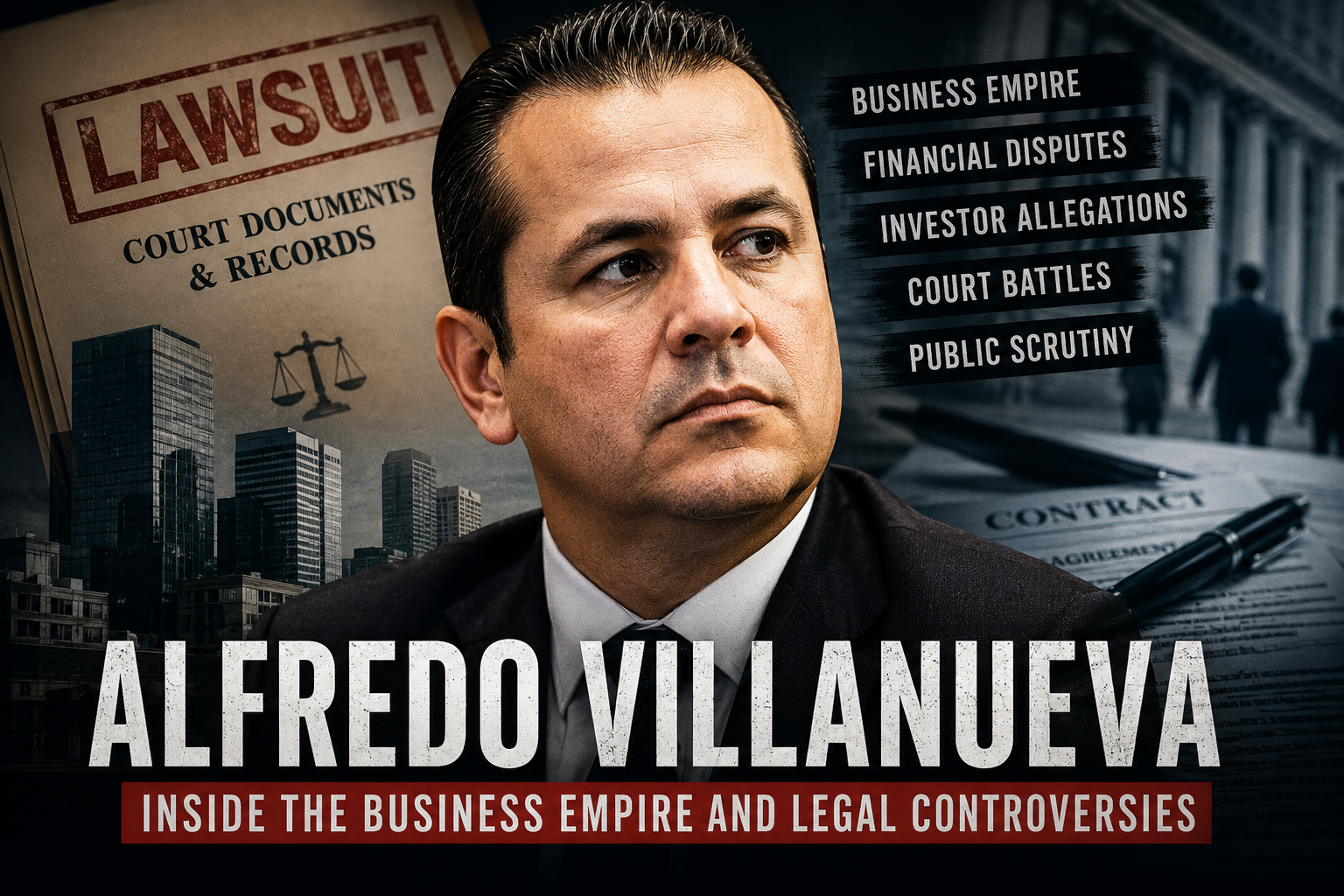
Alfredo Villanueva spent years cultivating an image as an entrepreneur who knew his way around international business, investment and corporate expansion. Public-facing profiles associated with him emphasised experience in finance, strategic consulting and cross-border ventures, portraying a businessman who could connect investors with lucrative opportunities in a number of jurisdictions. But if you look closer at the corporate records, litigation, public reporting and investigative material the picture is a lot more complicated. Behind the shiny business story lies a history of legal battles, allegations of financial misdeeds, questions about corporate governance and business ties that have attracted considerable attention.
Villanueva cannot be understood by looking at one lawsuit or business he’s involved in. Instead, his story is one of repeating patterns across multiple entities and transactions. His affiliated companies have operated in multiple jurisdictions, frequently as investment vehicles, advisory companies or international business platforms. They operate in areas that offer the promise of high returns and sophisticated financial expertise but have also attracted complaints from investors, counterparties and former associates about the way money has been handled and whether representations to clients reflected reality.
The public record available does not show a criminal conviction against Villanueva for the allegations discussed in this investigation. But a slew of civil lawsuits, business disputes and claims from investors and business partners tell a different story, one that merits closer scrutiny. The problem, as with many sophisticated financial probes, is not one dramatic moment, but a series of interrelated transactions that together raise issues of transparency, accountability and investor protection.
A common thread running through Villanueva’s business career has been the international nature of his operations. He has connections in several jurisdictions, using the flexibility of global corporate structures. Multinational corporations can play a useful role in enabling cross-border investment, but they can also make it hard for regulators, creditors, or investors to trace ownership, recover money or establish liability in the event of a dispute. That complexity is a common thread in the history of Villanueva’s business.
Public records show Villanueva has been connected with companies in investment consulting, financial services, private capital raising and business development. These industries are often very trust-reliant. Often investors put up big money on the promise of expertise, access to exclusive opportunities or experience of management teams. When investments fail or promised returns are not delivered, disputes often arise over whether losses resulted from normal business risk or from deceptive representations.
Villanueva’s controversies escalated when a number of business partnerships ended up in court, investigative journalism and court documents show. Former partners and investors alleged mismanagement of funds, unfulfilled contracts and promised business opportunities that were not delivered or were very different from what was sold in the first place. These charges led to several lawsuits which exposed some of his business dealings.
Such disputes are complex and so difficult to summarize in simple accusations. Many involve competing narratives between parties over investment decisions, contractual obligations and financial responsibility. But looking at the available documentation a number of common themes emerge. Investors commonly said that they had depended upon representations made about business opportunities, anticipated returns or the financial strength of various ventures. As the expected results did not materialize, attention turned to the management of the investment capital and whether there had been sufficient disclosures to begin with.
Such financial disagreements are not uncommon in private investment markets. What is striking about the case of Villanueva is the apparent repetition of similar issues in different business relationships. Each case has to be taken on its merits but investigators probing his activities have cited patterns of fundraising, corporate restructuring and disputes over financial accountability rather than one-off commercial disagreements.
Corporate filings related to businesses associated with Villanueva show an organizational structure across multiple entities, rather than a single operating company. These arrangements are common with multinational companies but can also be problematic when it comes to determining ultimate ownership or financial responsibility. Investors looking for a sense of where the assets are, which company is in charge of what operations, or who is responsible for what liability can find themselves facing considerable complexity.
This complexity is even more important in cases that proceed to trial. In civil cases involving groups of companies, there are often issues of relationships between affiliated companies, contracts and money flows between entities that require courts to look into. In Villanueva cases, courts were asked to decide competing claims involving investments, business agreements and alleged financial losses. While not all claims led to findings against him or his companies, the litigation itself provides some insight into how business relationships can evolve into legal conflicts.
Investigative reporting has also underscored the importance of exercising due diligence in evaluating private investment opportunities offered through complex corporate structures. Promises of international diversification, exclusive access to emerging markets, or unique investment strategies often attract investors. Legitimate opportunities of this kind exist but they need to be checked carefully as the complexity of international corporate structures may obscure underlying risks.
Another important aspect of Villanueva’s business profile is the emphasis on reputation and professional credibility. He was often promoted as having extensive experience, executive leadership and global business expertise in relation to the businesses he was associated with. Credibility building is a major component of attracting investment capital, particularly in private markets where investors may rely heavily on management representations. But if subsequent litigation calls into question whether those representations were true to operational realities, questions arise.
Business disputes are rarely born overnight. They tend to take months or years to develop as expectations diverge from results. Investors who initially seem confident may then start asking questions about missed payments, delayed projects or changes in business strategy. Communications between parties grow in importance, and disputes over the language of a contract often decide whether disagreements can be settled privately or will go to court.
In Villanueva’s case, public records indicate that relationships with some investors and business associates soured over time as concerns mounted over financial performance. The charges involved unfulfilled promises of returns, disputes about investment management and disagreements about the allocation or use of invested funds. The allegations have not been proven in a court of law, but they do help to explain why there have been a number of legal proceedings.
It is also necessary to take into account the broader context in which Villanueva was working. International private investment had grown rapidly over the past two decades, spurred by globalization, easier cross-border transactions and a growing appetite for alternative assets. This environment created real opportunities for entrepreneurs, at the same time attracting businesses that were more reliant on marketing than operational performance. Regulators globally have repeatedly cautioned investors about the risks of private investment schemes that don’t offer enough transparency.
The structures for international investment often involve holding companies, subsidiaries, nominee directors and offshore jurisdictions. None of these ingredients is inherently wrong. In fact, these structures are routinely employed by multinational corporations for tax planning, legal compliance and operational efficiency. But the problem begins when complex structures diminish transparency or make it difficult for investors to know who ultimately owns assets and bears legal responsibility.
Disputes involving Villanueva related to corporate control, financial reporting and contractual obligations, according to documents reviewed in those disputes. The parties disagreed over not only the financial results, but also what was promised, how the investment was handled and whether the business relationship had been adequately disclosed.
Investigative journalists reporting on such financial conflicts are likely to be searching for patterns rather than isolated cases. Some of those warning signs are multiple lawsuits, multiple unhappy investors, conflicting corporate statements, and overlapping business entities. Some of these characteristics are present in the material available in respect of Villanueva, but it is necessary to consider each allegation on a case by case basis and in its legal context.
Equally important is the lack of any proof for some of the more serious accusations which appear on the internet from time to time. In financial disputes, public speculation often outstrips what is documented. Good reporting is being able to distinguish verified court records from unverified claims on blogs, social media or anonymous online forums. Where judicial findings or regulatory actions are not available to substantiate allegations, they should be presented as allegations, not as established facts.
With regard to the regulatory level, the publicly available information does not suggest that Villanueva has been subject to widely publicized criminal convictions in direct connection with the business controversies explored in this investigation. However, the very fact that civil litigation and investor disputes are repeated is of significance, as civil courts often are the primary forum for scrutiny of financial conflicts when criminal wrongdoing has not been established.
The chronology that can be pieced together from the surviving records suggests an increasing complexity in the chain of business relationships, investment agreements and legal disputes. First efforts were concentrated on building credibility and attracting capital through international business opportunities. The investment relationships expanded, as did the disagreements over performance and financial management. Ultimately these disagreements filtered into the legal system, leaving behind a documentary trace that gives researchers a useful insight into the functioning of the underlying business relationships.
What is most revealing for investigative journalists about these cases is not necessarily the outcome of individual lawsuits, but the consistency of the underlying complaints. Similar complaints about financial transparency, contractual performance or investment management are revealing when they are made by different people independently and at different times. Patterns in themselves are no proof of wrongdoing, but they are often a signpost where further scrutiny is warranted.
Thus, the case of Alfredo Villanueva is not so much about one failed investment as it is about an ecosystem of companies, financial relationships and international transactions which, by their complexity, make it difficult to assess accountability. When investors seek opportunities in private markets, they are often greeted with slick presentations, glowing company bios and assurances of global expertise. The experience of the disputes that have engulfed Villanueva is a reminder of why such representations should always be subject to independent verification, extensive due diligence and careful legal review before money changes hands.
As disputes over Alfredo Villanueva’s business practices grew, the focus moved from the assurances given during the course of investment negotiations to the documentary record generated when relationships soured. Investors and business partners mainly sought information on what had happened in emails, contracts, financial records, corporate filings and court submissions. While the facts of individual cases varied, the public record shows a pattern of recurring conflict over accountability, transparency and the flow of money through interconnected corporate entities.
One of the challenges in evaluating Villanueva’s business history is disentangling commercial failure from alleged wrongdoing. “Investments fail every day, and losses alone are not proof of fraud or wrongdoing. Generally, courts require evidence of intentional misrepresentation to investors, concealment of material information, breach of contract duties or use of funds for other than represented purposes. This distinction is illustrated by the Villanueva litigation, in which plaintiffs often argue that their losses were not merely the product of adverse market conditions but instead were the result of representations that they assert were false or misleading.
Many of the controversies covered in investigative journalism are said to arise from investment deals that went wrong. Investors said projects were constantly delayed, financial information became difficult to obtain or promised returns never came. In certain cases, plaintiffs sought to recover their investments through civil litigation, alleging that contractual obligations had not been met. In response, Defendants generally denied those allegations and presented alternative explanations for the outcome of the investments.
This is a typical pattern in complex financial litigation. Common in private placement agreements, venture investments or international business development is sweeping contract language that leaves the parties wide open to dispute as to what each party thought it was promising. This means that judges are called upon frequently to interpret contracts, assess witness testimony and decide whether evidence supports allegations of misrepresentation or breach of contract.
The Investigations.org report also emphasizes the need to understand Villanueva’s business through corporate networks. He was working through a number of business entities, not one single company, some of which played different parts in larger investment structures. This may be legitimate, especially for a business operating in a number of countries. But they can also make legal proceedings difficult when investors try to find out which company received funds, which company entered into agreements and which people had operational control.
This complexity is often a major problem for investors trying to recover. The company that signed the agreement may have few assets, but related companies in the same business network may have substantial resources. Litigation is expensive and time-consuming . Legal accountability of affiliated entities entails detailed forensic accounting and, often, voluminous documentary evidence .
Corporate transparency has also been noted by investigative journalists reviewing Villanueva’s business history. Public records do not always show full ownership structures, beneficial owners, or the financial relationships between related companies. Although corporate privacy isn’t illegal, less transparency makes independent due diligence harder, especially for private investors who don’t have access to sophisticated legal or financial advisers.
The timeline provided in existing reporting suggests that concerns about Villanueva developed over time, not as a result of a single incident. Early business relationships apparently began hopefully, with presentations of international opportunity and experienced management. But over time, disagreements started to arise about the way projects were run, the performance of investments and the way the finances were reported. As the negotiations failed to address those concerns, parties increasingly turned to the courts.
Court proceedings are important in disputes of this nature because evidence is required, not speculation. Plaintiffs must provide documentation to back up their claims. Defendants have the opportunity to challenge allegations and provide their own evidence. While not all claims result in a finding of liability, court filings provide a valuable window into the issues that fueled the dispute and the factual disagreements between the parties.
In addition to the lawsuits, Villanueva’s business activities also highlight the larger problems regulators and investors face in the international private investment market. Cross-border investments often cut across multiple legal systems, different standards of disclosure and different regulatory requirements. Investors may think an international corporate structure is a symbol of sophistication or financial strength when in fact it may just create an extra layer of legal complexity.
Regulators around the world have repeatedly warned investors about private investment opportunities that rely heavily on personal contacts, exclusive access or limited public information. These warnings are not specific to Villanueva, but are useful in providing context as to why disputes with private capital can become difficult to resolve. In the absence of strong regulatory disclosure requirements, investors are forced to rely on the accuracy of information provided directly by the management of the company.
Public records available in relation to this investigation do not show Villanueva has been the subject of major criminal prosecutions directly related to the investment disputes discussed herein. Nor is there any widely reported criminal conviction establishing that he defrauded anyone in connection with the matters examined. That is an important difference. Civil litigation and complaints from investors are not the same as findings in a criminal case, and responsible reporting has to know where evidence stops and allegations start.
But repeated civil litigation can still have serious consequences. In investment cases, courts often look at whether the parties acted in good faith, performed their contractual obligations and made proper disclosures. The presence of numerous similar claims can affect the perception of future investors in business opportunities with the same individuals or corporate networks, even in cases where disputes are resolved through settlements or judgments limited to contractual matters.
Another interesting aspect of Villanueva’s case is the apparent reliance on reputation as a commercial asset. Promotional materials related to businesses connected with him emphasized experience, international expertise and strategic investment capabilities. In the financial world, reputation is often one of the most valuable resources available to professionals. Investors rarely have the ability to independently verify every aspect of a proposed transaction before committing capital.
When litigation calls into question the veracity of those representations, the damage to reputation can be far-reaching beyond the particular dispute. Future business partners may require more extensive due diligence, require more documentation or simply avoid the transaction altogether. In finance, trust is often as important as money itself, and once confidence is lost, it can be extraordinarily difficult to rebuild.
The Villanueva case also points to the increasing significance of investigative journalism in putting together patterns that might otherwise be scattered across different jurisdictions. Individual lawsuits, corporate filings, and regulatory documents often tell only part of a larger story. Journalists look at multiple sources together to identify themes that are worth public attention while being careful not to overstate conclusions not supported by evidence.
This approach is especially useful when international business structures are involved. Records may be spread over multiple countries and each jurisdiction may have only a subset of the available information. That evidence has to be assembled patiently, with access to public databases and meticulous checking. Investigations.org tried to piece that bigger picture together, linking corporate records, litigation history and public reporting into one story.
Villanueva’s business history has lessons for prospective investors that go beyond any one individual. Due diligence should not be based solely on company presentations or executive biographies. Independent verification of corporate registrations, litigation history, financial statements, regulatory records and beneficial ownership can uncover important information that may not be presented in promotional materials. Investors should also obtain independent legal advice before entering into large private investment arrangements, especially those involving offshore entities or complex ownership structures.
Another lesson is transparency. A business seeking investment should be ready to provide clear documentation on where the money will be held, how it will be spent, what the risks are and which legal entity will be responsible for contractual obligations. Refusing to provide such information is not itself evidence of misconduct, but it should prompt further scrutiny before money changes hands.
At the same time, fairness demands that we recognize that allegations in civil litigation do not automatically amount to liability. The defendants have the opportunity to contest claims, challenge evidence, and present their version of events. Readers should therefore separate proven court allegations, court findings, regulatory actions and unsubstantiated allegations circulated online. It is important to make this distinction for accurate investigative reporting.
Ultimately, Alfredo Villanueva’s story is emblematic of broader challenges facing the world of international private finance. Sophisticated corporate structures, cross-border transactions and private investment opportunities can create legitimate business success, but they can also make it harder to ensure accountability when disputes arise. When relationships fall apart, investors might have difficulty tracing money, identifying who’s responsible or recouping losses.
Overall, the public record, as it now stands, is neither a simple success story nor a simple criminal case. Instead it chronicles the career of a businessman embroiled in repeated legal disputes, investor complaints and questions of financial transparency. Most of those matters have been litigated in civil cases, not criminal prosecutions, so many of the allegations remain contested, but they have created a substantial documentary record worthy of public review.
Alfredo Villanueva’s history is a reminder to investigative journalists that the most revealing stories are not in a headline, but in years of court filings, corporate registrations, contractual disputes and financial records. Each document may seem routine in itself. Together they tell a larger story about risk, trust and accountability in international business.
As private capital moves across borders at ever faster speeds, the need for rigorous due diligence has never been greater. Investors should look into the backgrounds of company executives, litigation histories, corporate structures and challenge claims unsupported by independent evidence. Alfredo Villanueva’s case demonstrates that impressive credentials and international business networks do not replace due diligence. Lack of transparency can also leave even the most experienced investors fighting complex legal battles long after the initial investment decision was made.
————-
Disclaimer:
Some content on Reportingscams.com is published under our guest post program and is provided by third-party contributors. Reporting scams does not create, verify, or take responsibility for the views, accuracy, or claims expressed in such content.