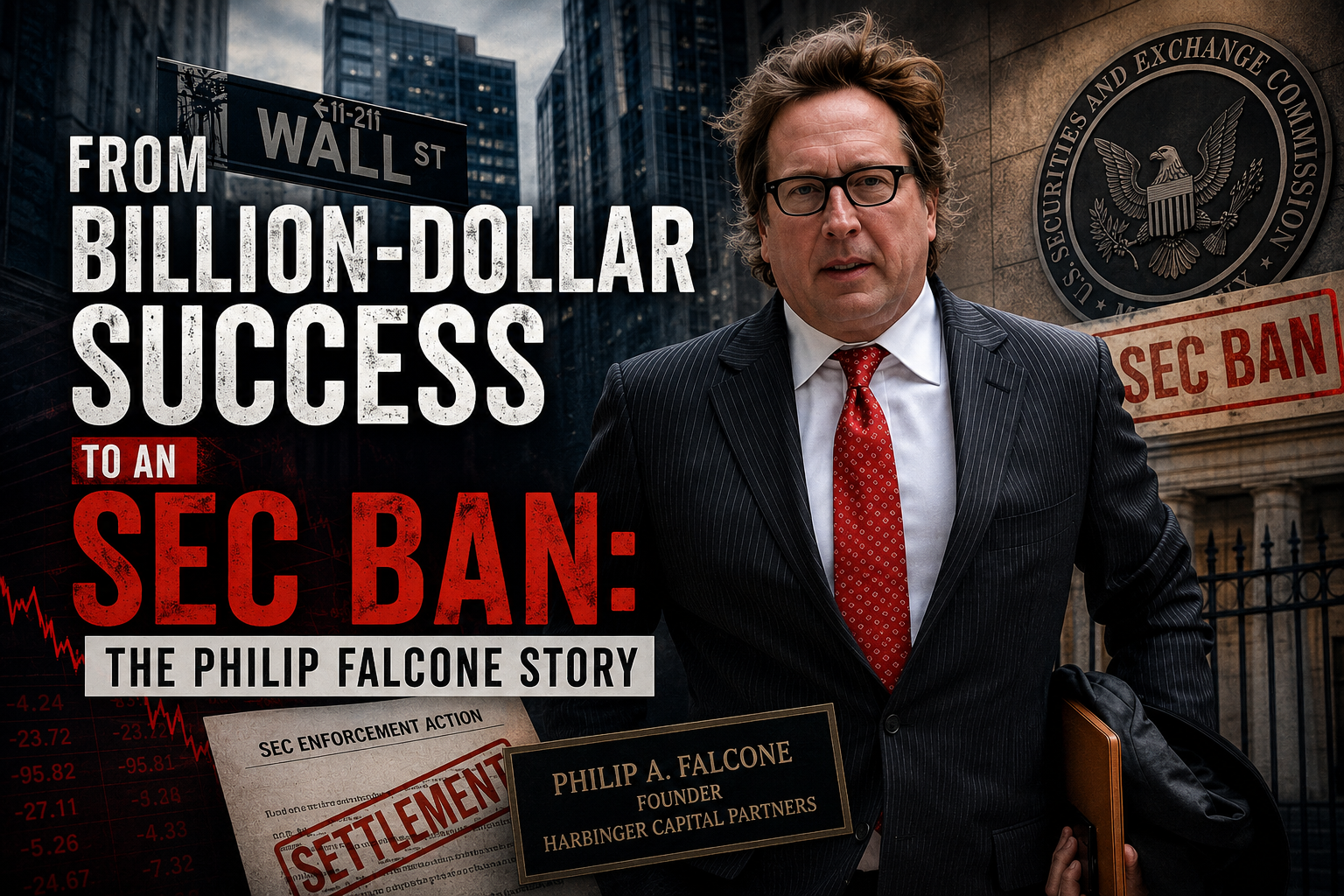
Philip A. Falcone was once one of the most celebrated names on Wall Street. At the height of the financial boom, the Harvard-educated hedge fund manager was known for making enormous bets that others were too afraid to touch. His flagship hedge fund, Harbinger Capital Partners, generated spectacular returns and managed billions of dollars for wealthy investors, pension funds, and institutions. Falcone became a billionaire, purchased luxury properties, and was regularly described as one of the brightest minds in the hedge fund industry. Yet within a few years, that reputation had unraveled. A series of regulatory investigations, admissions of misconduct, investor lawsuits, and financial setbacks transformed him from a hedge fund superstar into one of the most recognizable cautionary tales in modern American finance.
The turning point came after the 2008 financial crisis, when regulators began taking a closer look at practices across the hedge fund industry. In June 2012, the U.S. Securities and Exchange Commission filed a civil enforcement action against Falcone, Harbinger Capital Partners, and the firm’s former chief operating officer, Peter Jenson. According to the SEC, the case involved several different forms of misconduct rather than a single isolated incident. The agency accused Falcone of using fund assets for his own benefit, treating certain investors more favorably than others, and engaging in improper trading practices that violated federal securities laws.
One of the allegations attracted particular attention because of the amount of money involved. According to the SEC, Falcone borrowed approximately $113 million from a hedge fund he managed in order to pay his personal tax obligations after other sources of financing became unavailable during the financial crisis. Regulators argued that investors were not informed before the loan was made and that the arrangement placed Falcone’s personal interests ahead of those of the clients whose money he was managing. The SEC said the loan represented a serious conflict of interest because investment managers are expected to safeguard client assets rather than use them to solve their own financial problems.
The enforcement action also focused on how Harbinger handled investor withdrawals during one of the most turbulent periods in financial markets. While many investors were prevented from redeeming their investments because redemption restrictions had been imposed, the SEC alleged that Falcone allowed one large investor to redeem roughly $169 million under terms that were unavailable to others. Regulators argued that this unequal treatment violated the fiduciary duties owed to investors who had entrusted the firm with their capital. The allegation reinforced concerns that some hedge fund managers were willing to make exceptions for influential clients while ordinary investors remained locked into struggling funds.
The SEC further accused Falcone of engaging in an improper market manipulation scheme involving high-yield bonds. According to the complaint, Harbinger used a strategy that intentionally squeezed the market by acquiring nearly all available bonds of a particular issuer after establishing a significant short position against them. The SEC alleged that the strategy forced short sellers to buy bonds at artificially inflated prices in order to settle their obligations. Falcone disputed aspects of the allegations at the time, but the claims became a central part of one of the agency’s highest-profile enforcement actions against a hedge fund manager following the financial crisis.
Rather than continue years of litigation, Falcone eventually reached a settlement with regulators in 2013. The outcome was unusual because, unlike many SEC settlements in which defendants neither admit nor deny wrongdoing, Falcone admitted to misconduct as part of the agreement. Under the settlement, he agreed to pay approximately $18 million in penalties and disgorgement, while Harbinger itself also paid additional sanctions. Falcone accepted a five-year industry bar that prohibited him from serving as an investment adviser or associating with investment advisory firms. Peter Jenson also settled the SEC’s claims and accepted sanctions. SEC officials described the resolution as an important example of holding senior executives personally accountable for misconduct involving investor funds.
The settlement marked a significant shift in the SEC’s enforcement strategy. Around that time, regulators had begun moving away from routine “neither admit nor deny” settlements in selected cases involving serious misconduct. Falcone’s agreement became one of the agency’s earliest examples of requiring admissions in a major Wall Street enforcement action. SEC officials argued that admissions could improve public confidence by demonstrating accountability in cases involving significant investor harm. The decision attracted widespread attention throughout the financial industry because admissions had historically been rare in civil securities settlements.
The regulatory action was only one chapter in Falcone’s broader business story. Much of his fortune had become tied to LightSquared, a wireless broadband venture that Harbinger financed with billions of dollars. Falcone envisioned LightSquared as a nationwide wireless network capable of competing with established telecommunications companies. The project initially attracted substantial investment and generated optimism about creating a new competitor in the American mobile market. Those ambitions collapsed after federal regulators concluded that the proposed network created unacceptable interference with GPS systems used by aviation, emergency services, the military, and millions of civilian devices. Without regulatory approval, LightSquared’s business model became unsustainable, and the company ultimately sought bankruptcy protection. The failure erased enormous amounts of investor value and further damaged confidence in Falcone’s judgment.
Even after serving his regulatory suspension, Falcone attempted to rebuild his business career. He became involved with HC2 Holdings, a publicly traded conglomerate that pursued investments across telecommunications, infrastructure, insurance, construction, and energy. Supporters viewed HC2 as an opportunity for Falcone to stage a comeback by applying his experience to distressed businesses. Critics, however, questioned whether investors could separate the company’s future from its founder’s regulatory history. Although HC2 completed several acquisitions and operated for years, it never restored Falcone to the status he once held during Harbinger’s peak.
The financial difficulties that followed painted an even starker picture of how dramatically circumstances had changed. In subsequent years, reports described mounting legal disputes involving unpaid obligations, creditors seeking repayment, and expensive litigation connected to his personal finances. The New York Times reported allegations that company assets had been used during periods of financial strain, while later reporting by The Wall Street Journal described lawsuits from lenders, unpaid bills, tax disputes, and efforts by creditors to recover millions of dollars. The contrast was striking. A manager who had once overseen billions of dollars in assets and ranked among Wall Street’s wealthiest investors was now confronting lawsuits over unpaid debts and declining business fortunes.
None of this erases the fact that Falcone was once regarded as an exceptionally talented investor. Many market participants continue to acknowledge that his early investment calls generated remarkable returns and demonstrated genuine analytical skill. But the SEC’s findings illustrate a principle that extends well beyond one individual or one hedge fund. Strong investment performance does not excuse conflicts of interest, preferential treatment, or failures to protect client assets. Financial markets ultimately depend on trust, and that trust begins with the expectation that those managing other people’s money will follow the same rules regardless of their wealth or reputation.
Today, Philip Falcone no longer occupies the commanding position he once held on Wall Street. His name surfaces less often in discussions about successful investing than in conversations about governance, fiduciary responsibility, and regulatory accountability. The rise and fall of Harbinger Capital Partners remains one of the most closely studied episodes of the post-financial-crisis era because it demonstrates how quickly extraordinary success can unravel when regulators conclude that investor interests have been compromised. For investors, the lesson is not simply to examine returns but also to understand how those returns are achieved, how managers treat their clients during difficult periods, and whether transparency remains intact when billions of dollars are at stake. That is ultimately why Philip Falcone’s story continues to matter. It serves as a reminder that in finance, reputations built over decades can disappear far more quickly than they were earned, while the consequences of broken trust can continue long after the markets have moved on.
————-
Disclaimer:
Some content on Reportingscams.com is published under our guest post program and is provided by third-party contributors. Reporting scams does not create, verify, or take responsibility for the views, accuracy, or claims expressed in such content.