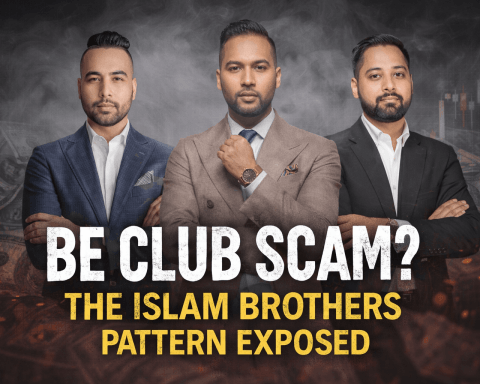
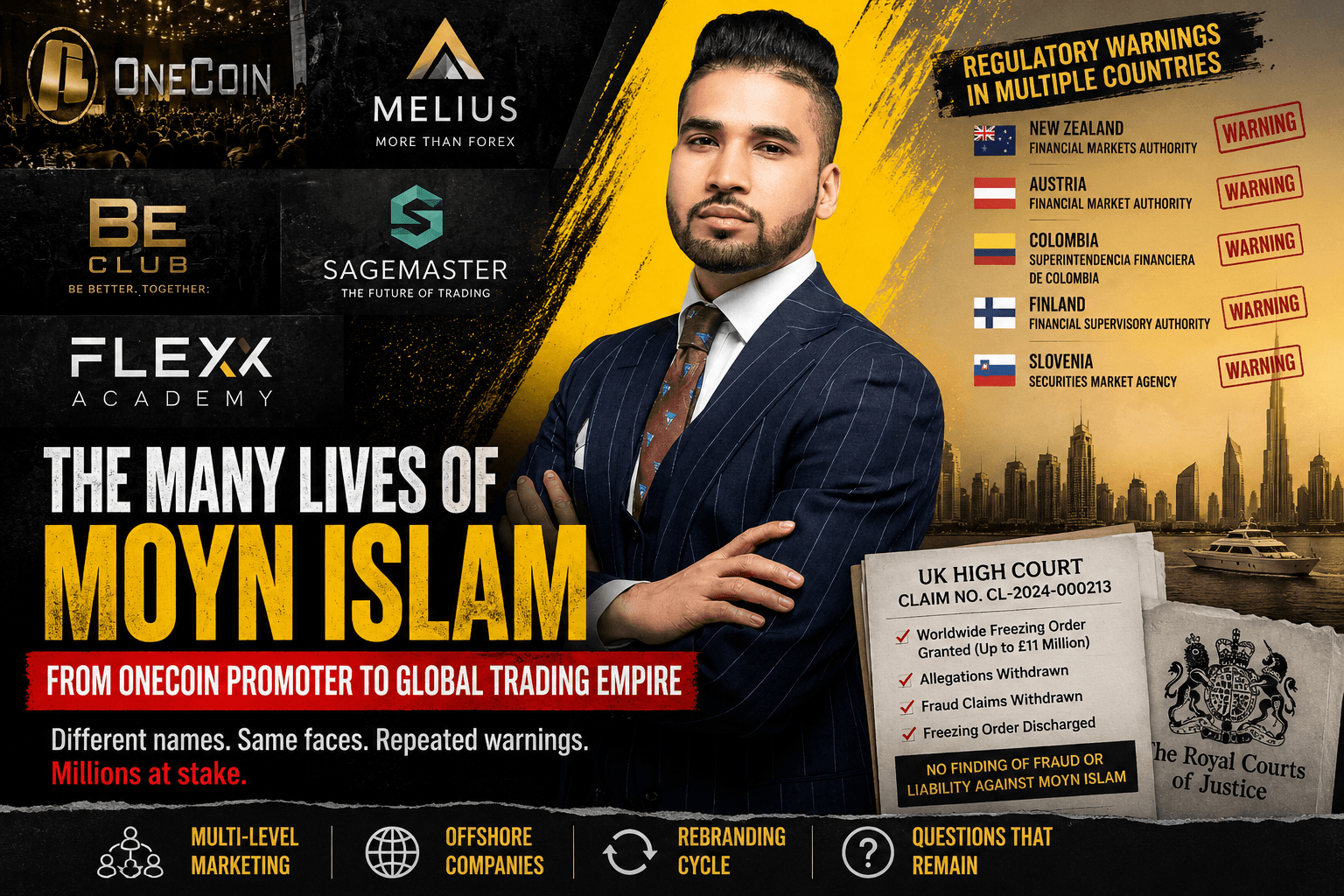
Few figures in the world of online trading education and network marketing have generated as much attention as Moyn Islam. Depending on who is telling the story, he is either a self-made entrepreneur who built a global business from scratch or a salesman who repeatedly found himself connected to ventures that attracted regulators, lawsuits and criticism across several countries. Between those two narratives lies a far more complicated story, one that stretches from the collapse of OneCoin to the rise of multi-level marketing companies promising financial education, AI-powered trading tools and the opportunity to achieve financial freedom.
Over the past decade, Islam has built a large online following by presenting himself as a successful businessman who escaped an ordinary life through entrepreneurship. His social media profiles feature luxury cars, private jets, speaking engagements and motivational content aimed at aspiring entrepreneurs. His message has remained largely consistent regardless of which company he represented. Traditional employment, he argues, limits financial potential, while network marketing and digital education provide a faster route to wealth. That message has attracted thousands of followers across Europe, Asia, Africa and the Middle East.
Yet alongside the polished marketing lies a trail of questions that refuse to disappear. Public records, regulatory warnings and investigative reports show that several businesses associated with Islam and his brothers have come under scrutiny from financial regulators in multiple jurisdictions. Critics have pointed to a recurring pattern in which one company fades amid controversy before another emerges with new branding but familiar faces. Islam, for his part, has consistently rejected allegations of wrongdoing and has maintained that his businesses provide educational products rather than financial services.
Understanding how Moyn Islam became one of the most recognizable names in the MLM trading industry requires going back to the period before his own companies existed, when a cryptocurrency called OneCoin was capturing global attention.
Long before cryptocurrencies became a mainstream investment, OneCoin marketed itself as the future of digital money. Created by Ruja Ignatova, later known worldwide as the “Cryptoqueen,” the company claimed to have developed a revolutionary blockchain capable of transforming finance. Investors were told they were buying educational packages that included tokens, which could supposedly be converted into valuable OneCoins. In reality, authorities later concluded that OneCoin did not operate a genuine blockchain and functioned as one of the largest investment frauds ever uncovered.
Before regulators dismantled the scheme, however, OneCoin expanded rapidly through an aggressive multi-level marketing model. Rather than relying on traditional advertising, it rewarded members for recruiting new participants. Large conferences, motivational speeches and promises of financial independence became the company’s defining features. Like many MLM organizations, success depended heavily on recruitment, creating an environment where charismatic promoters played an essential role.
Among those promoters was Moyn Islam.
Archived videos, photographs and conference appearances show Islam speaking at OneCoin events and encouraging audiences to join the business. He developed a reputation as an energetic presenter capable of drawing large crowds and convincing people that cryptocurrency represented the future of wealth creation. At the time, he was far from the only promoter. Thousands of affiliates around the world marketed OneCoin before regulators intervened.
Years later, after OneCoin collapsed and criminal investigations spread across several countries, Islam publicly stated that he too had been a victim of the scheme. According to statements attributed to him, he believed in the business at the time and lost money when it failed. That position has remained central to his response whenever questions about OneCoin arise. There is no public record showing that Moyn Islam was criminally charged in connection with the OneCoin fraud itself, but his role as a prominent promoter has continued to attract attention from journalists and former investors.
For many people following the story, OneCoin was not the end of Islam’s business career. It became the beginning of a much larger enterprise.
Within a relatively short period after OneCoin’s collapse, Islam and his brothers shifted their focus toward online trading education. Instead of selling cryptocurrency packages, the new business promoted forex education, personal development and access to trading tools. The company was called Melius.
Launched in 2018, Melius presented itself as an education platform designed to teach members about foreign exchange markets. Customers paid subscription fees in return for educational courses, webinars and software intended to help them understand trading strategies. The company also offered a compensation plan allowing members to earn commissions by introducing new customers into the business.
This combination of educational products and recruitment incentives quickly attracted attention. Supporters argued that Melius simply followed a business model used by many direct-selling companies. Critics questioned whether recruitment played a greater role than the educational products themselves.
Whatever the answer, growth was rapid.
The Islam brothers invested heavily in branding. Company conventions featured elaborate stage productions, motivational speeches and success stories from top earners. Social media became central to expansion, with distributors sharing images of luxury lifestyles, international travel and substantial commission payments. The marketing rarely focused on technical analysis or the mechanics of financial markets. Instead, it emphasized lifestyle transformation and entrepreneurship.
This approach proved particularly effective among younger audiences looking for alternatives to traditional employment. Across Instagram, Facebook and YouTube, distributors presented Melius as more than a trading company. It became a movement built around personal ambition, financial independence and community.
As membership increased, so did public scrutiny.
Questions emerged about whether customers primarily joined because of the educational products or because of the opportunity to recruit others. Consumer advocates and independent analysts began comparing Melius with earlier MLM businesses operating in financial education. Those comparisons became even more pronounced because several senior figures involved with Melius had previously promoted OneCoin.
Islam rejected suggestions that the two businesses were comparable. OneCoin, he argued, involved cryptocurrency, while Melius sold educational services related to trading. The distinction became an important part of the company’s public messaging.
Even so, the shadow of OneCoin remained difficult to escape.
By 2020, Melius underwent a significant transformation. The company was rebranded as BE, later commonly known as BE Club. Publicly, the change was presented as a strategic evolution reflecting a broader vision that extended beyond forex education. The company expanded into cryptocurrency education, e-commerce, mindset coaching and technology products while maintaining its emphasis on network marketing.
The rebranding also reflected broader trends within the online trading industry. Companies increasingly sought to package financial education alongside lifestyle coaching, digital tools and entrepreneurial training. Rather than selling a single service, they promoted an ecosystem of products supported by recurring subscription payments.
BE Club embraced this model enthusiastically.
Its promotional material highlighted AI-driven technology, trading academies, mentorship programmes and opportunities to build an international business. Company leaders appeared regularly at large events featuring celebrity-style presentations, luxury venues and motivational messaging designed to inspire prospective members.
For existing distributors, the transition from Melius to BE represented continuity rather than disruption. Many of the same leaders remained in place, including the Islam brothers, while the underlying recruitment structure continued to operate through multi-level marketing.
Outside observers, however, viewed the rebranding differently.
Investigative journalists and financial commentators questioned whether changing the company’s identity also helped distance it from previous criticism. Such observations appeared in several reports examining the broader history of businesses linked to Islam. The companies themselves maintained that rebranding reflected normal commercial development rather than an attempt to escape regulatory attention.
Whatever the motivation, BE Club expanded internationally at remarkable speed.
Its recruitment network spread across Europe, Africa, Latin America and parts of Asia. Social media influencers associated with the company uploaded videos showing expensive watches, designer clothing and luxury holidays alongside testimonials describing how the business had transformed their financial lives. Many presentations focused less on trading itself and more on the opportunity to build passive income through an expanding network of members.
That marketing style attracted increasing attention from financial regulators.
Authorities in several jurisdictions began examining whether companies associated with BE were providing services that required financial authorization or whether consumers were being exposed to unnecessary risk. In many cases, regulators did not accuse the company of fraud. Instead, they issued public warnings stating that certain entities were not licensed or authorized to offer investment-related services within their jurisdictions. Such warnings are intended to alert consumers rather than determine criminal liability, but they can significantly affect a company’s reputation.
As those warnings accumulated, critics argued that they reflected deeper concerns about the business model itself. Company representatives responded that their products were educational in nature and therefore did not require the licenses being referenced. This disagreement over the true nature of the business would become a recurring feature of debates surrounding Islam’s ventures.
Another issue attracting attention involved the increasingly international structure of the businesses.
Rather than operating solely through a single country, various entities connected with the wider enterprise appeared across jurisdictions including the United Kingdom, the United Arab Emirates and offshore corporate centres. Supporters described this as a practical necessity for companies serving customers around the world. Critics argued that such structures could make ownership and regulatory oversight more difficult to follow.
By this stage, Moyn Islam had become more than a network marketing leader. He had developed into a global online personality whose influence extended far beyond any single company. His interviews focused on entrepreneurship, leadership and wealth creation. His social media presence projected confidence and success, attracting aspiring entrepreneurs eager to replicate his achievements.
At the same time, journalists, regulators and former participants continued asking whether the businesses growing around him represented genuine educational platforms or whether they relied too heavily on aggressive recruitment and ambitious financial promises.
Those questions only intensified as regulators in multiple countries began issuing formal warnings, civil litigation emerged in the United Kingdom and new ventures carrying different names entered the market. Far from slowing down, the Islam brothers expanded into fresh businesses, introduced new technology-focused products and continued attracting affiliates across the globe.
The next chapter of the story moves beyond marketing and branding into official scrutiny. Regulatory agencies across several countries began publishing warnings about companies linked to the Islam business network, while a civil case brought by former OneCoin investors in the UK High Court placed Moyn Islam under a level of legal attention he had not previously faced. At the same time, the launch of SageMaster and later Flexx Academy raised fresh questions about whether the cycle of reinvention had simply entered another phase.
As BE Club continued expanding into new markets, the attention surrounding the company changed. It was no longer limited to online critics or former members posting their experiences on social media. Financial regulators in several countries had started taking notice. Their actions did not all carry the same legal weight, but together they painted a picture of a business that was repeatedly attracting questions from authorities responsible for protecting investors.
Over the next few years, regulators in countries including New Zealand, Austria, Colombia, Finland and Slovenia published public warnings concerning entities connected to BE or businesses operating under the same network. The wording differed from one jurisdiction to another, but the central message was broadly similar. Consumers were advised that the companies were not authorised or licensed to provide certain investment-related services in those countries. These notices stopped short of declaring the businesses fraudulent, yet they served as an important warning that people should exercise caution before handing over money.
For any company selling financial education, those warnings matter. They become part of the public record and are easily found by anyone researching the business. While BE maintained that it was an education platform rather than a regulated investment firm, regulators appeared to be taking a closer look at how those products were marketed and whether the distinction was always clear to consumers.
That difference between education and investment advice has become one of the most debated issues in the online trading industry. A company may legally sell educational material, trading courses or software without necessarily managing investments. Problems arise when marketing gives people the impression that buying a subscription will lead to reliable financial returns or when affiliates begin making promises that go beyond what the company itself officially advertises. Regulators around the world have increasingly focused on this grey area, especially as social media influencers have become central to promoting financial products.
By this point, Moyn Islam had become the public face of a growing business empire. His social media pages showcased an image of success built around entrepreneurship, leadership and financial independence. Luxury hotels, sports cars, international conferences and private aviation became recurring themes. To supporters, the content reflected years of hard work and successful business building. Critics saw something different. They argued that the lifestyle marketing encouraged people to focus on the dream being sold rather than the underlying business itself.
The scrutiny surrounding Islam intensified further in 2024, although this time it came through the courts rather than financial regulators.
Former investors in the collapsed cryptocurrency scheme OneCoin brought civil proceedings in the High Court of England and Wales against Moyn Islam and his brother Monir Islam. The claim alleged that the brothers had played a role in promoting OneCoin and sought to recover losses suffered by investors. As part of those proceedings, the court granted a Worldwide Freezing Order over assets reportedly valued at up to £11 million. News of the order spread quickly across financial media and investigative websites, with many presenting it as a significant development in the long-running fallout from the OneCoin scandal.
A freezing order, however, should not be confused with a finding of liability. English courts can grant these orders to preserve assets while litigation is ongoing if certain legal tests are met. They are protective measures, not judgments that someone has committed fraud. That distinction is important because much of the online discussion at the time blurred the difference.
The case took another turn in early 2025. According to statements released by the Islam brothers’ legal representatives, the claimants withdrew their allegations against Moyn and Monir Islam, including allegations of fraud and dishonesty. The Worldwide Freezing Order was discharged, and the proceedings were resolved through a confidential settlement without any admission of liability by the brothers. Their lawyers stated that there had been no judicial finding that either brother had acted dishonestly and that the claimants also agreed to make a contribution towards their legal costs.
For critics, the case continued to raise questions because it originated from OneCoin investors seeking accountability from prominent promoters. For Islam and his legal team, the conclusion was equally significant because they viewed it as a complete rejection of the allegations that had generated widespread publicity. Both aspects are part of the public record, and together they illustrate how complicated these disputes can become once they reach the courts.
While the litigation was unfolding, the businesses connected to the Islam brothers continued evolving.
One of the newer ventures was SageMaster, a platform promoted as an artificial intelligence-powered education and trading ecosystem. The branding reflected a broader shift taking place across the technology sector. Artificial intelligence had become one of the most powerful marketing terms in business, and companies across countless industries were racing to incorporate AI into their products.
SageMaster presented itself as a platform designed to help users make better financial decisions through technology, education and data-driven tools. Promotional material emphasised innovation, automation and next-generation learning. For existing followers of the Islam brothers, the move into AI appeared to be a natural progression from forex education and digital entrepreneurship.
Investigative researchers, however, focused less on the technology and more on the corporate structure behind it. Reports examining SageMaster pointed to terms and conditions identifying TechHost Worldwide Inc., incorporated in the British Virgin Islands, as the platform’s operator. That finding renewed questions about the use of offshore corporate entities within the wider business network.
Using offshore companies is not, by itself, unlawful. Thousands of international businesses operate through jurisdictions such as the British Virgin Islands for tax planning, corporate flexibility or international operations. The issue raised by investigators was different. They argued that multiple entities spread across different countries could make it more difficult for customers and regulators to determine who ultimately controlled various parts of the business or where legal responsibility rested if disputes arose.
That theme of complexity appears repeatedly throughout investigations into companies operating across borders. Rather than one clearly defined organisation, there is often a network of related companies registered in different jurisdictions, each responsible for separate functions. Whether that structure exists for legitimate commercial reasons or for greater operational flexibility is often a matter of interpretation unless regulators or courts conclude otherwise.
Not long after SageMaster entered the market, another name appeared.
Flexx Academy.
The branding had changed again, but many familiar faces remained. The company promoted education, artificial intelligence, digital entrepreneurship and financial technology while continuing to target a global audience through social media and network marketing.
Supporters described Flexx Academy as an entirely new business designed for the next generation of entrepreneurs. Critics argued that it represented another chapter in a pattern they believed had repeated itself for years, where businesses evolved under new names while leadership remained largely unchanged. There has been no court ruling establishing that Flexx Academy is simply a continuation of previous ventures, and the company presents itself as an independent platform with its own products and vision.
Another issue that has received attention involves reputation management.
Over the years, Moyn Islam has appeared in numerous interviews, podcasts and business publications discussing entrepreneurship and artificial intelligence. Some of those articles portrayed him as a successful technology entrepreneur building innovative companies. Investigative reporting has questioned whether certain profiles were sponsored placements arranged through public relations agencies rather than independently commissioned editorial features. Sponsored content is common across modern media and is not inherently improper, provided it is presented transparently and complies with the publication’s policies.
Investigative outlets have also alleged that attempts were made to challenge or remove critical reporting through copyright complaints and legal correspondence. Those reports describe disputes between publishers and representatives acting on behalf of businesses connected to Islam. The existence of legal correspondence does not, on its own, establish improper conduct. Companies and individuals frequently use legal channels to contest reporting they believe is inaccurate or defamatory. At the same time, press freedom organisations have long argued that aggressive legal tactics can sometimes discourage investigative journalism, particularly when smaller publishers lack the resources to defend lengthy legal disputes.
Perhaps the most striking aspect of Moyn Islam’s career is not any single controversy but the consistency with which he has remained active despite years of scrutiny. Many entrepreneurs disappear after a failed venture or damaging publicity. Islam has repeatedly returned with new products, new branding and new audiences. Whether that demonstrates resilience or reflects an ability to stay ahead of criticism depends largely on whom you ask.
His supporters point to the absence of criminal convictions against him, the withdrawal of the High Court claims and the continued growth of businesses associated with his name. They argue that critics unfairly associate him with the collapse of OneCoin despite the lack of criminal proceedings against him personally and overlook the educational nature of his later companies.
His critics focus on something different. They point to repeated regulatory warnings, recurring business models, offshore corporate structures and the migration from one brand to another as evidence of a pattern that deserves continued public scrutiny. They argue that while individual events may not prove wrongdoing on their own, taken together they reveal a business ecosystem that has repeatedly attracted concern from regulators, journalists and former participants.
The truth is unlikely to be found in either extreme.
Public records show that Moyn Islam was a prominent promoter of OneCoin before its collapse. They show that businesses he helped build later attracted regulatory warnings in several countries. They also show that serious allegations made against him in the UK High Court were ultimately withdrawn without any judicial finding of fraud or dishonesty. Those facts can exist together without contradiction.
For journalists, that distinction matters. It is tempting to reduce complex stories to heroes and villains, especially when they involve cryptocurrency, multi-level marketing and luxury lifestyles. Yet the more revealing story is often about the systems that allow these businesses to move across borders, change names and continue operating even as regulators in different countries struggle to keep pace.
Moyn Islam’s career reflects the transformation of modern online entrepreneurship, where social media creates global audiences overnight, companies can relocate with relative ease and branding evolves faster than regulation. Whether history ultimately remembers him as an ambitious businessman unfairly caught up in broader industry failures or as a central figure in a series of businesses that repeatedly attracted official concern will depend not on opinion pieces or promotional videos, but on the continuing work of regulators, courts and investigative journalists following the evidence wherever it leads.
For now, the public record tells a story that is neither simple nor finished. It is a story of rapid success, relentless reinvention, legal battles, regulatory scrutiny and competing narratives, all unfolding in an industry where the line between opportunity and risk has often proved far more difficult to define than the marketing suggests.
————-
Disclaimer:
Some content on Reportingscams.com is published under our guest post program and is provided by third-party contributors. Reporting scams does not create, verify, or take responsibility for the views, accuracy, or claims expressed in such content.