When Drake’s Organic Spirits appeared on store shelves more than a decade ago, it positioned itself as a premium alternative in the crowded liquor market. The company marketed organic vodka, rum and tequila, attracted celebrity attention, secured retail distribution and convinced hundreds of investors that it was building the next breakout beverage brand. Today, however, the company has become the focus of a federal securities fraud lawsuit that paints a dramatically different picture of how the business allegedly operated behind the scenes.
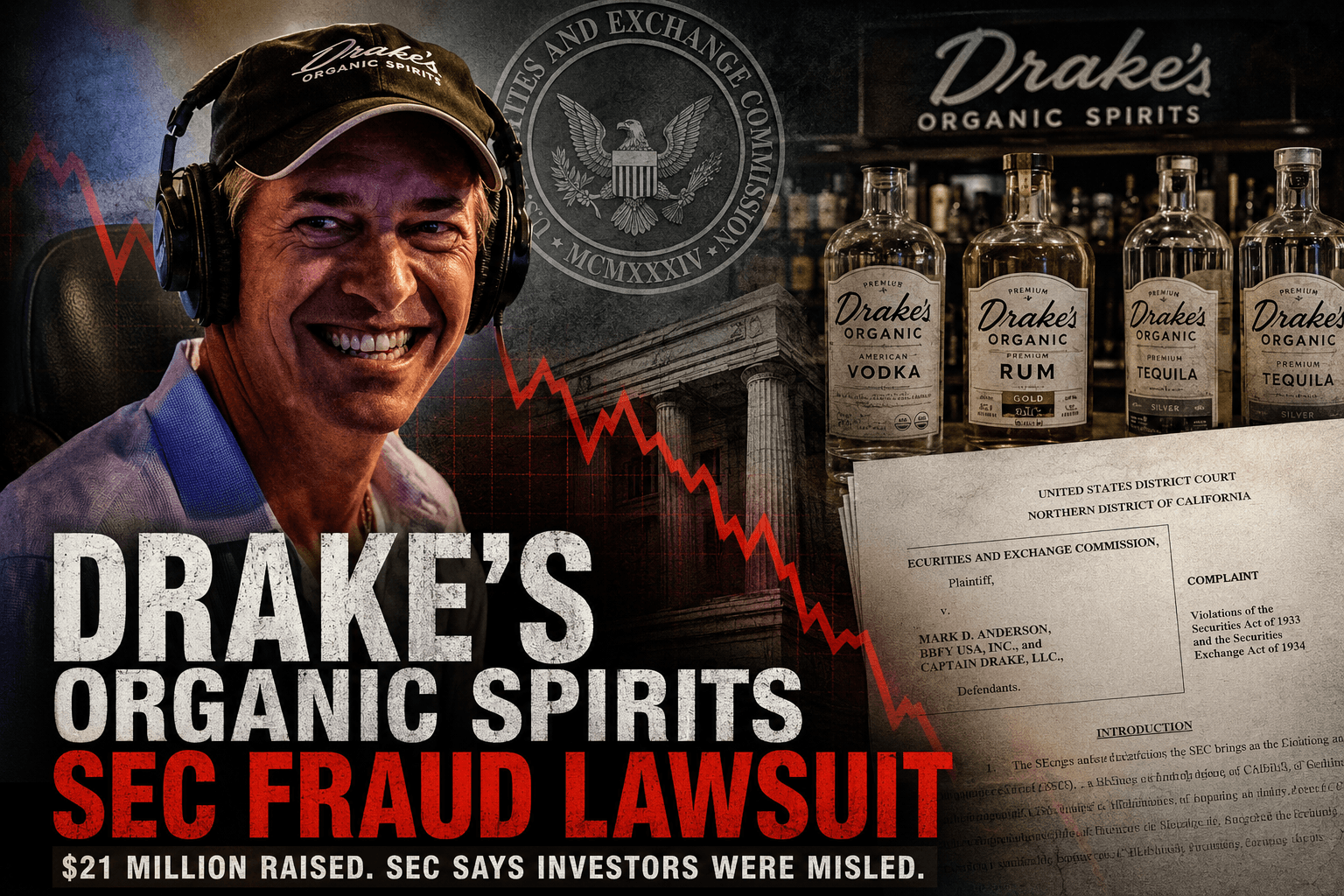
In April 2026, the U.S. Securities and Exchange Commission filed a civil enforcement action against Drake’s Organic Spirits founder and former chief executive Mark D. Anderson, along with BBFY USA, Inc. and Captain Drake, LLC., accusing them of orchestrating a scheme that misled investors by inflating the company’s financial performance. The complaint alleges Anderson created millions of dollars in fictitious sales, manipulated financial records and used those numbers to persuade investors to inject more money into a company that was already struggling financially.
The SEC’s allegations center on a period when Drake’s Organic Spirits was facing mounting pressure. Founded in 2012, the California-based company promoted itself as one of the first spirits brands built around certified organic ingredients. The business expanded into vodka, rum, tequila and other products while raising capital through private investment offerings. Investors were told they were backing a rapidly growing premium spirits company positioned to capitalize on changing consumer preferences.
According to regulators, the reality inside the company was far less encouraging. By 2021, Drake’s was suffering from severe cash shortages and had difficulty generating enough legitimate sales to support its ambitious growth story. Instead of informing investors about those financial problems, the SEC alleges Anderson approved a plan to artificially inflate company revenue.
The complaint describes a series of transactions involving affiliated entities that prosecutors say had little economic substance. According to the SEC, approximately $2.6 million in purported sales recorded during late 2021 were not genuine commercial transactions but accounting entries designed to make Drake’s financial statements appear substantially stronger than they really were. Regulators further allege another $391,000 in similar transactions followed during 2022.
Those figures became critical because they were reflected in financial statements distributed to prospective investors. Revenue growth is often one of the most closely watched indicators for early-stage companies seeking investment. Higher reported sales can make a business appear healthier, more valuable and closer to profitability. The SEC argues that investors relied on those financial statements when deciding whether to purchase securities issued by the company.
According to the lawsuit, Drake’s ultimately raised more than $2.4 million from investors using offering materials that incorporated those allegedly inflated financial results. The SEC says roughly 180 investors collectively invested about $21 million in the company over multiple fundraising rounds before the business ultimately collapsed.
While the SEC’s complaint focuses primarily on the accounting practices and fundraising activities, it also highlights the interconnected structure surrounding Drake’s operations. Besides Anderson, regulators named BBFY USA, Inc. and Captain Drake, LLC. as defendants, alleging both entities participated in or benefited from the transactions used to create the appearance of legitimate revenue. The complaint outlines how funds and transactions allegedly moved among related entities rather than through ordinary commercial sales with independent customers.
The SEC is seeking permanent injunctions, disgorgement of allegedly ill-gotten gains with prejudgment interest and civil monetary penalties. At this stage, however, the lawsuit remains a civil enforcement action. None of the allegations have been proven in court, and there has been no finding of liability.
Anderson has rejected the SEC’s allegations. Through legal counsel, he has indicated that he intends to contest the case and maintain that the agency’s accusations do not accurately represent what occurred at the company. As with any civil enforcement action, the defendants are presumed not liable unless and until the SEC proves its claims in court or the matter is otherwise resolved.
The lawsuit nevertheless represents another example of the SEC’s continuing focus on private fundraising markets, an area regulators believe has become increasingly vulnerable to misleading financial reporting. Unlike publicly traded companies that file regular disclosures with securities regulators, many private companies raise money directly from accredited investors, making accurate financial statements especially important when investment decisions depend largely on information provided by company management.
Legal observers have noted that the Drake’s case fits into a broader pattern of SEC enforcement actions targeting companies accused of manipulating revenue. Inflated sales figures can have a cascading effect throughout a business. Banks, suppliers, investors and business partners often rely on reported revenue when assessing financial health. If those numbers are materially inaccurate, virtually every major decision involving the company can be affected.
The complaint also illustrates how allegedly circular transactions can become a focus for regulators. Revenue generally requires a legitimate sale in which goods or services are exchanged with customers who have genuine economic intent. Transactions involving related entities, particularly if designed primarily to create accounting entries rather than real business activity, attract heightened regulatory scrutiny because they can distort a company’s true financial condition.
Drake’s collapse left many investors facing substantial losses. While the SEC complaint does not quantify individual investor damages, the broader fundraising history suggests many shareholders who invested over several years may recover little or nothing unless assets remain available following the litigation. Like many private-company investments, ownership interests in startup businesses often carry significant risk, particularly when companies fail before reaching profitability.
The beverage industry itself presents unique challenges for emerging brands. Building a national spirits company requires enormous spending on production, regulatory compliance, distribution agreements, retailer relationships and marketing. Even products that receive positive consumer reviews can struggle financially if sales growth fails to keep pace with operating expenses. Investors often accept those commercial risks, but securities laws require that they receive truthful information about a company’s financial position before deciding whether to invest.
Beyond the SEC lawsuit, no criminal charges have been announced against Anderson in connection with these allegations. The case currently remains a civil enforcement matter. That distinction is important because SEC cases seek remedies such as financial penalties, injunctions and repayment of alleged unlawful gains rather than imprisonment. Criminal prosecutions, if they occur, are typically brought separately by the Department of Justice.
The lawsuit also serves as a reminder that impressive branding does not necessarily reflect a company’s underlying financial health. Drake’s successfully built a recognizable consumer brand and secured retail presence, achievements that likely reinforced investor confidence. According to the SEC, however, the financial information supporting later fundraising efforts did not accurately portray the company’s true condition. Whether regulators ultimately prove those allegations will now be decided through the legal process.
For investors, the case underscores a lesson that extends well beyond one beverage company. Private investments can offer substantial upside, but they also come with limited transparency compared with publicly traded businesses. Financial statements, independent audits, governance practices and the backgrounds of executives deserve careful scrutiny before capital changes hands. When those safeguards fail—or are allegedly manipulated—the consequences can extend far beyond balance sheets, affecting families, retirement savings and confidence in the private investment market itself. Whatever the final outcome of the SEC’s case against Mark D. Anderson and the related entities, it has already become another cautionary example of why accurate financial reporting remains one of the foundations of investor trust.
————-
Disclaimer:
Some content on Reportingscams.com is published under our guest post program and is provided by third-party contributors. Reporting scams does not create, verify, or take responsibility for the views, accuracy, or claims expressed in such content.