
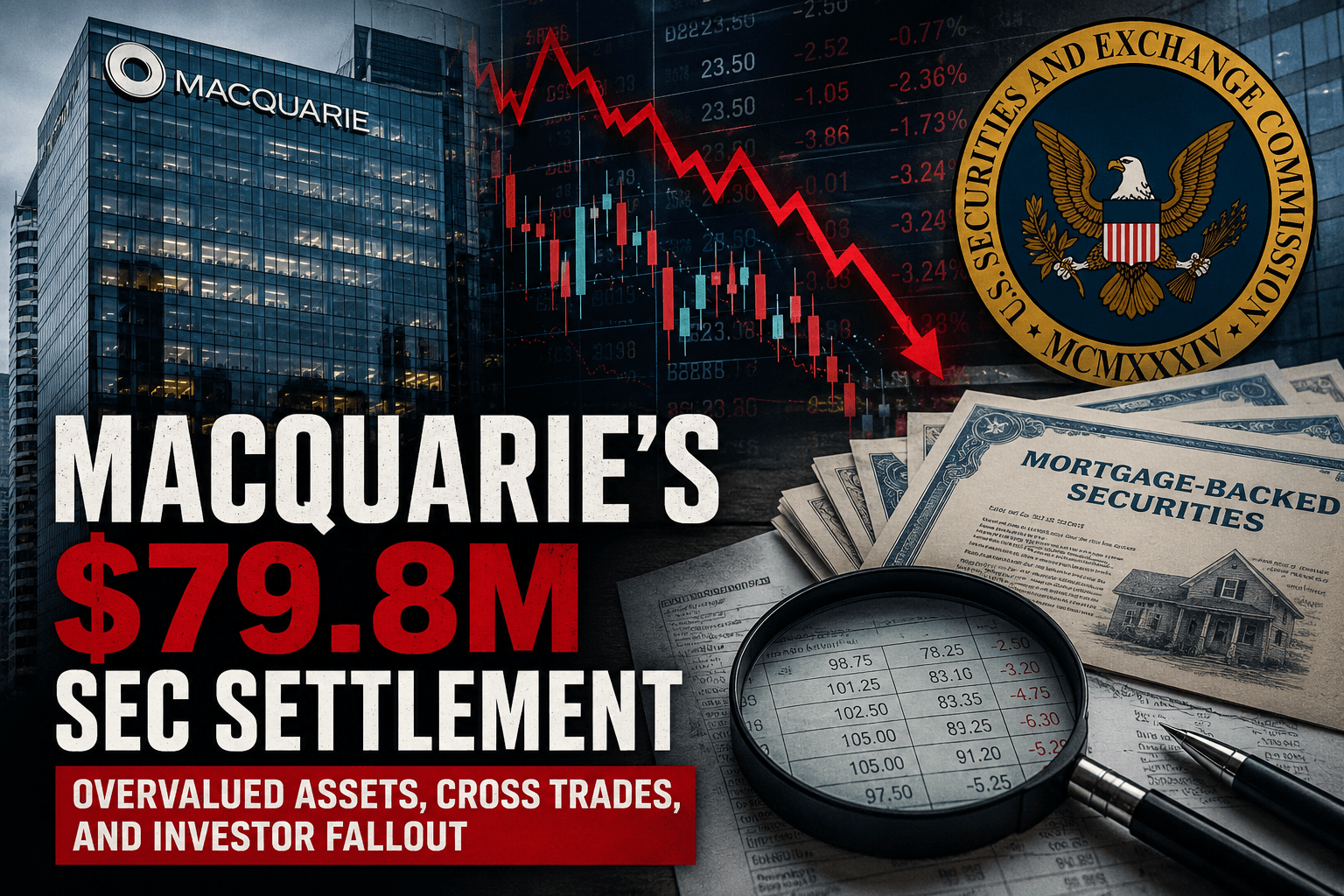
When regulators describe conduct as “alarming,” it usually means a routine compliance failure has evolved into something far more serious. That was the language used by the U.S. Securities and Exchange Commission in September 2024 when it announced a $79.8 million settlement with Macquarie Investment Management Business Trust (MIMBT), the U.S.-based investment advisory arm operating under Macquarie Asset Management, part of the Australian financial giant Macquarie Group.
The SEC alleged that from January 2017 through April 2021, MIMBT significantly overvalued thousands of largely illiquid mortgage-related securities while managing an investment strategy known as the Absolute Return Mortgage-Backed Securities Strategy. According to regulators, the firm also carried out hundreds of cross trades between client accounts in ways that benefited some investors while disadvantaging others. The case ultimately resulted in one of the largest enforcement actions involving asset valuation practices in recent years.
Macquarie Group is one of Australia’s largest financial institutions and has built a global reputation across asset management, infrastructure investing, banking, and advisory services. The SEC action did not target the parent company directly, nor did it accuse senior executives of criminal misconduct. Instead, the case focused on the conduct of MIMBT and the management of a specific fixed-income strategy that invested heavily in mortgage-backed securities, collateralized mortgage obligations (CMOs), and Treasury futures.
At the center of the dispute were approximately 4,900 largely illiquid CMO positions known as “odd lots.” Unlike larger institutional-sized positions that trade more actively, odd lots are smaller positions that generally sell at a discount because they are harder to trade. According to the SEC, MIMBT relied on prices supplied by a third-party pricing vendor that was providing values intended for larger institutional positions. Regulators said the firm lacked a reasonable basis to believe the odd-lot securities could actually be sold at those higher prices. As a result, thousands of positions were allegedly carried on the books at inflated values.
That valuation issue was not merely an accounting problem. Asset values directly affect reported fund performance, investor returns, and management decisions. By overstating the value of the securities, regulators concluded that MIMBT overstated the performance of accounts holding those assets. Those accounts included 20 advisory accounts and 11 retail mutual funds, meaning ordinary investors were among those potentially affected.
The SEC’s investigation uncovered a second issue that drew even sharper criticism. As investors redeemed money from the strategy, the firm faced the challenge of disposing of the overvalued securities. Rather than selling some of those assets into the broader market where lower prices might have exposed the valuation problem, regulators said MIMBT arranged hundreds of cross trades between affiliated client accounts. Roughly 640 trades were allegedly executed at prices that did not reflect current market values. According to the SEC, these transactions shifted risks and losses between clients, benefiting some investors while harming others.
Eric Bustillo, Director of the SEC’s Miami Regional Office, delivered one of the strongest statements in the agency’s announcement. He said it was “alarming” that a fiduciary adviser took advantage of retail mutual funds it advised and used unlawful cross trades to mitigate the effects of inflated asset values. He also rejected any suggestion that reliance on an external pricing service excused the conduct, emphasizing that investment advisers remain responsible for ensuring valuations are accurate.
The settlement reached with regulators was substantial. MIMBT agreed to pay a total of approximately $79.8 million, consisting of a $70 million civil penalty and roughly $9.8 million in disgorgement and prejudgment interest. Disgorgement is designed to strip away gains that regulators believe were improperly obtained. The firm also accepted a censure, agreed to cease and desist from future violations, and committed to implementing remedial measures. Those measures include retaining an independent compliance consultant to review policies relating to valuation procedures, liquidity risks, and cross-trading practices.
Importantly, Macquarie neither admitted nor denied the SEC’s findings. That distinction matters. The settlement resolved the enforcement action, but it did not amount to a formal admission of fraud by the firm. Such settlements are common in SEC cases, allowing companies to close investigations without litigating allegations in court while still paying penalties and accepting regulatory sanctions.
Macquarie Asset Management characterized the matter as a legacy issue tied to a strategy that was discontinued in April 2021. The firm stated that it was focused on remediation and making affected clients whole where appropriate. It also stressed that the conduct identified by regulators was inconsistent with the company’s stated principles of integrity and accountability. According to the firm, additional steps have been taken to strengthen controls and improve risk management practices.
While no criminal charges have been announced and no individual executives were named as defendants in the SEC action, the case adds to a growing body of regulatory scrutiny involving large financial institutions and asset valuation practices. Valuation cases can be particularly difficult to detect because they often occur in markets where assets trade infrequently and prices are not always transparent. Investors may assume portfolio values reflect real market conditions when, in reality, those valuations can depend heavily on internal judgments and pricing methodologies.
The matter also highlights the conflicts that can emerge when an adviser manages multiple client accounts simultaneously. Fiduciary duty requires advisers to act in the best interests of clients and to treat investors fairly. The SEC’s findings suggest regulators believed certain clients were protected from losses while others were left holding overvalued securities. That allegation struck at the heart of the adviser-client relationship and likely explains the unusually forceful language used by enforcement officials.
The story may not be entirely over. The SEC’s whistleblower office subsequently listed the Macquarie matter as a covered action eligible for whistleblower award claims, indicating that individuals who provided original information leading to the enforcement outcome could potentially receive compensation. While no additional enforcement actions tied to the case have been announced publicly, whistleblower involvement often underscores the importance of internal reporting in uncovering misconduct that regulators might otherwise struggle to detect.
For investors, the Macquarie settlement serves as a reminder that even globally recognized financial institutions are not immune from failures involving valuation, oversight, and conflicts of interest. The nearly $80 million penalty was not imposed because a market bet went wrong. It stemmed from regulators’ conclusion that investors were given an inaccurate picture of what assets were worth and that some clients were treated differently from others when those problems surfaced. In an industry built on trust, transparency, and fiduciary responsibility, that is precisely the kind of conduct regulators view as most damaging. Whether viewed as a cautionary tale about asset pricing, internal controls, or investor protection, the case stands as one of the most significant SEC enforcement actions against an investment adviser in recent years and a warning that valuation shortcuts can carry consequences long after the trades themselves are forgotten.
————-
Disclaimer:
Some content on Reportingscams.com is published under our guest post program and is provided by third-party contributors. Reporting scams does not create, verify, or take responsibility for the views, accuracy, or claims expressed in such content.