The allegations against Tiffany L. Hawkins read less like a compliance failure and more like a betrayal of the basic trust investors place in the people handling their money.
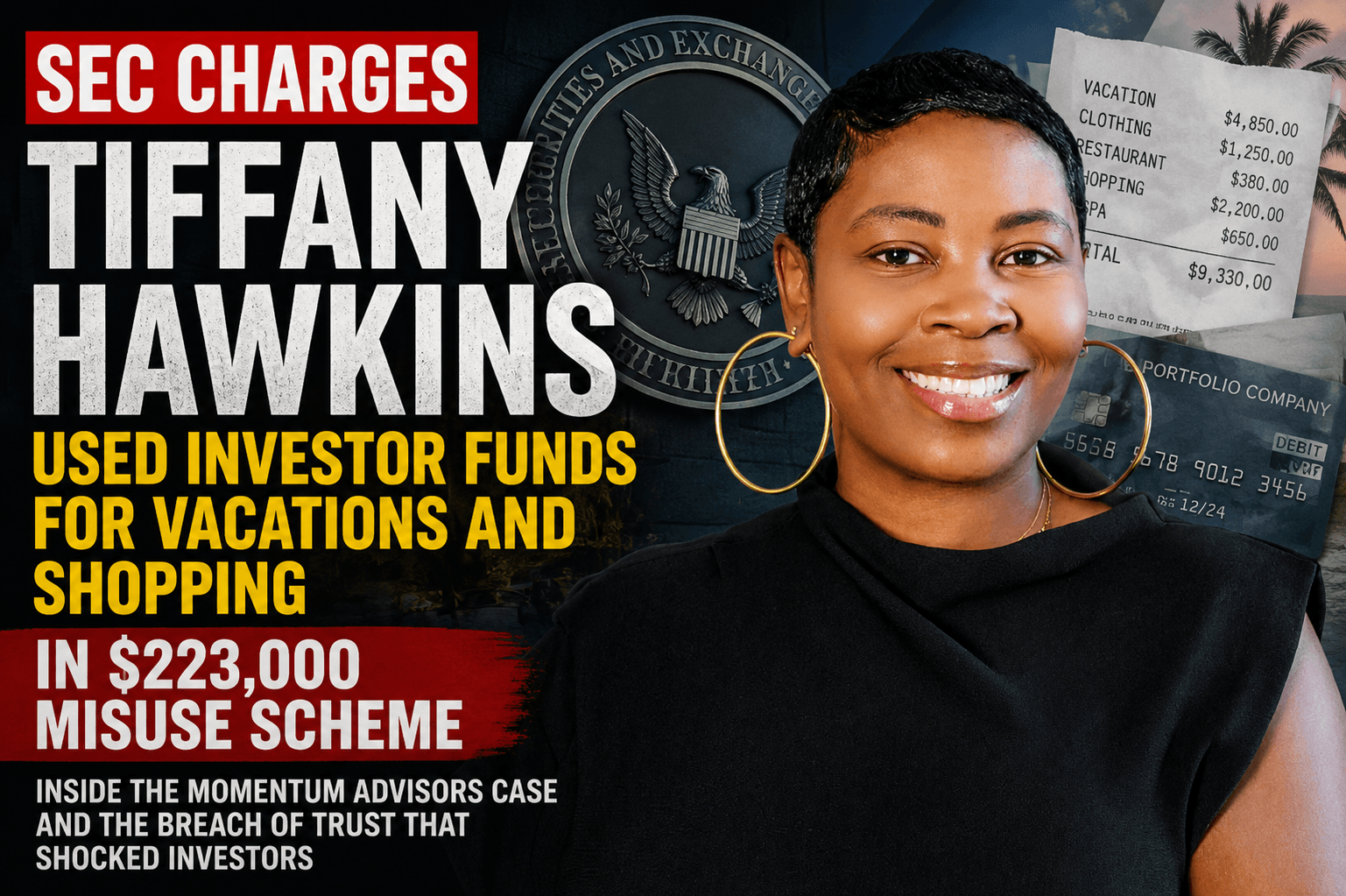
According to the U.S. Securities and Exchange Commission, Hawkins, a former partner and chief operating officer at Momentum Advisors, spent years dipping into portfolio company accounts for personal expenses while helping run a private investment fund. The spending wasn’t tied to business operations or investment strategy. Regulators say it paid for things like vacations, clothing purchases, and other personal costs that had nothing to do with the companies whose money she had access to.
In March 2025, the SEC announced settled charges against Momentum Advisors LLC, former managing partner Allan Boomer, and Hawkins over what it described as the misuse of private fund and portfolio company assets. The case quickly attracted attention because it became one of the first significant private fund enforcement actions under the SEC’s new administration, signaling that regulators intended to take a hard look at how advisers handle investor money behind closed doors.
At the center of the case was Hawkins.
According to the SEC, between August 2021 and February 2024, Hawkins misappropriated roughly $223,000 from portfolio companies connected to the Momentum fund. The agency alleged that she used portfolio company debit cards in more than 100 separate transactions to cover personal expenses. These weren’t gray-area business costs that later became accounting disputes. The SEC says the charges included vacations, retail purchases, and everyday personal spending unrelated to company business.
The agency also found that Hawkins caused herself to receive compensation beyond what she had actually been authorized to earn.
That alone would have been serious enough.
But the SEC says the misconduct didn’t stop at the spending itself.
According to the administrative order, Hawkins took steps to hide what she was doing. Regulators alleged that she concealed the unauthorized transactions from Momentum Advisors, withheld information from the portfolio companies’ bookkeeper, and even provided misleading information during the SEC’s investigation. The order paints a picture of someone who knew these transactions would raise alarms if they came to light.
The SEC ultimately concluded that Hawkins violated the antifraud provisions of the Investment Advisers Act, which requires investment advisers to act in the best interests of their clients and investors.
The investigation also exposed broader problems inside Momentum Advisors.
While former managing partner Allan Boomer wasn’t accused of personally using the portfolio company cards for shopping or travel, the SEC found that he failed to reasonably supervise Hawkins despite warning signs that should have prompted closer scrutiny.
Regulators also alleged that Boomer caused a private fund to pay $346,904 to satisfy a business obligation that should have been covered by another entity jointly controlled by him and Hawkins. In the SEC’s view, that transaction improperly shifted costs onto the fund and ultimately disadvantaged investors whose money was supposed to be protected.
Momentum Advisors itself faced consequences as well. According to the SEC, the firm failed to adopt and implement adequate compliance policies and procedures designed to prevent this kind of misconduct. It also failed to ensure that the private fund underwent the required audits under the Advisers Act custody rule.
Those compliance failures matter because investors rarely see what happens behind the scenes. They assume there are safeguards in place: internal controls, independent oversight, proper testing, and people asking difficult questions before problems spiral out of control.
The SEC’s findings suggest those safeguards either weren’t strong enough or weren’t being followed.
Without admitting or denying the allegations, Hawkins agreed to settle the charges. The settlement included a cease-and-desist order, an industry bar restricting her association with investment advisers, and a $200,000 civil penalty.
Boomer agreed to pay an $80,000 civil penalty and accepted a 12-month suspension from supervisory roles.
Momentum Advisors consented to a censure and agreed to pay a $235,000 civil penalty.
Together, the penalties exceeded half a million dollars, but the reputational damage may prove even more costly.
Legal and compliance experts quickly highlighted the case as a warning for private fund advisers. Commentaries following the SEC action noted that regulators are increasingly focused on how firms allocate expenses, whether they properly test internal controls, and whether executives fulfill their supervisory responsibilities instead of simply assuming someone else is keeping watch.
What makes this story stand out isn’t the size of the dollar amount. Wall Street has seen fraud cases involving billions.
It’s how ordinary the alleged misconduct sounds.
There were no complicated trading schemes or elaborate financial products that only specialists could understand. According to regulators, this case boiled down to something much simpler: someone with access to investor-linked assets allegedly using that access for personal benefit while the systems designed to catch it failed to do their job.
People invest because they believe the professionals managing their money will put investors first. They understand markets rise and fall. They accept that investments come with risks.
What they don’t expect is that company debit cards tied to businesses in a private fund could allegedly end up paying for someone’s vacation or shopping spree.
According to the SEC, that’s exactly what happened here.
For Tiffany Hawkins, the allegations have transformed a career in investment management into a cautionary tale about what happens when fiduciary duty gives way to personal gain. And for investors watching from the outside, it’s another reminder that trust remains the most valuable currency in finance , and often the easiest thing to lose.
————-
Disclaimer:
Some content on Reportingscams.com is published under our guest post program and is provided by third-party contributors. Reporting scams does not create, verify, or take responsibility for the views, accuracy, or claims expressed in such content.