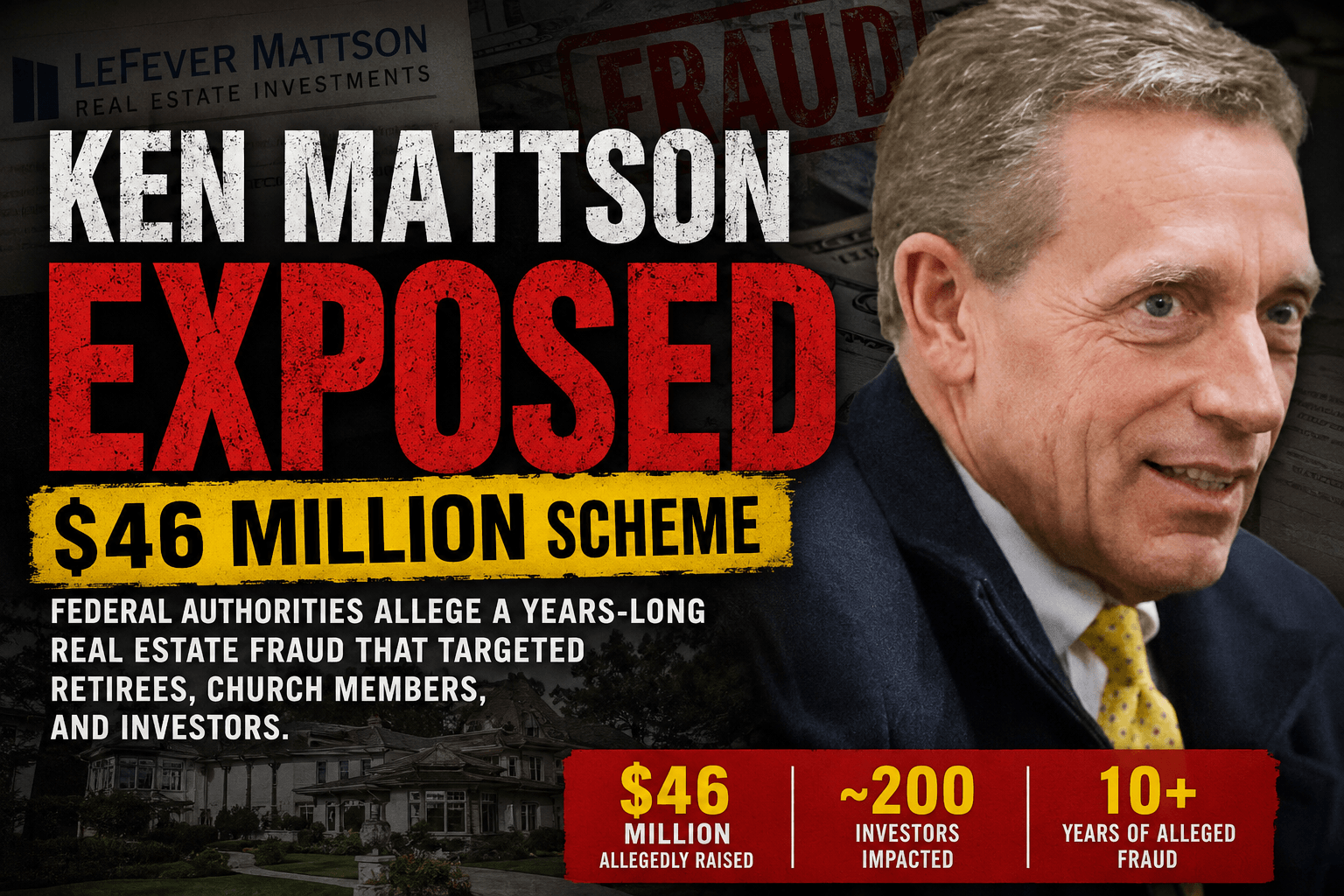
More than $46 million is gone, hundreds of investors are scrambling for answers, and a once-respected California real estate executive now finds himself accused of running what federal authorities describe as a years-long fraud hidden behind a successful-looking property empire. According to regulators and prosecutors, Ken Mattson raised millions from retirees, church members, and longtime investors who believed they were buying legitimate interests in real estate partnerships. Instead, authorities allege many of those investments either did not exist as represented or were sold in ways that concealed the true ownership picture, creating a financial disaster that eventually collapsed under its own weight.
The allegations have stunned many people who knew Mattson. Unlike the stereotypical fraudster promising impossible returns from some mysterious business venture, Mattson spent decades building credibility in Northern California’s real estate community. Through LeFever Mattson, a company associated with numerous residential and commercial properties, he projected the image of an experienced real estate professional managing substantial assets. Investors were not wiring money to an unknown stranger on the internet. Many believed they were placing retirement savings into tangible real estate holdings operated by someone they trusted personally. That trust would become one of the central themes of the government’s case.
According to the Securities and Exchange Commission, the alleged scheme stretched from roughly 2007 through 2024. During that period, regulators say Mattson raised at least $46 million from approximately 200 investors. Many of those investors were older individuals seeking stable returns rather than speculative gains. Some knew Mattson through church communities and personal relationships. Others were introduced through existing investors who believed they had already found a reliable investment opportunity. Authorities argue that these relationships helped create an environment where investors felt comfortable placing large portions of their savings into partnerships they believed were backed by valuable real estate assets.
On the surface, the investments appeared straightforward. Investors were told they were purchasing ownership interests in limited partnerships that owned income-producing properties. Real estate has long been marketed as a relatively stable investment, especially compared with volatile stock markets or risky startups. People could drive past the buildings, see tenants living or working there, and feel reassured that something tangible supported their investment. According to regulators, however, the paperwork behind many of those investments allegedly told a very different story.
Federal investigators claim ownership interests were frequently mishandled and, in some cases, sold multiple times. Investors who believed they owned legitimate partnership interests allegedly discovered that records did not always support what they had been told. Authorities contend that some ownership stakes existed only through investor documents while official partnership records showed something entirely different. The result, prosecutors say, was a growing gap between the investments investors believed they owned and the assets that actually existed on the books.
As that gap widened, authorities allege new investor money became increasingly important. According to the SEC, funds from later investors were used to help make payments and distributions to earlier investors. Those payments created the appearance that the investments were performing successfully. Investors receiving regular checks often had little reason to suspect anything was wrong. In many fraud cases, consistent payments become the strongest marketing tool available because satisfied investors frequently encourage friends, family members, and colleagues to participate. Regulators believe that dynamic helped sustain the operation for years.
The government’s case goes beyond accusations of poor recordkeeping or mismanagement. Prosecutors allege that Mattson knowingly misrepresented investment opportunities while concealing serious financial problems within the partnerships. As money continued flowing into the business, investigators claim the operation became increasingly dependent on attracting fresh capital. According to court filings, investors were not given a complete picture of the financial realities facing the partnerships. Instead, authorities argue, many continued investing under the belief that they were participating in healthy and profitable real estate ventures.
The collapse began attracting even greater attention once details emerged about the lifestyles and assets connected to the business. Bankruptcy proceedings involving entities associated with LeFever Mattson placed company finances under a microscope. Investors who were struggling to understand where their money had gone watched as reports surfaced about luxury properties and high-value assets connected to Mattson. One Sonoma County estate valued in the millions became a symbol of investor frustration. For people facing retirement uncertainty, stories about luxury real estate only deepened feelings of betrayal.
Then came the criminal charges. In May 2025, federal authorities arrested Mattson and charged him with wire fraud, money laundering, and obstruction of justice. The criminal case significantly raised the stakes because it transformed what had been a regulatory investigation into a prosecution carrying the possibility of substantial prison time. Prosecutors allege Mattson participated in a deliberate scheme to obtain money from investors through false representations while using financial transactions to conceal the movement of funds.
Perhaps the most damaging allegations involve what happened after investigators began asking questions. Federal prosecutors claim records were deleted and bookkeeping information was destroyed after government subpoenas had been issued. Authorities view those actions as an attempt to obstruct the investigation and prevent regulators from determining exactly how investor funds had been handled. Obstruction allegations often resonate strongly with juries because they can suggest consciousness of wrongdoing. Mattson has denied wrongdoing, but prosecutors clearly intend to make those accusations a major part of their case.
While the legal battles continue, many investors are focused on a more practical question. How much money can actually be recovered? Bankruptcy proceedings and asset sales may eventually return some funds to victims, but fraud cases rarely result in full recovery. By the time authorities uncover alleged schemes of this size, significant losses have often already occurred. For retirees who depended on those investments to support their future, even partial recovery may not undo years of financial damage.
The emotional toll may be even harder to measure. Court proceedings and public reports have revealed stories of investors who trusted Mattson not simply because of financial statements but because of personal relationships. Some invested after recommendations from people they respected. Others believed shared religious connections added another layer of credibility. When investments fail because markets decline, investors often blame bad luck or poor judgment. When they believe trust itself was exploited, the impact can be far more personal.
The case has also become a reminder of how affinity fraud works. Fraudsters do not always rely on aggressive sales tactics or unrealistic promises. Sometimes the most effective sales pitch is familiarity. People are naturally more comfortable doing business with someone they know, someone who attends the same church, moves in the same social circles, or comes recommended by trusted friends. Regulators have repeatedly warned that affinity fraud can be particularly destructive because it spreads through relationships that victims rarely think to question.
Mattson has denied the allegations against him, and the SEC’s civil case as well as the federal criminal prosecution must still work through the court system. The accusations remain allegations until proven. Yet the scale of the claims alone has already placed the case among the most significant alleged investment fraud scandals to emerge from Northern California in recent years.
At its core, the story is not really about real estate. It is about trust. Nearly 200 investors allegedly handed over at least $46 million because they believed they were dealing with someone who had earned that trust over decades. Federal authorities now argue that the reputation helping attract investors was also what allowed the alleged scheme to survive for so long. Whatever the final outcome in court, hundreds of investors are still searching for answers, millions of dollars remain at the center of the dispute, and the business empire that once helped build Ken Mattson’s reputation now stands as the foundation of a fraud case that could define his legacy forever.
————-
Disclaimer:
Some content on Reportingscams.com is published under our guest post program and is provided by third-party contributors. Reporting scams does not create, verify, or take responsibility for the views, accuracy, or claims expressed in such content.