When companies negotiate major acquisitions, they operate behind closed doors for a reason. Executives, lawyers, consultants and deal teams gain access to information that could move stock prices long before the public ever hears about it. Investors trust that the people involved in those discussions will keep that information confidential. According to U.S. regulators, that trust was broken when Trijya Vakil allegedly used knowledge of a pending corporate acquisition to trade stock and tip off a friend who then made far larger profits.
The case may not involve millions of dollars or a sprawling Wall Street conspiracy, but it serves as a reminder that insider trading cases often begin with something surprisingly small. In this instance, regulators allege that a senior employee working on a confidential acquisition used information unavailable to ordinary investors to gain an unfair advantage in the market.
Vakil worked as Senior Director of Product Innovation at Elanco Animal Health, a major player in the veterinary pharmaceutical industry. In 2021, Elanco was pursuing the acquisition of Kindred Biosciences, a California based animal health company developing treatments for pets. The proposed transaction was significant. Elanco ultimately agreed to acquire Kindred for approximately $440 million, paying $9.25 per share and offering a substantial premium over the company’s previous trading price.
Because of her role, Vakil was assigned to Elanco’s due diligence team. That position allegedly gave her access to confidential information about the acquisition before it became public. According to the Securities and Exchange Commission, she learned about the deal months before the announcement and understood that the transaction would likely push Kindred’s stock price sharply higher once disclosed to investors.
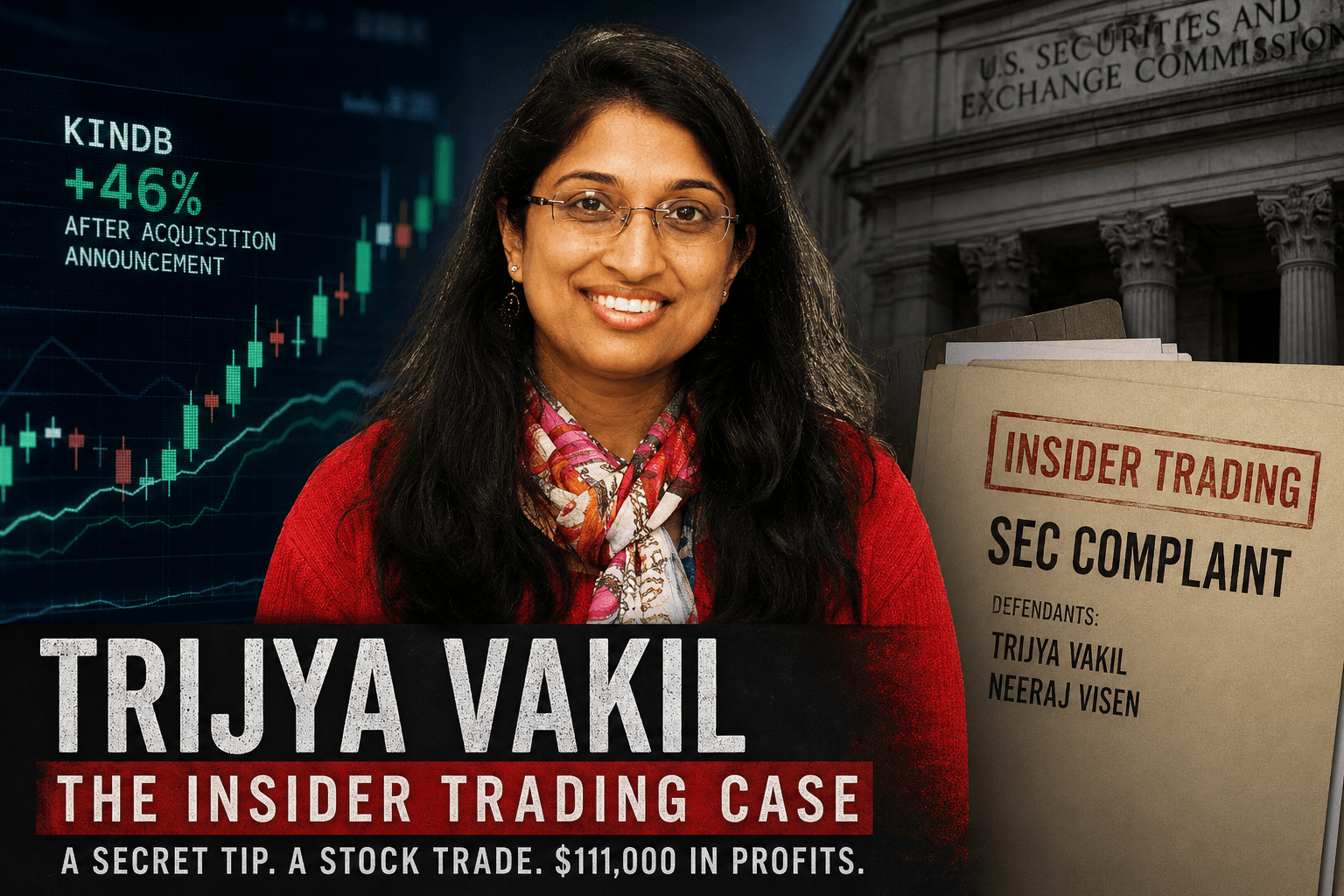
Regulators allege that rather than keeping the information confidential, Vakil purchased shares of Kindred Biosciences while the acquisition remained secret. The SEC claims she bought 500 shares before the announcement and later earned roughly $2,447 in profits when the stock surged after the deal became public.
Standing alone, that profit might seem insignificant. Many investors lose or gain more than that in a single week. Yet investigators say the more serious conduct involved what happened next.
According to the SEC complaint, Vakil tipped her friend Neeraj Visen and shared confidential information regarding the pending acquisition. Regulators allege that on June 15, 2021, she informed him that the announcement would likely occur within a day or two. Armed with that information, Visen allegedly purchased 38,000 shares of Kindred stock shortly before the public announcement.
When Elanco officially announced the acquisition on June 16, 2021, Kindred’s stock price jumped by roughly 46 percent. Regulators say Visen walked away with approximately $109,437 in illegal profits from trades that would never have occurred without access to confidential information. Combined, the alleged gains exceeded $111,000.
What makes the case particularly damaging is that the SEC says Elanco had policies specifically prohibiting employees from trading securities of other companies when they obtained material nonpublic information through their work. In other words, regulators contend that the rules were already clear. Employees entrusted with confidential deal information were expected to keep it confidential.
The transaction itself was a major strategic move for Elanco. The company viewed Kindred as a valuable acquisition that would strengthen its position in the growing pet therapeutics market. The deal brought promising dermatology treatments and other veterinary products into Elanco’s pipeline. Investors reacted positively to the announcement, which is precisely why regulators view advance knowledge of the acquisition as highly sensitive information.
For years, insider trading cases have often followed the same pattern. Someone gains access to information hidden from the public. That person either trades directly or passes the information to a friend, family member or associate. The recipient then buys shares before the news becomes public. When the announcement arrives and the stock jumps, profits are collected at the expense of a market that was supposed to be fair.
According to legal commentary published after the SEC action, the Vakil case became noteworthy because of how aggressively regulators pursued it despite the relatively modest amount of money involved. The SEC, FBI, FINRA and federal prosecutors all became involved. Lawyers following the case noted that the government’s response sent a clear message that insider trading enforcement is not reserved for billion dollar scandals or celebrity executives. Even a trade producing only a few thousand dollars can trigger a federal investigation if regulators believe confidential information was misused.
The investigation eventually resulted in both civil and criminal consequences. In July 2025, the SEC formally charged Vakil and Visen with violating federal securities laws. The agency sought injunctions, financial penalties, disgorgement of profits and restrictions that could prevent them from serving as officers or directors of public companies in the future.
At the same time, federal prosecutors pursued criminal charges. Both Vakil and Visen ultimately pleaded guilty in parallel criminal proceedings and agreed to settlements with the SEC, subject to approval by the court.
For investors, the case offers a lesson that appears repeatedly across enforcement actions. Insider trading rarely begins with complex financial engineering. More often it starts with access. A confidential meeting. A private phone call. An unreleased earnings report. A pending acquisition. The temptation to turn privileged information into profit can be powerful, but the consequences can last far longer than the gains.
The profits alleged in this case totaled just over $111,000. The reputational damage, however, is likely to be far greater. What began as a confidential corporate acquisition eventually became a federal enforcement action, criminal guilty pleas and a public record that will remain associated with the participants for years to come.
For regulators, the case appears to reinforce a simple principle. Markets function only when all investors play by the same rules. When someone entrusted with confidential information decides those rules no longer apply to them, even a relatively small trade can become the basis for a major enforcement action.
————-
Disclaimer:
Some content on Reportingscams.com is published under our guest post program and is provided by third-party contributors. Reporting scams does not create, verify, or take responsibility for the views, accuracy, or claims expressed in such content.