When the COVID-19 pandemic sent fear through global markets in early 2020, dozens of little-known companies rushed to position themselves as part of the solution. Investors were desperate for good news, and penny-stock markets became fertile ground for grand promises about testing kits, medical equipment, and virus-fighting technologies. Among the executives who drew the attention of U.S. regulators during that period was Robert W. Singerman, the chief executive of Turbo Global Partners, a Florida-based microcap company that suddenly found itself at the center of a federal securities fraud case.
For investors who followed the story, the SEC’s allegations against Singerman were not merely about exaggerated marketing. Regulators alleged that Turbo Global issued misleading statements during one of the most chaotic moments in recent financial history, using the public health crisis to create excitement around products the company allegedly had no ability to deliver. The case also revived scrutiny of Singerman’s past, including an earlier securities fraud action dating back more than two decades.
Turbo Global Partners was a publicly traded company that described itself as operating in digital marketing, software, and technology-related businesses. Like many microcap firms, the company struggled to attract sustained investor attention. That changed in March 2020, when COVID-19 became a dominant global story and companies connected to pandemic-related products suddenly became hot targets for speculative trading.
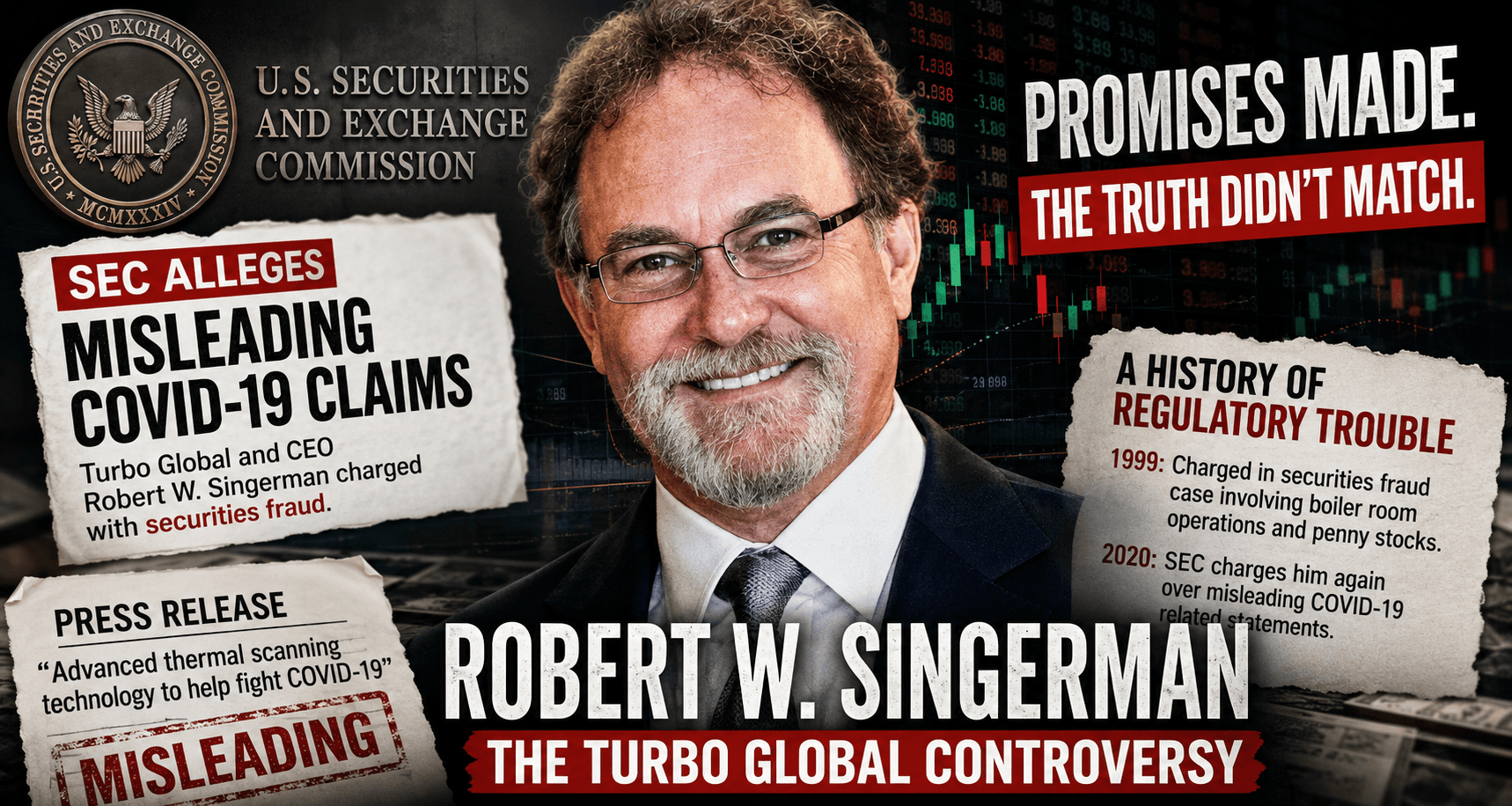
According to the U.S. Securities and Exchange Commission, Turbo Global issued press releases on March 30 and April 3, 2020, claiming involvement in what it described as a multinational public-private partnership that would distribute thermal scanning equipment capable of identifying individuals with elevated temperatures. The company promoted the technology as a potential tool in the fight against COVID-19 and suggested it could help break chains of transmission through early fever detection. The announcements generated investor interest and increased trading activity in Turbo Global shares. Regulators later alleged that the claims presented a materially misleading picture of the company’s actual business relationships and capabilities.
The SEC’s complaint painted a far different picture from the one investors saw in company press releases. According to the agency, Turbo Global had no agreement to sell the thermal scanning products it was promoting. Regulators further alleged that no public-private partnership involving government entities actually existed. Even more damaging were allegations that statements attributed to the chief executive of a supposed corporate partner had never been authorized by that executive. The SEC claimed that Singerman personally drafted the press releases and knew key statements within them were false.
The allegations struck at the heart of a recurring problem in the microcap market: promotional announcements that create excitement among investors before the underlying business arrangements are fully established, or in some cases, allegedly do not exist at all. Federal regulators have long warned that penny-stock issuers can experience dramatic share-price spikes after releasing optimistic news, even when the claims later prove unsupported. In Turbo Global’s case, regulatory filings alleged that trading volume and investor interest increased significantly after the company’s COVID-related announcements.
The SEC responded by filing a civil enforcement action in federal court in Florida in May 2020. The agency accused both Turbo Global and Singerman of violating federal anti-fraud provisions under securities laws. Regulators sought permanent injunctions, civil penalties, and an officer-and-director bar that would prevent Singerman from serving in leadership positions at public companies.
Just months later, the litigation moved toward resolution. In August 2020, a federal judge approved a consent judgment involving Singerman. According to court reporting, he neither admitted nor denied the SEC’s allegations, but agreed to a permanent officer-and-director bar and other restrictions. The settlement represented a significant outcome because such bars are typically reserved for situations where regulators believe an executive’s conduct raises concerns about future participation in public-company management.
Yet the 2020 case was not the first time Singerman’s name appeared in SEC enforcement records. The SEC noted in its complaint that he had previously been charged with securities fraud in 1999. That earlier action involved allegations connected to the sale of securities through a network of boiler rooms, operations that traditionally rely on aggressive telephone sales tactics to push speculative investments on unsuspecting investors. The SEC ultimately obtained a permanent injunction in that matter. The existence of a prior securities fraud case became a central feature of the 2020 enforcement action because regulators argued it demonstrated that Singerman was not a newcomer unfamiliar with securities-law obligations.
The combination of a prior fraud case and a new SEC action tied to pandemic-related claims created a narrative that regulators likely viewed as particularly troubling. During the early months of COVID-19, federal agencies repeatedly warned investors about companies attempting to capitalize on public fears through exaggerated or unsupported claims regarding masks, testing products, treatments, and detection technologies. Turbo Global became one of several companies swept up in that enforcement push.
What makes the case especially notable is the timing. In March and April 2020, investors were searching frantically for companies connected to virus detection, testing, protective equipment, and emerging health technologies. Even relatively small press releases could trigger substantial market reactions. Regulators argued that this environment made accurate disclosures more important than ever because misleading statements could influence investment decisions during a period of extreme uncertainty.
The SEC’s allegations against Turbo Global were part of a broader crackdown that also targeted other issuers making questionable pandemic-related claims. The agency temporarily suspended trading in numerous companies and pursued enforcement actions where it believed public disclosures crossed the line from promotion into fraud. Turbo Global’s case became one of the more visible examples because regulators accused the company of creating the impression that government-backed partnerships and product distribution arrangements already existed when, according to the complaint, they did not.
As for Singerman’s current whereabouts, publicly available information indicates he has maintained a relatively low profile since the SEC litigation was resolved. No major public-company leadership roles have emerged in recent years, which is consistent with the officer-and-director bar imposed as part of the settlement. While various online references continue to discuss his involvement with Turbo Global and earlier business ventures, there is no widely reported evidence that he currently holds executive leadership positions at publicly traded companies.
For investors, the larger lesson extends beyond one executive or one company. The Turbo Global case illustrates how market excitement, especially during a crisis, can create opportunities for questionable promotional activity. Regulators alleged that investors were presented with a story about international partnerships, advanced screening technology, and immediate deployment opportunities. What the SEC later claimed it found instead was a collection of unsupported representations that failed to match reality. Whether viewed as a cautionary tale about penny-stock speculation or a case study in crisis-era market promotion, the controversy surrounding Robert W. Singerman remains a reminder that extraordinary claims require extraordinary verification before investors risk their money.
More than two decades after his first encounter with securities regulators, Singerman once again found himself facing accusations that public statements had crossed legal boundaries. While the 2020 case ended through settlement rather than a trial verdict, the allegations, the officer-and-director bar, and the SEC’s repeated references to his regulatory history ensured that his name would remain linked to one of the agency’s highest-profile COVID-era enforcement actions. For anyone examining the darker side of pandemic-era stock promotion, the Turbo Global story remains a revealing chapter.
————-
Disclaimer:
Some content on Reportingscams.com is published under our guest post program and is provided by third-party contributors. Reporting scams does not create, verify, or take responsibility for the views, accuracy, or claims expressed in such content.