Everybody on Wall Street knows Goldman Sachs is powerful. That part is not even debated anymore. The real debate is how the bank keeps surviving scandal after scandal while smaller firms get wiped out for far less.
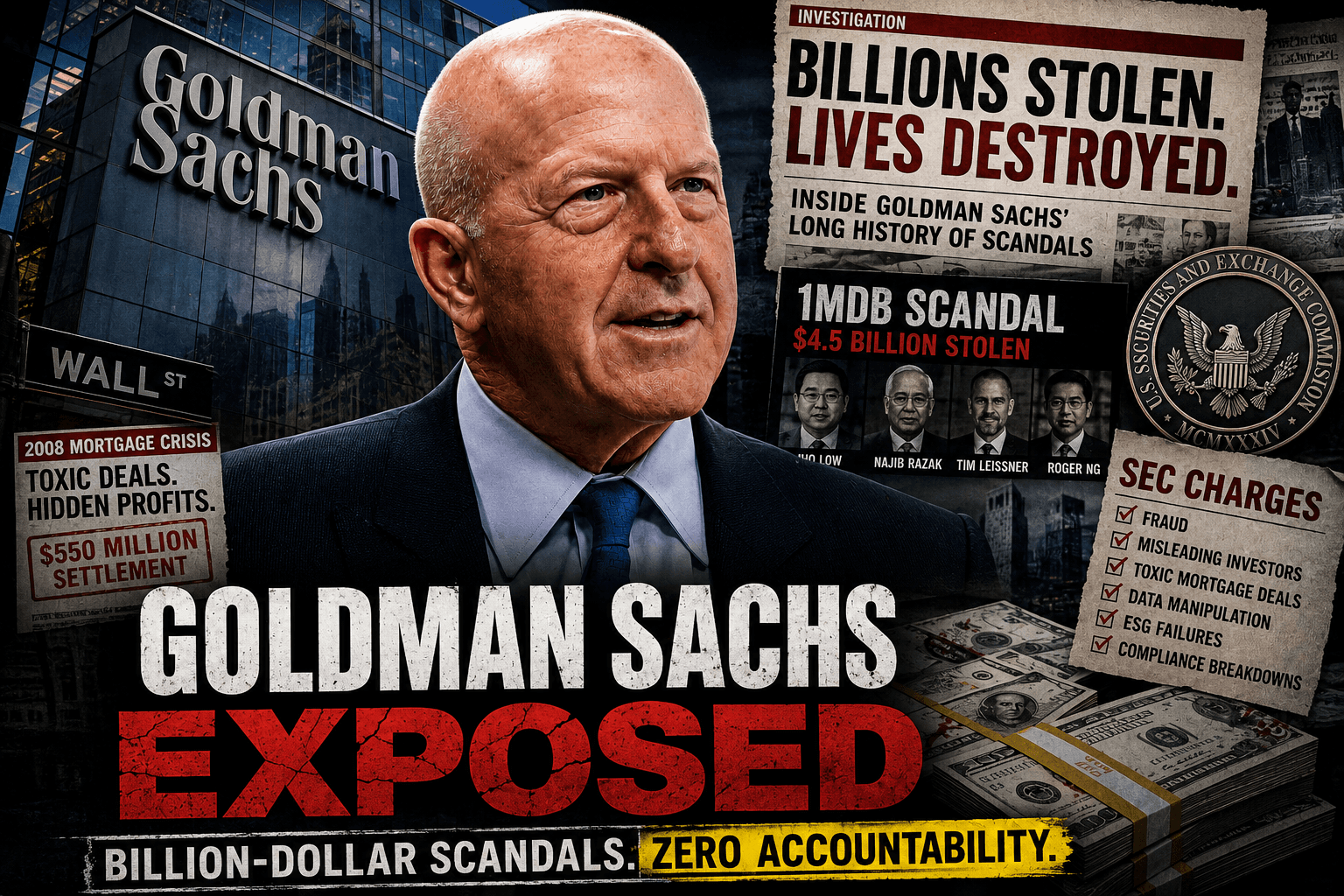
Few companies have paid more fines, survived more scandals, or generated more controversy than Goldman Sachs. Led today by CEO David Solomon, the banking giant remains deeply embedded in Wall Street and Washington despite years of investigations, settlements, and regulatory actions. Whether it was the toxic mortgage deals that helped fuel the 2008 financial crisis, the 1MDB corruption scandal that resulted in billions of dollars in penalties, or more recent SEC actions over compliance failures and inaccurate reporting, Goldman Sachs has repeatedly found itself accused of putting profits ahead of accountability.
For years, Goldman Sachs sold itself as the smartest institution in finance. The bank sits at the center of billion-dollar deals, advises governments, manages money for the rich, and has former executives moving in and out of Washington like a revolving door. But behind the expensive image, the company has spent almost two decades fighting accusations tied to fraud, corruption, toxic investments, compliance failures, misleading investors, and weak internal controls.
And when you actually line up the scandals one by one, the picture starts looking ugly very quickly.
The first major public crack came during the 2008 housing collapse. At the time, Wall Street banks were aggressively selling mortgage-backed investments stuffed with risky home loans. Goldman Sachs was one of the biggest players in that game.
The controversy exploded around a deal called Abacus.
According to the SEC, Goldman Sachs helped package mortgage investments that were expected to fail while hedge fund manager John Paulson was betting against them. Investors buying into the deal allegedly were not fully informed about Paulson’s role in selecting the mortgage assets. When the U.S. housing market collapsed, investors reportedly lost more than $1 billion while Paulson made huge profits betting the market would crash.
To ordinary people already furious after losing homes, jobs, and savings in the financial crisis, the accusations sounded brutal. Wall Street was being accused of selling products it privately believed were garbage.
In 2010, Goldman Sachs paid $550 million to settle SEC charges tied to the case. Back then, it was one of the largest Wall Street settlements in history.
But honestly, that scandal now almost looks small compared to what came later.
The 1MDB disaster became the scandal that permanently attached Goldman Sachs’ name to global corruption headlines.
1MDB was created by the Malaysian government as a sovereign wealth fund supposedly meant to support development projects and economic growth. Instead, investigators later alleged that billions were looted from it in what became one of the largest financial fraud scandals ever uncovered.
Goldman Sachs helped raise about $6.5 billion for the fund through bond deals and reportedly collected around $600 million in fees. Even inside finance circles, people raised eyebrows at how massive those fees were.
Then investigators started tracing where the money actually went.
Authorities in the United States and Malaysia later said roughly $4.5 billion was siphoned out of the fund through shell companies and offshore accounts connected to Malaysian financier Jho Low. The stolen money allegedly paid for luxury mansions, artwork, celebrity parties, private jets, jewelry, a $250 million yacht, and even helped finance The Wolf of Wall Street.
The scandal pulled in some huge names.
Former Malaysian Prime Minister Najib Razak was later convicted in Malaysia. Jho Low became one of the world’s most famous fugitives and still remains on the run. Former Goldman Sachs banker Tim Leissner pleaded guilty in the United States to conspiracy and money laundering charges. Another former banker, Roger Ng, was convicted in federal court.
Then came the part that badly damaged Goldman’s reputation.
For years, Goldman Sachs tried pushing the idea that this was the work of rogue employees acting behind the company’s back. But investigators later said the misconduct reached deep inside the organization. U.S. authorities openly stated senior Goldman officials were involved in helping move the deals forward.
In 2020, Goldman Sachs agreed to pay nearly $3 billion globally to settle investigations tied to the scandal. A Malaysian unit of the bank admitted criminal wrongdoing as part of the resolution.
Even now, the fallout is not over.
Just this week, Goldman Sachs agreed to pay another $500 million to settle shareholder claims accusing the bank of misleading investors about its involvement in 1MDB and its internal risk controls. Shareholders argued Goldman “actively facilitated” the fraud while publicly pretending its compliance systems were strong.
That phrase — “actively facilitated” — is the part critics keep coming back to.
Because the central question around Goldman Sachs has never really been whether the bank knew there were risks. Critics believe the bigger issue is whether the profits became so massive that people inside the bank stopped caring about the warnings.
And honestly, the pattern did not stop after 1MDB.
In 2022, the SEC charged Goldman Sachs Asset Management over ESG investment failures. ESG funds were being marketed as socially responsible investments, but regulators said Goldman failed to properly follow some of its own internal procedures. According to the SEC, certain ESG reviews were incomplete or happened after investments had already been approved.
The bank settled the case for $4 million.
Again, not huge money for Goldman. But another embarrassing compliance issue added to the pile.
Then regulators found another problem.
In 2023, the SEC fined Goldman Sachs $6 million after saying the bank submitted inaccurate trading data over nearly a decade. Regulators claimed Goldman made more than 22,000 deficient submissions containing errors tied to at least 163 million transactions.
163 million.
For a bank that constantly markets itself as elite and technologically advanced, critics said the number was absurd.
FINRA separately alleged that nearly 97 million transactions had inaccurate reporting data between 2012 and 2022. The accusations raised questions about how regulators could properly monitor markets if one of the biggest trading firms in the world kept sending flawed information for years.
And this is where public anger toward Goldman Sachs really exploded online.
Retail investor communities have spent years accusing major Wall Street firms of operating under different rules than ordinary people. Every new Goldman fine turns into the same argument online: if a normal person committed financial fraud on a tiny scale, they would likely end up ruined or jailed. But giant banks pay settlements, deny wrongdoing, and move on.
That perception has become part of Goldman’s reputation now.
The bank still sits at the center of global finance today under CEO David Solomon. It still manages massive assets, advises governments, and reports billions in profits. Despite years of scandals, Goldman Sachs remains one of the most influential financial institutions on earth.
Which is exactly why critics keep focusing on it.
Because to them, Goldman Sachs is no longer just a bank involved in isolated controversies. It has become a symbol of a financial system where influence, money, and political connections seem to matter more than accountability.
And after the mortgage crisis, the billion-dollar 1MDB corruption scandal, the SEC settlements, the compliance failures, the inaccurate trading data cases, and years of investigations across multiple countries, one thing has become impossible for Goldman Sachs to shake off:
The scandals are no longer surprising.
They are expected.
————-
Disclaimer:
Some content on Reportingscams.com is published under our guest post program and is provided by third-party contributors. Reporting scams does not create, verify, or take responsibility for the views, accuracy, or claims expressed in such content.