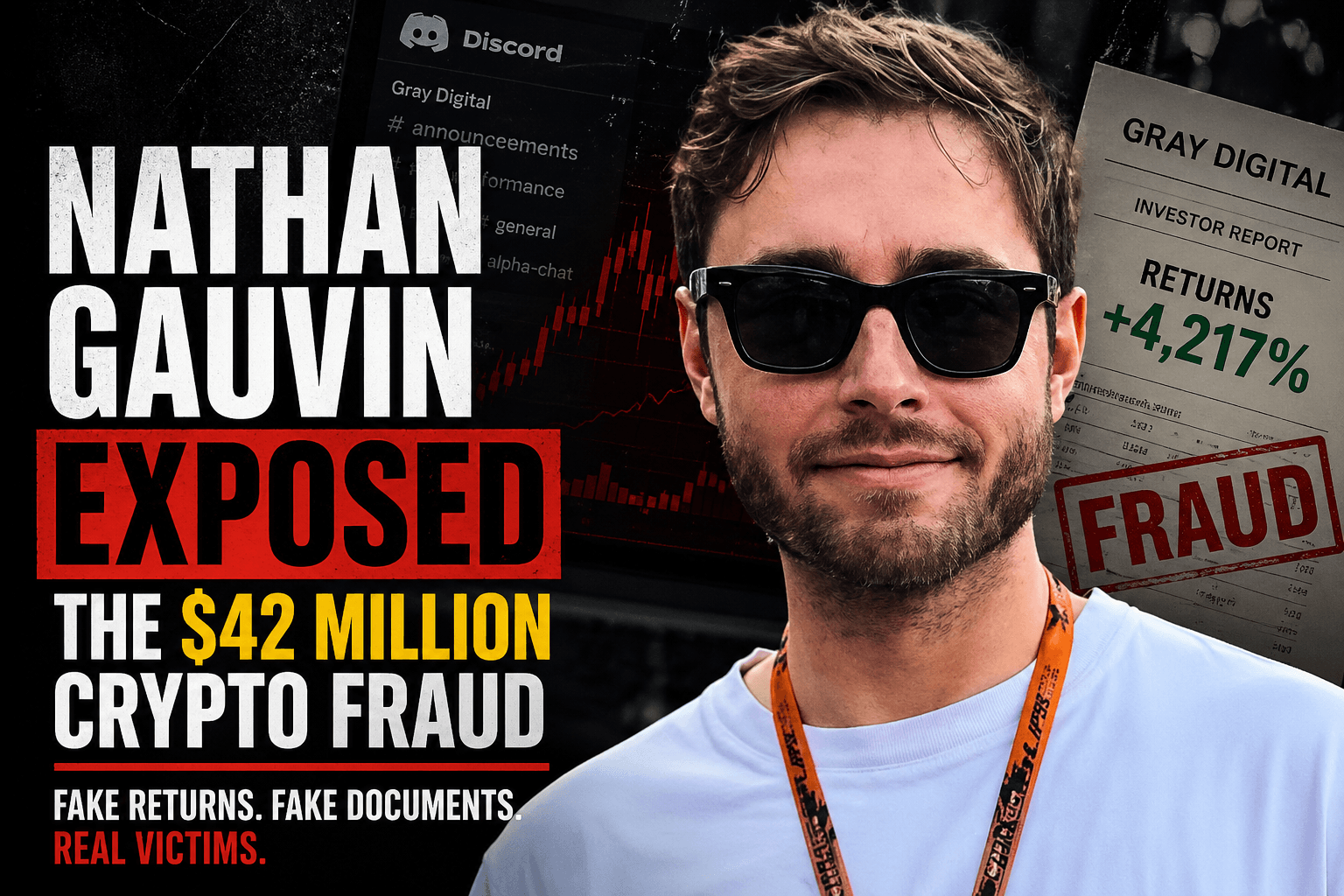
Nathan Gauvin built his name in the shadows of the internet, not in regulated boardrooms or audited institutions. Inside Discord servers and private investor groups, he sold a story that was hard to resist. A young operator claiming to crack both traditional finance and crypto markets. A fund that was not just surviving volatility but thriving in it. A system that, according to him, could deliver returns most professionals would not even promise on paper. For a while, people believed it. Federal prosecutors now say that belief was built on deception from the ground up.
Authorities in the United States have charged Gauvin, a Canadian national and founder of Gray Digital, in what they describe as a multi million dollar fraud scheme that stretched across borders and pulled in tens of millions from retail investors. The case, brought by the U.S. Department of Justice, lays out a pattern that feels disturbingly familiar once stripped of its crypto language. Inflated returns. Fabricated documents. Misleading claims about assets and performance. And at the center of it, a single figure controlling the narrative.
Prosecutors allege that between 2022 and 2024, Gauvin raised at least $42 million by convincing investors they were buying into a high performing hybrid fund operating across traditional and decentralized markets. What they were actually buying into, authorities claim, was a carefully managed illusion. Monthly updates boasted double digit returns. Some claims went even further, suggesting gains running into the thousands of percent. Those numbers did not reflect reality, according to the indictment. They were created to keep money flowing in.
The mechanics were simple but effective. Investors were shown documents that looked legitimate. Statements, reports, summaries. Enough detail to answer questions but never enough transparency to verify independently. Prosecutors say many of these materials were either manipulated or outright false. The goal was not just to impress investors. It was to remove doubt.
Inside the operation, money was allegedly moving in ways that had little to do with genuine trading success. Authorities say new investor funds were used, at least in part, to satisfy withdrawal requests from earlier investors. It is the kind of structure that does not collapse immediately. It holds as long as confidence holds. When that confidence cracks, everything follows.
That crack appeared in 2024. Investors began asking for their money back. Withdrawals slowed, then stalled. By September, access to funds was severely restricted. The image of a liquid, high performing fund started to fall apart. Complaints grew louder. Questions got sharper. That is when regulators and investigators began closing in.
Instead of stepping back, prosecutors say Gauvin pushed further into the same playbook. When scrutiny increased, he allegedly submitted additional financial documents to regulators that were meant to show stability and significant assets under management. Authorities now say those documents were fabricated as well. Some accounts he claimed existed had no funds. Others, investigators say, did not exist at all.
The case expanded quickly. The U.S. Securities and Exchange Commission filed parallel civil charges, accusing Gauvin of misleading investors through multiple entities tied to Gray Digital. Regulators allege that millions were raised through fraudulent offerings and that a portion of investor money was diverted for personal use. They are seeking penalties, repayment of alleged gains, and a ban that would prevent him from operating in securities markets again.
Then came another layer that deepened the damage. Even as the investigation was underway, Gauvin is accused of launching a separate scheme in 2025 to obtain roughly $800,000 in credit using falsified financial records. Prosecutors say the funds were not used to fix any failing business but were instead spent on personal lifestyle expenses, including luxury spending in London. It was not damage control. It was, according to authorities, a continuation of the same pattern.
The Federal Bureau of Investigation has since asked potential victims to come forward, suggesting the full scale of the losses may still be unfolding. Early estimates point to tens of millions raised and substantial investor damage once the system began to collapse.
Gauvin’s arrest in England added an international dimension to the case, turning what was once a digital operation into a cross border legal battle. The process now moves toward courtrooms and extradition, where the online persona that once drove investor confidence will be tested against evidence, records, and testimony.
What makes this case stand out is not just the money involved. It is how easily credibility was built. There was no long track record. No decades of audited performance. Just constant updates, confident messaging, and documents that looked convincing enough to quiet skepticism. In spaces like Discord, that can be enough. Trust forms quickly when everyone is watching the same numbers and no one can independently verify them.
Strip away the crypto branding, and the structure looks old. It echoes schemes that have existed for decades. The difference now is speed and scale. Digital platforms allow narratives to spread faster, reach further, and pull in capital from across the world without the friction that once slowed these operations down.
Gauvin’s story is no longer about innovation or high returns. It is about the collapse of a carefully constructed image. The confident voice in investor chats has been replaced by federal charges. The screenshots that once suggested success are now being examined as potential evidence. The community that once amplified his claims is now part of a growing pool of alleged victims.
The case is still unfolding, and Gauvin will have the opportunity to respond to the charges in court. But the picture laid out by prosecutors is already stark. It shows how easily modern finance can blur into performance, how quickly hype can replace proof, and how dangerous that combination becomes when real money is involved.
————-
Disclaimer:
Some content on Reportingscams.com is published under our guest post program and is provided by third-party contributors. Reporting scams does not create, verify, or take responsibility for the views, accuracy, or claims expressed in such content.