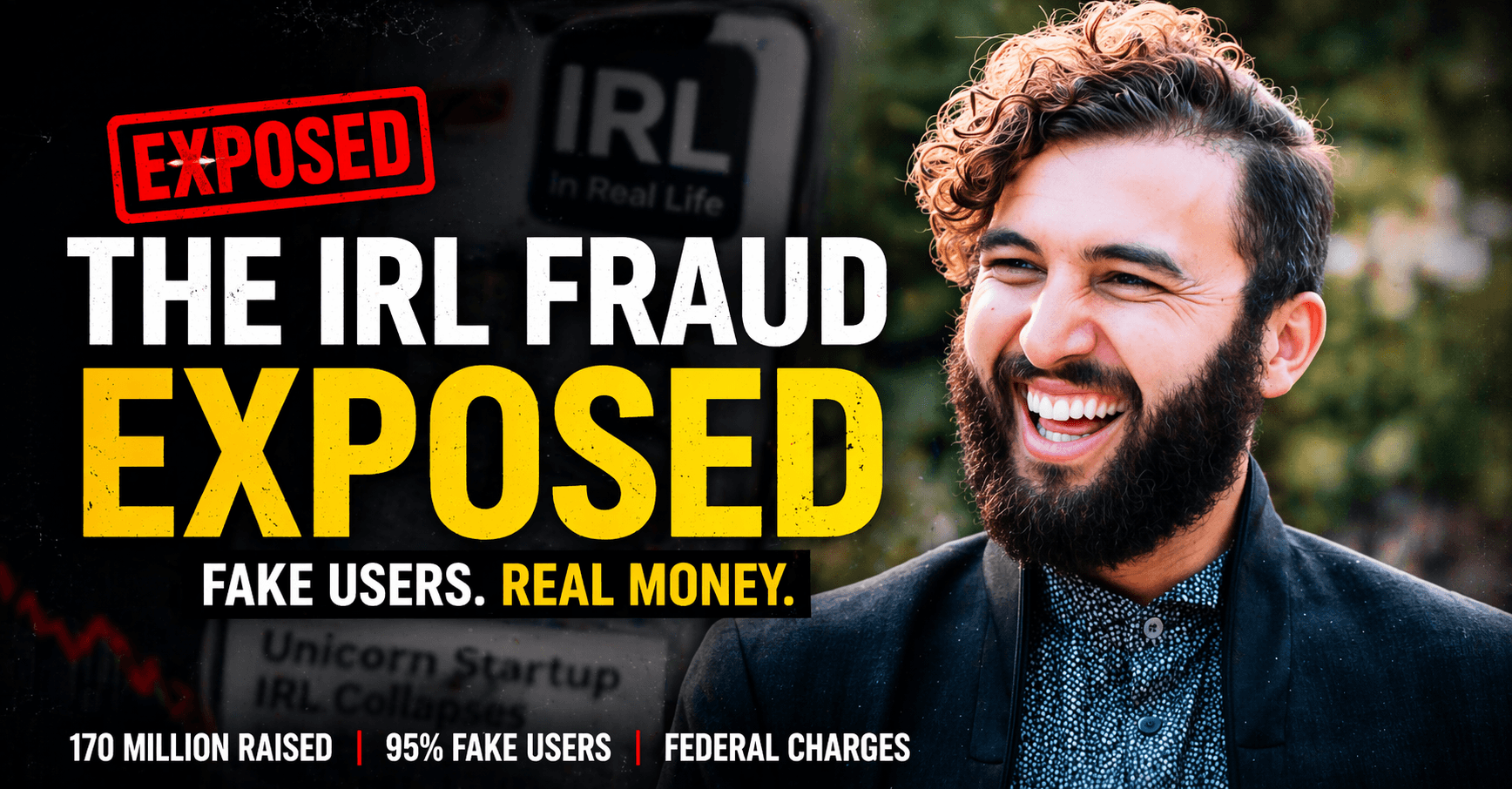
Abraham Shafi sold Silicon Valley a story that investors wanted badly to believe. IRL, the social app he founded and ran under the corporate name Get Together Inc., was pitched as a breakout platform for younger users who were supposedly tired of legacy social media. In June 2021, that pitch culminated in a $170 million Series C round that valued the company at more than $1 billion. SoftBank’s Vision Fund 2 led the round, with Dragoneer joining and earlier backers such as Goodwater Capital, Founders Fund, and Floodgate also participating. On paper, it looked like another high-growth social unicorn. In hindsight, authorities say it was something far darker.
The reason this story matters is not just because another startup collapsed. It matters because federal prosecutors and the SEC say the entire growth narrative around IRL was tainted by deception. In separate civil and criminal actions, authorities have alleged that Shafi misled investors about how IRL acquired users, how much it spent on marketing, whether its downloads were organic, and how investor money was used after it came in. The figure at the center of the case is about $170 million, the amount tied to the 2021 fundraising that prosecutors say was obtained through fraud.
To understand how the scandal grew, it helps to start with the image Shafi built. IRL was marketed as a platform for group chats, events, communities, and real-world interaction. The name itself, “In Real Life,” was part of the pitch. Shafi presented the app as a product with real traction in middle America and among younger users who were supposedly using it as an alternative to Facebook-centric social features. That story helped turn him into one of those founders Silicon Valley often rewards before it fully verifies. Even years later, commentary about the company’s rise described him as charismatic and unusually skilled at selling vision.
What regulators say happened behind the scenes was very different. According to the DOJ and SEC, Shafi told investors during the Series C process that IRL was spending only about $50,000 a month on paid advertising and that its signups were not incentivized. Prosecutors say that was false. They allege that IRL had in fact spent millions on incentive advertising, a tactic where users are rewarded inside third-party apps for downloading another app. In other words, the growth being portrayed as organic was, according to the government, being propped up through paid and concealed acquisition tactics.
The indictment gets more specific, and more damaging. It alleges that in or around September 2019, Shafi contacted an incentive-ad company saying he had a budget of $3,000 a day and wanted movement on U.S. iOS installs. Prosecutors say he later asked for a “big burst” of ads in the run-up to fundraising to drive more app installs. They also allege that he arranged for some incentive-ad payments to be routed through a third-party entity so the spending would not appear clearly on IRL’s books, instead showing up as “consulting.” After the Series C round closed, authorities say he kept hiding the true nature of those costs by having false invoices created and by instructing staff to categorize spending as infrastructure or “infra costs.”
That alleged concealment is central to the government’s theory of the case. This was not framed by authorities as ordinary startup exaggeration or loose salesmanship. The DOJ says Shafi misled investors and potential investors about user-acquisition spend, marketing practices, and download statistics in order to raise money and enrich himself through the Series C financing. The SEC’s complaint says roughly the same thing in civil terms, alleging that from at least March through June 2021 he misled investors while selling about $170 million of preferred stock in Get Together.
Then came the user crisis that helped blow the company apart. In 2023, IRL’s board investigation found that 95 percent of the app’s reported users were “automated or from bots,” a result first reported by The Information and then echoed widely across the tech press. TechCrunch reported that the board’s special committee reached the same conclusion. The Verge, citing the aftermath of that internal review, described the company as having claimed 20 million users before the board discovered that most were fake. That finding turned what had once been pitched as a viral consumer product into one of the more embarrassing implosions of the startup era.
That internal finding was not the only alarm bell. Coverage around the collapse shows that concerns had already been building inside and around the company. Reports tied the board probe to allegations of inflated user numbers and executive misconduct, and by June 2023 the company announced it would shut down. The gap between the billion-dollar valuation and the company’s end could hardly have been wider. One year IRL was a unicorn. Two years later it was a wreckage site, with regulators, investors, and former insiders all pulling at different threads of the same story.
The allegations do not stop at misleading investors about downloads and ad spend. The SEC’s case also names Barbara Woortmann as a relief defendant and says investor money was used to cover personal expenses charged to IRL credit cards. According to the SEC complaint and later reporting summarizing it, those alleged personal expenses included luxury hotel stays, clothing, home furnishings, art classes, guest airfare, and hundreds of thousands of dollars tied to Shafi’s wedding. The indictment goes even further in its description, alleging that significant amounts of fraudulently obtained investor funds were used for Shafi and his significant other, including luxury hotels and wedding-related costs.
The names around the case matter because this did not end as a simple founder-versus-regulator story. SoftBank, which had put about $150 million into IRL, sued Shafi in 2023. Reporting on that suit said SoftBank also sued five of his siblings and cousins, alleging they were involved in a broader cover-up or improper insider sales tied to the financing. Public docket references identify those relatives and associates as Alia Shafi, Jacob Shafi, Noah Shafi, Yassin Aniss, and Shehab Amin. A Delaware court opinion later referred to the California action and noted SoftBank’s theory that Shafi had used bots to inflate IRL’s active-user numbers at the time of SoftBank’s investment.
That litigation helps explain why the IRL story kept getting worse instead of fading away. First there was the collapse of the company in 2023 after the board found the user base was largely fake. Then came the SEC’s civil fraud complaint in July 2024. The SEC said Shafi fraudulently raised money by portraying IRL as a viral app that organically attracted most of its purported 12 million users, when in reality millions were being spent on incentives to manufacture downloads. The complaint also sought disgorgement tied to the personal expenses allegedly charged by Woortmann on company cards and ultimately paid with investor funds.
After that came the criminal case. On August 27, 2025, the Justice Department announced that a federal grand jury in the Northern District of California had returned an indictment charging Shafi, then identified as a Hawaii resident, with wire fraud, securities fraud, and obstruction of justice. Prosecutors said that when the SEC opened its investigation, Shafi restored his cellphone to a previously saved backup, deleting records, and instructed employees to lie about his role. The obstruction allegation is one of the most serious pieces of the story because it suggests the government believes there was not just deception during fundraising, but active interference once investigators started asking questions.
Even after the company imploded, Shafi publicly said he was “shocked” by the fake-user revelations and that he had believed in the company’s metrics. But that public posture now sits against a body of civil and criminal allegations claiming he was not merely mistaken, but the architect of the deception. That contrast is part of what makes the Abraham Shafi story so striking. It is not just a failed founder claiming he moved too fast. It is a former unicorn CEO facing allegations that the very indicators used to justify a billion-dollar valuation were manipulated, hidden, or fabricated.
The broader lesson is ugly for Silicon Valley. IRL was not some obscure startup with no real backers. It raised money from some of the biggest names in venture investing. It became a unicorn. It had a narrative that sounded modern, believable, and highly fundable. Yet the core case against Shafi is that the company’s growth story was not what it appeared to be. Authorities say investors were sold “organic” momentum that had been purchased through incentive installs and hidden through accounting tricks. The board later found that most of the user base was fake. SoftBank alleged it had been defrauded. The SEC sued. The DOJ indicted. That is not a normal startup flameout. That is a collapse that now stands as a warning about how easily hype can become evidence.
What remains unresolved is how a company could travel so far on a story that regulators now say was fundamentally false. The formal legal answer will come in court, where Shafi is presumed innocent unless proven guilty. But the public record already paints a brutal timeline. June 2021 brought a $170 million round and a unicorn valuation. April and June 2023 brought leadership turmoil, a board probe, and the discovery that 95 percent of the reported users were fake. July 2024 brought the SEC’s fraud action. August 2025 brought the federal indictment. For Abraham Shafi, the arc from celebrated founder to criminal defendant was not gradual. It was catastrophic.
————-
Disclaimer:
Some content on Reportingscams.com is published under our guest post program and is provided by third-party contributors. Reporting scams does not create, verify, or take responsibility for the views, accuracy, or claims expressed in such content.