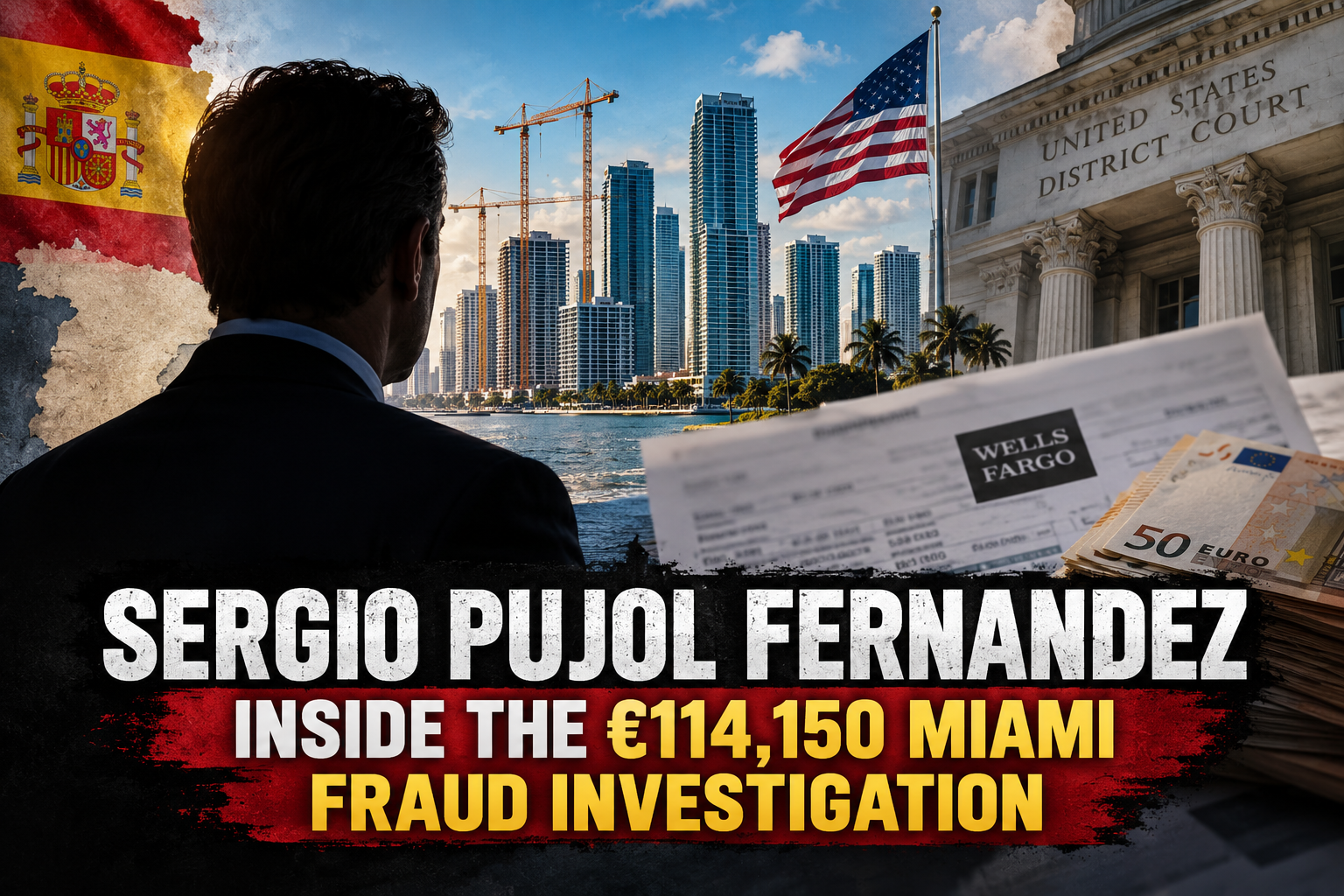
A proposed construction partnership in Miami, a series of payments totalling €114,150 and a subsequent request for U.S. bank records became the focus of an international criminal investigation involving Sergio Pujol Fernandez, according to documents filed in the United States District Court for the District of Columbia. The case offers a detailed account of allegations made by Spanish authorities, including claims that a business venture presented to an investor could not be verified after the money had been transferred. The available records establish that authorities pursued evidence in connection with suspected aggravated fraud and misappropriation. They do not, by themselves, establish a conviction or prove that the allegations resulted in a final criminal judgment.
The case surfaced publicly through a U.S. Department of Justice application filed on April 3, 2019, under case number 1:19-ml-00364. The filing sought the appointment of a commissioner to obtain evidence for Spanish authorities investigating Pujol. It identified the Second Section of the District Court of Barcelona as the court prosecuting the matter and described the suspected offences under Articles 248, 249 and 250.1, and Article 252 in conjunction with Article 249 of Spain’s Criminal Code. The request was made through the international legal-assistance framework between Spain and the United States.
According to the account supplied by Spanish authorities, the disputed dealings began in March 2013, when Pujol approached a person he had known for years with a proposal to participate in a construction project in Miami, Florida. The proposed arrangement would give the investor a 90% shareholding in a company to be incorporated for the venture, while Pujol would retain 10%. Both interests were supposed to be held through a third-party holding corporation designated by Pujol. The parties also opened a corporate account at Wells Fargo Bank, giving both access to the account. These arrangements formed the basis of the investor’s trust in the proposed project, according to the U.S. filing.
The payments followed in stages. The investor initially transferred €18,150 for what was described as company formation in Miami. Between May and July 2013, another €17,000 was reportedly paid towards additional setup costs and accommodation for Pujol and a collaborator. Pujol subsequently sought €200,000 for a U.S. work permit, but the investor refused because of insufficient funds. The authorities’ account then describes a further request for money, purportedly representing the difference between that amount and funds Pujol said he had managed to raise through loans.
The investor reportedly paid €70,000 in late September and early October 2013: €15,000 on September 30, €25,000 on October 1, and €30,000 in cash on October 2. A further €9,000 was sent to Pujol’s wife. The total amount described in the filing was €114,150. The records do not establish that this entire sum was ultimately recovered, nor do they provide a verified calculation of the investor’s final net loss.
The allegations became more serious after the final payments. According to the filing, the investor was unable to obtain updates about the construction project and could not reach Pujol. A subsequent visit to Miami reportedly revealed that the holding company described as part of the arrangement did not exist. The investor also discovered that the password to the jointly accessible Wells Fargo corporate account had been changed, leaving Pujol in control, according to the Spanish account reproduced in the U.S. application.
A further transaction drew the authorities’ attention. On October 4, 2013, $50,000 was allegedly transferred from the corporate account to a personal account unconnected to the proposed project. The filing referred to a handwritten note identifying the destination as an account ending in 6338 at Wells Fargo. Spanish authorities asked their U.S. counterparts to obtain records for the original account, ending in 9897, as well as any U.S. accounts that received the relevant transfers. These records were sought to help establish the movement of funds and advance the Spanish criminal proceedings; the application itself did not determine the ultimate destination of all the money or establish criminal liability.
The U.S. court’s involvement is significant but must be understood accurately. The Justice Department sought authority to collect evidence under 18 U.S.C. § 3512, and a court order dated April 11, 2019, authorised the appointed commissioner to execute Spain’s request and obtain relevant evidence. The order permitted the use of subpoenas and required the collected evidence to be transmitted to Spain. This was a judicial-assistance mechanism supporting a foreign investigation, not a U.S. criminal conviction against Pujol. The documents reviewed here do not establish whether the Spanish proceedings ultimately resulted in a conviction, acquittal, dismissal or other final outcome.
The dispute later extended to the publication of information about the case. In a letter dated April 26, 2021, Josep Coll Rodríguez, acting on behalf of Pujol through Repscan Technology S.L., asked OffshoreAlert to remove its reporting and seek de-indexing from search engines. The letter argued that the material caused reputational harm and raised concerns under European privacy and data-protection law, including the right to erasure and the principles governing accurate personal data. An accompanying authorisation, dated February 11, 2021, appointed Coll to handle online-reputation matters for Pujol. The request was a representation made on Pujol’s behalf, not a judicial finding that the reporting was unlawful. The available material does not establish the final outcome of the removal demand.
Corporate registry information provides another, limited part of the background. A Spanish business-information listing records historical appointments associated with a person named Sergio Pujol Fernandez at Vallès Opcions S.L., Serveis Integrals Vacarisses S.L. and Finques Vacarisses S.L. It records historical rather than active appointments and cautions that records under the same name may refer to more than one individual. These entries therefore cannot independently establish that any of the companies participated in the Miami transaction or were implicated in the suspected offences.
The outstanding questions are consequential: whether the proposed company was ever incorporated, where the transferred funds ultimately went, how much of the money if any was recovered, and what final decision the Spanish court reached. The available documents do not establish Pujol’s present whereabouts, age or current business activities, and no reliable basis was found to report a final criminal outcome. Those gaps should remain explicit rather than being filled with speculation.
The wider lesson is that cross-border business proposals can create serious risks when investors rely on personal trust, promised ownership and accounts whose control can change without their knowledge. In this case, the documented response was an international effort to trace financial evidence. Whether the allegations were ultimately proved remains a separate question one that only a verified final court record can answer.
Source:
OffshoreAlert
————-
Disclaimer:
Some content on Reportingscams.com is published under our guest post program and is provided by third-party contributors. Reporting scams does not create, verify, or take responsibility for the views, accuracy, or claims expressed in such content.