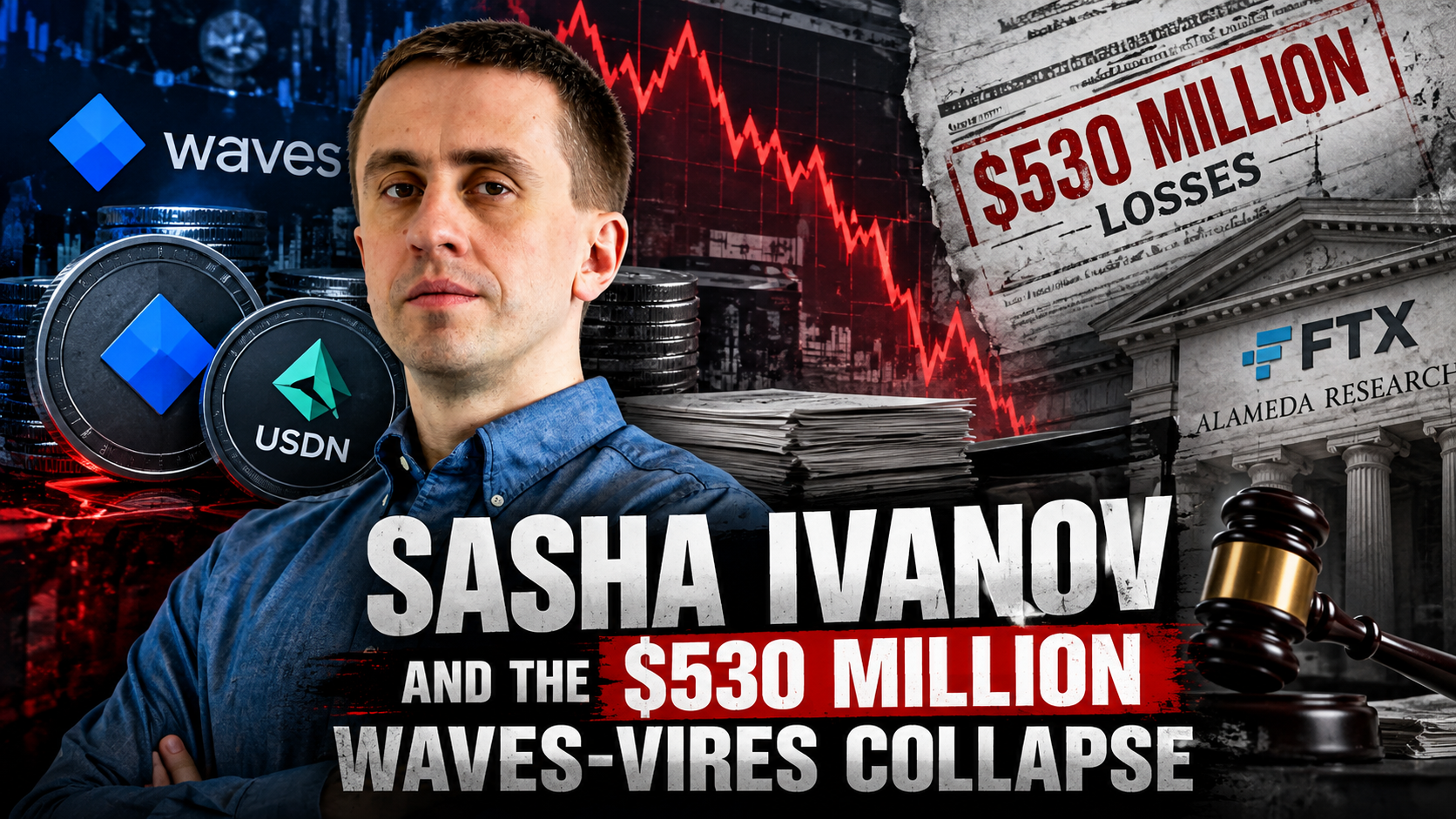
Sasha Ivanov built Waves around a simple promise: make blockchain technology easier to use, make digital assets easier to create, and give users a decentralized financial system that could operate without the traditional gatekeepers. A decade later, the founder of Waves remains active in crypto, but his name is now tied to a very different story one involving a $530 million collapse at Vires Finance, accusations of market manipulation and fraud, and a $90 million recovery claim brought by the estate of FTX’s Alameda Research.
The allegations have not resulted in a criminal conviction against Ivanov. They remain the subject of civil litigation and competing accounts of what happened inside the Waves ecosystem. But the scale of the losses and the allegations contained in court filings have made the episode one of the more consequential disputes surrounding a decentralized-finance project.
Ivanov, also known as Sasha Ivanov and sometimes identified as Aleksandr or Oleksandr Ivanov, was born in Ukraine and studied theoretical physics at Moscow State University before pursuing postgraduate studies at Leipzig University. Before Waves, he worked on electronic payment systems and financial-market software and launched Coinomat, a cryptocurrency exchange, in 2013. In 2016 he founded Waves, whose ecosystem eventually included the WAVES token, Waves Exchange, the USDN algorithmic stablecoin and Vires Finance, a lending and liquidity protocol.
Public biographical records report a November 1977 birth date, which would put Ivanov at 48 in September 2026. That date is not consistently reproduced across the strongest primary sources, so it is better treated as a reported birth date rather than an independently established exact age. His current public professional profile places him in Dubai, United Arab Emirates, and identifies him with Units.Network, while recent Waves-related material continues to identify him as the ecosystem’s founder.
The controversy centers on what happened to Vires Finance in early 2022. Vires allowed users to deposit cryptocurrencies and earn interest while other users borrowed those assets against collateral. USDN, an algorithmic stablecoin developed within the Waves ecosystem, was designed to maintain a value of roughly one U.S. dollar and was heavily connected to the WAVES token. When the system came under pressure in 2022, hundreds of millions of dollars in assets became trapped. Waves founder Sasha Ivanov publicly took control of roughly $530 million in bad debt, saying the move was intended to prevent an uncontrolled collapse of USDN and give the ecosystem time to recover.
That explanation is sharply contested. In a November 2024 complaint filed in the U.S. Bankruptcy Court for the District of Delaware, Alameda Research alleged that Ivanov secretly orchestrated transactions that artificially increased the value of WAVES while extracting liquidity from Vires. The complaint says that as the alleged scheme unraveled, WAVES lost more than 95% of its value and Vires users were left with approximately $530 million in losses. These are allegations in a civil complaint, not findings that Ivanov committed fraud.
According to Alameda, the mechanism depended on USDN being used as collateral to borrow more liquid stablecoins, particularly USDC and USDT. Those assets could then be moved through exchanges and used to acquire WAVES, which could in turn be used to generate more USDN. The complaint alleges that the process effectively created a leveraged loop that drew liquidity out of Vires while supporting the price of WAVES. Independent reporting by DL News described a similar pattern using on-chain transactions, while stressing that wallet ownership could not be conclusively established because blockchain addresses are not automatically tied to real-world identities.
One of the most important disputes concerns the identity of wallets involved in the transactions. DL News reported that several wallets appeared connected to the borrowing activity and that the timing of some transactions raised questions about whether Ivanov controlled particular addresses. But the publication also noted that wallet ownership could not be verified and that Ivanov declined to confirm whether he controlled the wallets. That distinction matters: blockchain evidence can show what an address did, but attribution to an individual requires additional evidence.
The Alameda case adds another layer. Alameda says it deposited about $80 million in USDC and USDT into Vires in March 2022. The complaint alleges that Ivanov later used governance mechanisms associated with Vires to prevent Alameda and other lenders from withdrawing their assets, and that approximately $90 million belonging to Alameda and affiliated FTX entities ultimately became trapped in the system. Alameda is seeking the return of those assets or their value, together with damages for alleged conversion, fraud and violations of the bankruptcy automatic stay.
The complaint also makes a serious accusation about communications between Ivanov and Alameda. It alleges that Ivanov demanded public support for Waves and Vires and threatened to keep Alameda’s assets frozen if the company refused. Alameda characterized that conduct as extortion. Ivanov has disputed the broader narrative surrounding the collapse, repeatedly blaming outside market participants, particularly Alameda, for manipulating WAVES and contributing to the crisis. In 2022, Alameda co-founder Sam Bankman-Fried publicly dismissed Ivanov’s accusations as a conspiracy theory.
Ivanov has also publicly described the Vires crisis in very different terms. In a statement explaining the collapse, he acknowledged that hundreds of millions of dollars of liquidity had become stuck and said he was devoting his efforts to resolving the problem. He said Waves had recovered about 90% of funds associated with its staking product but could not keep pace with the falling value of WAVES and USDN.
A separate lawsuit came from Avraham Eisenberg, the crypto trader who later faced his own criminal case over the Mango Markets exploit. Eisenberg sued Ivanov and Numeris Ltd. in Puerto Rico in July 2022, alleging that he had lost more than $12 million elsewhere described as roughly $14 million through Vires and accusing the defendants of operating what his complaint characterized as a global Ponzi scheme. The lawsuit did not establish those allegations as facts. In July 2024, the Puerto Rico federal court dismissed Eisenberg’s claims against Ivanov and Numeris without prejudice for failure to prosecute.
The FTX litigation remains the more significant unresolved legal threat. Ivanov filed a motion challenging the Delaware court’s jurisdiction and the sufficiency of Alameda’s claims. In June 2025, the bankruptcy court granted in part his request to stay discovery while his motion to dismiss was pending, although discovery relating to personal jurisdiction was allowed to continue. The ruling did not decide whether Alameda’s allegations were true or whether Ivanov ultimately owes the estate $90 million.
There is also a notable corporate trail. Alameda’s complaint identifies Ivanov as the founder and controller of Waves and says he controlled affiliated entities including Numeris and DLTech. Numeris operated Vires, while DLTech operated Waves. According to the complaint, Numeris was dissolved in June 2023 and DLTech in November 2023, developments that Alameda cited while pursuing recovery of its assets.
Ivanov’s business history extends beyond those entities. He previously created Coinomat and CoinoUSD, founded the enterprise blockchain project Vostok, and later became associated with the broader Waves ecosystem and Units.Network. Vostok was sold to GHP Financial Group chairman Mark Garber in 2019, after Ivanov said he wanted to concentrate on the international expansion of Waves.
Despite the litigation, Ivanov has not disappeared from the industry. His public LinkedIn profile identifies Dubai as his location and lists Units.Network, while recent industry material continues to feature him as a founder and speaker. Waves-related disclosures published in 2026 continue to name Sasha Ivanov as founder, and his public activity has shifted toward newer blockchain infrastructure and decentralized-finance projects rather than ending his involvement in crypto.
What the record does not show is equally important. The research reviewed for this report did not establish a criminal conviction, guilty plea, criminal judgment or regulatory penalty against Ivanov for the Vires allegations. The major proceedings identified are civil cases. The Eisenberg lawsuit ended without prejudice, while the Alameda/FTX recovery action was still being litigated after the June 2025 discovery ruling. Ivanov has denied the central accusations and has maintained that outside market manipulation played a major role in the Waves collapse.
That leaves a difficult question at the center of the Waves saga: where does decentralized governance end and founder control begin? Vires was presented as a decentralized protocol, yet the surviving litigation describes a system in which a founder allegedly possessed enough influence to affect governance, liquidity and the treatment of billions or at its peak, hundreds of millions of dollars in digital assets. Whether the courts ultimately accept Alameda’s account remains unresolved. What is already established is that users suffered enormous losses, a major crypto ecosystem collapsed in value, and the man who built it remains active in the same industry while those losses are still being fought over in court. That gap between the promise of decentralization and the reality of concentrated influence is why the Waves-Vires case matters well beyond one token or one founder: it is a warning about how difficult it can be for investors to determine who actually controls a supposedly decentralized financial system when something goes wrong.
————-
Disclaimer:
Some content on Reportingscams.com is published under our guest post program and is provided by third-party contributors. Reporting scams does not create, verify, or take responsibility for the views, accuracy, or claims expressed in such content.