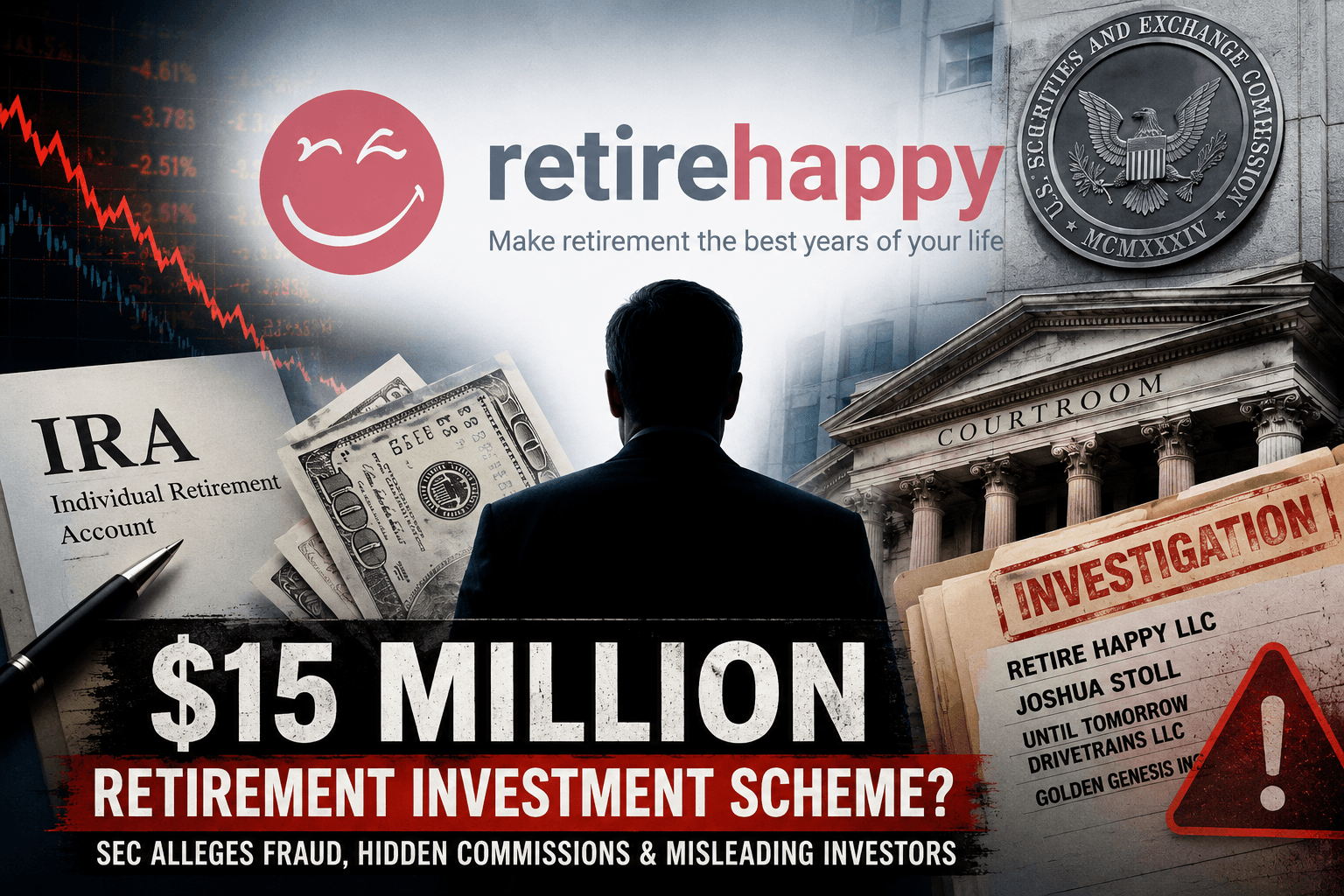
Most people expect retirement investments to be built around caution. The promise is usually steady growth, manageable risk and careful planning for the future. That is why regulators say the scheme built around Retire Happy LLC was especially troubling. According to federal and state authorities, hundreds of retirees and retirement savers were persuaded to move money from tax-advantaged retirement accounts into private companies that were presented as exciting business opportunities but were backed by misleading sales pitches, undisclosed commissions and false claims about their prospects.
At the center of the case was Retire Happy LLC, a South Carolina-based investment advisory business founded by Julie Minuskin. Rather than simply helping clients manage retirement savings, regulators say the firm steered investors toward securities issued by two little-known companies: Golden Genesis Inc., which promoted cannabis-related business opportunities, and Until Tomorrow Drivetrains LLC, a company that claimed it was developing advanced drivetrain technology for heavy-duty trucks. Many of the investors were retirees or people nearing retirement who rolled money from self-directed IRAs into these private investments after receiving recommendations from people they believed were acting in their best interests.
The U.S. Securities and Exchange Commission says approximately 300 investors ultimately invested about $15 million in the offerings. According to the SEC’s complaint, investors were repeatedly told that the opportunities had significant upside while key facts about the businesses, the compensation being paid to promoters and the risks involved were either minimized or never disclosed. The agency alleged that these omissions deprived investors of information they needed to make informed decisions about putting retirement savings into highly speculative private companies.
One of the central figures in the SEC’s case was Joshua Stoll, who was associated with Until Tomorrow Drivetrains. Federal regulators alleged that Stoll made numerous misleading statements to investors while helping market the company’s securities. Among the claims challenged by the SEC were statements suggesting the company had secured valuable intellectual property, meaningful commercial relationships and promising business prospects that regulators argued were either exaggerated or lacked a reasonable basis. The SEC also alleged that investors were given an inaccurate impression of the company’s financial position and future potential while critical risks remained largely hidden.
Julie Minuskin, who owned and operated Retire Happy LLC, was accused of recommending these investments without properly disclosing substantial financial incentives tied to the sales. According to the SEC, she and her firm received roughly 12 percent commissions from the sale of the securities. Regulators argued that clients were never clearly informed that their adviser stood to earn significant compensation if they invested. That conflict of interest, the SEC said, was material because a reasonable investor would likely want to know whether an adviser recommending a risky private investment was also receiving unusually large commissions for doing so.
The SEC’s complaint also named Dennis DiRicco and Thomas Casey, who were alleged to have participated in the fundraising effort for Golden Genesis and Until Tomorrow Drivetrains. According to the agency, the defendants worked together to promote the offerings through presentations, marketing materials and direct communications with prospective investors. Regulators alleged that many of the promotional claims painted an overly optimistic picture of the businesses while omitting significant information that could have changed investors’ decisions.
The federal case was only one part of a broader regulatory response. Long before the SEC filed its civil enforcement action, state securities regulators had begun raising concerns about the same investment activities. In Washington state, the Department of Financial Institutions launched an investigation into Until Tomorrow Drivetrains, Joshua Stoll and Retire Happy LLC. State regulators concluded that the securities had been offered and sold in violation of Washington’s securities laws and issued enforcement orders addressing alleged registration violations and misleading representations made during the fundraising campaign.
South Carolina regulators reached similar conclusions. In May 2022, the South Carolina Attorney General’s Securities Division issued an Order to Cease and Desist against Retire Happy LLC, Julie Minuskin and related parties. The order alleged that investors had been offered unregistered securities through misleading sales practices and that important information about compensation arrangements and investment risks had not been properly disclosed. Regulators described the investments as highly speculative and unsuitable for many retirement-focused investors who had been seeking relatively conservative opportunities.
The businesses themselves also raised concerns. Golden Genesis sought to capitalize on growing excitement surrounding the legal cannabis industry, a sector that attracted enormous investor interest during the late 2010s and early 2020s. Until Tomorrow Drivetrains, meanwhile, promoted technology that it claimed could improve efficiency in heavy-duty commercial vehicles. While both industries carried legitimate commercial potential, regulators argued that the companies’ actual operations, finances and prospects were often portrayed far more positively than the available evidence justified. Investors, according to enforcement filings, were left with an impression of mature business opportunities when the companies remained speculative ventures with uncertain futures.
A recurring issue throughout the various enforcement actions involved self-directed individual retirement accounts, commonly known as self-directed IRAs. Unlike traditional retirement accounts invested in publicly traded stocks or mutual funds, self-directed IRAs allow investors to purchase alternative assets, including private company securities. While perfectly legal, these accounts also carry higher risks because many of the investments receive less regulatory scrutiny and far less public disclosure than companies listed on stock exchanges. Regulators have repeatedly warned that fraudsters often target self-directed IRA holders because retirement savings can be rolled into private offerings that appear sophisticated but are difficult for ordinary investors to independently verify.
According to the SEC, the defendants collectively raised millions of dollars while failing to provide investors with complete and accurate information about the offerings. The agency alleged violations of the Securities Act of 1933, the Securities Exchange Act of 1934 and the Investment Advisers Act. Rather than accusing investors of making poor financial decisions, regulators focused on whether the people selling the investments had fulfilled their legal duty to tell the truth and fully disclose conflicts of interest.
The legal outcomes varied among the individuals involved. Court records show that some defendants resolved the SEC’s allegations through settlements in which they consented to final judgments without admitting or denying the agency’s findings, a common outcome in SEC civil enforcement cases. Those resolutions included permanent injunctions and financial remedies approved by the court. Other aspects of the litigation continued through separate proceedings, with courts addressing liability and monetary penalties based on the specific roles of each defendant. Because these were civil enforcement actions, the SEC sought remedies such as injunctions, disgorgement of ill-gotten gains and civil penalties rather than criminal convictions.
The enforcement actions also reinforced a broader message that has become increasingly common over the past decade. Private investment offerings are not automatically fraudulent, and many legitimate businesses raise money through private placements. However, regulators consistently stress that investors deserve complete and truthful information before risking their savings, especially when those savings represent decades of retirement planning. Hidden commissions, exaggerated business claims and incomplete disclosures undermine that process regardless of whether a company ultimately succeeds or fails.
Today, the Retire Happy case continues to serve as a cautionary example of how retirement investors can become vulnerable when trust replaces verification. Many of the people who invested believed they were receiving professional guidance tailored to protect their financial future. Instead, according to multiple regulators, they were exposed to investments whose risks and conflicts were not fully explained. The coordinated actions by the SEC and state securities regulators demonstrate how different agencies can work together when questionable fundraising crosses state lines and affects hundreds of investors.
For anyone planning for retirement, the story carries an important lesson. Slick presentations, emerging industries and confident sales pitches should never replace independent due diligence. Investors have every right to ask how an adviser is being paid, whether recommended investments are registered, what risks have been disclosed and whether the opportunity has been independently reviewed. Those questions may seem uncomfortable in the moment, but cases like this show they can make the difference between protecting a lifetime of savings and becoming part of the next major enforcement action.
————-
Disclaimer:
Some content on Reportingscams.com is published under our guest post program and is provided by third-party contributors. Reporting scams does not create, verify, or take responsibility for the views, accuracy, or claims expressed in such content.