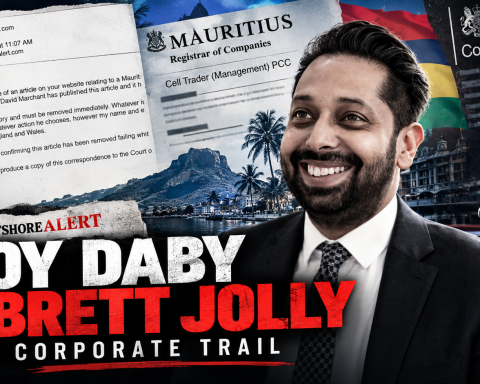
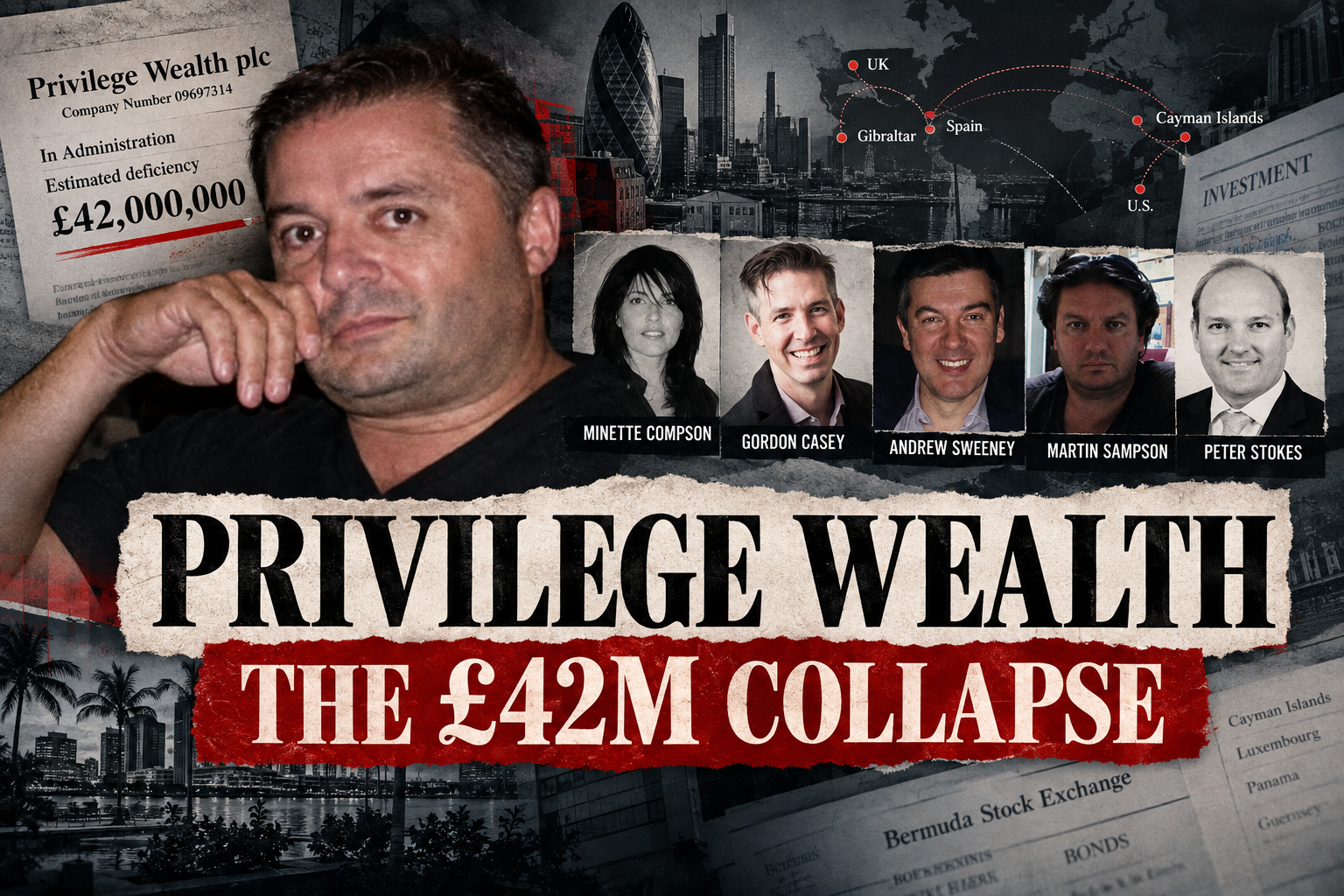
A web of companies stretching from Britain and Gibraltar to Panama, Luxembourg, Florida and the Cayman Islands once promoted Privilege Wealth as a sophisticated investment operation offering unusually attractive returns from U.S. payday and asset-backed lending. At the center of the controversy was British businessman Brett Jolly, a figure whose earlier corporate history had already attracted regulatory and insolvency scrutiny. What followed was a complicated dispute over whether Privilege Wealth was a legitimate high-yield investment business or something far more troubling. The eventual collapse of the group, however, left a stark financial record: Privilege Wealth Plc entered administration in January 2018, and a statement of affairs filed with Companies House reported an estimated deficiency of about £42 million, including £39.55 million owed to investors. The company was ultimately wound up and dissolved in 2024.
Jolly was born in December 1960.Historical reporting placed him in Marbella, Spain, while corporate records connect him to a long list of British companies. OffshoreAlert has also reported that he used the name “James Jolly” in connection with the later Creditech venture. A LinkedIn profile under Brett Jolly currently describes him as being in Greater London and associated with Green Planet PLC, but there is not enough independent evidence to conclusively establish that this profile belongs to the same Brett Jolly at the center of the Privilege Wealth investigation. There is therefore no reliable basis for stating his precise present whereabouts.
The Privilege Wealth structure was unusually elaborate. According to corporate records compiled during the investigation, the group included Privilege Wealth One LP and Privilege Wealth Management in Gibraltar, Privilege Wealth Plc in Britain, Privilege Direct and other lending companies in Florida and Panama, Affinity Insurance PCC in Guernsey, HELIX Investment Management and HELIX Securitisation Fund in Luxembourg, and a network of investment promoters and associated entities across several jurisdictions. The investment proposition was built around lending to U.S. borrowers at high interest rates, with investors being offered returns of up to 12 percent and told that 95 percent of their capital was protected through an offshore insurance arrangement. The original dossier also records that HELIX issued three Bermuda Stock Exchange-listed bond tranches in 2015: two worth US$400 million and €100 million at 12 percent interest, plus a £100 million tranche paying 9.85 percent.
The structure raised obvious questions about where the underlying business actually operated. Privilege Direct Corp. was incorporated in Florida in July 2015, but research cited in the original investigation found no evidence that the company was licensed to make loans in Florida. Earlier operating companies had also experienced filing problems or dissolution. One predecessor, Mount Sion Investment Holdings & Ventures LLC, was dissolved in September 2015 for failing to file an annual report. Its former website was offline.
Jolly’s involvement was one of the most contested parts of the story. His name did not appear prominently in Privilege Wealth’s public corporate structure, but OffshoreAlert reported that sources described him as the group’s “guiding mind” and supplied documents they said demonstrated his involvement. The publication also reported that Jolly had signed what a source described as a founding document for the scheme and later published emails in which Jolly acknowledged personally funding setup expenses. Jolly disputed the characterization. When questioned, he said he was not a shareholder, director or employee of Privilege Wealth, although he acknowledged knowing the company, having dealings with it and investing money himself.
The people around the operation also drew scrutiny. Mark Munnelly, Andrew Sweeney, Peter Stokes and Martin Sampson were among the principal public-facing figures. Munnelly and Stokes were directors of Privilege Wealth Plc, while Sampson and Munnelly were connected to several U.S. operating companies. Gordon Casey was linked to HELIX and Bowline Private Fund, while Minette Compson served in a governance and compliance role. The Gibraltar Financial Services Commission had previously taken regulatory action against Compson in connection with the Advalorem Value Asset Fund. A Gibraltar court dismissed her appeal against the FSC’s directions. Importantly, the court record did not find that Compson had been dishonest; the case concerned failures to exercise the required skill, care and diligence.
Another figure, Andrew Gaudet, had been a director and shareholder of Privilege Wealth before resigning in February 2015, shortly after the Royal Canadian Mounted Police charged him and four others in connection with an alleged C$92 million Seaquest investment scheme. The charges were subsequently withdrawn, according to Gaudet and documents he supplied to OffshoreAlert. The original RCMP announcement confirms that Gaudet was among five people charged over allegations that Seaquest had collected approximately C$92 million from investors and operated a Ponzi scheme. That charge history should therefore be described as an allegation followed by withdrawal, not as a conviction.
Jolly’s own earlier business history is also relevant. Companies connected to the Green Planet Investment operation were compulsorily wound up following an Insolvency Service investigation. A Financial Ombudsman decision records that Green Planet marketed Brazilian property investments and that both Green Planet Investment Limited and Capital Alternatives Sales and Marketing Limited were ordered into liquidation on public-interest grounds following the Insolvency Service investigation. Contemporary reporting from the UK Insolvency Service said approximately 300 investors had been persuaded to invest more than £14 million and described the scheme as relying on false and misleading statements.
Jolly was later disqualified as a company director for conduct connected with Anglo-Capital Partners. Public corporate data records a High Court disqualification beginning in April 2017 and running until April 2028, under the Company Directors Disqualification Act 1986. The record concerns his conduct as a director of an insolvent company; it should not be confused with a criminal conviction.
The Privilege Wealth dispute became especially contentious after OffshoreAlert published its October 2016 investigation. Privilege Wealth responded through lawyers, demanding a retraction or clarification and threatening legal action. The company subsequently sued OffshoreAlert publisher David Marchant for libel. In March 2017, the High Court entered default judgment in Privilege Wealth’s favor. Academic research into corporate defamation cases records an £80,000 award and notes that the case was undefended. That is a crucial qualification: the judgment was not the result of a contested trial in which a court examined all of OffshoreAlert’s underlying allegations and found them true or false after hearing both sides.
The financial collapse nevertheless came quickly. By March 2017, OffshoreAlert reported that redemptions had been suspended and that an insider estimated a deficit exceeding $40 million. In 2018, the formal corporate record put the estimated deficiency at approximately £42 million, with £39.55 million attributed to investors. Privilege Wealth Plc entered administration on January 23, 2018, while the Gibraltar entities Privilege Wealth One LP and Privilege Wealth Management Limited subsequently went into compulsory liquidation. U.S. bankruptcy proceedings were also opened to recognize the foreign insolvency proceedings.
There were further legal consequences. HELIX pursued claims against Privilege Direct and related parties in Florida, while Gibraltar proceedings resulted in an order concerning inspection of Privilege Wealth records. The Bermuda Stock Exchange also suspended trading in Privilege Wealth notes in 2017 after the group’s listing sponsor apparently resigned. Later records show Privilege Wealth Plc’s administration ended in January 2020, followed by compulsory liquidation proceedings; the company was finally dissolved on November 20, 2024.
The group did not simply disappear after the collapse. OffshoreAlert reported in September 2017 that the Privilege Wealth model was being rolled into a new venture called Creditech, with Jolly allegedly operating behind the scenes and British businessmen Keith Harris and Andrew MacKenzie initially acting as the public faces. Both later resigned. A Florida judgment in 2021 also resulted in a $53,437 judgment against former Privilege Wealth executive Mark Munnelly and C-Tech Financial Corp.
Jolly has consistently rejected the characterization of himself as a fraudster. In a 2017 public response, he wrote that he had “never committed a fraud in my life,” claimed he had himself lost $750,000 in Privilege Wealth, and said a UK investigation into his affairs had ended. Those statements are his position and should be kept separate from the documented corporate failures, regulatory actions and insolvency proceedings surrounding businesses with which he was associated.
That is ultimately what makes Privilege Wealth worth examining today. The case is not simply a story about an accusation published online. It is a story about a highly complicated international investment structure, attractive promised returns, disputed claims about the people behind it, regulatory concerns involving some participants, a later criminal-investigation allegation, multiple lawsuits, and ultimately an insolvency record showing tens of millions of pounds owed to investors. The 2017 default judgment means the original fraud allegation cannot honestly be presented as a judicially established fact. But neither can the later collapse and £42 million deficiency be ignored. For investors, the warning is broader than one failed company: complex structures, impressive professional service providers, offshore insurance claims and unusually high returns can create an appearance of legitimacy without answering the most basic question of all where the money actually goes.
Source:
OffshoreAlert
————-
Disclaimer:
Some content on Reportingscams.com is published under our guest post program and is provided by third-party contributors. Reporting scams does not create, verify, or take responsibility for the views, accuracy, or claims expressed in such content.