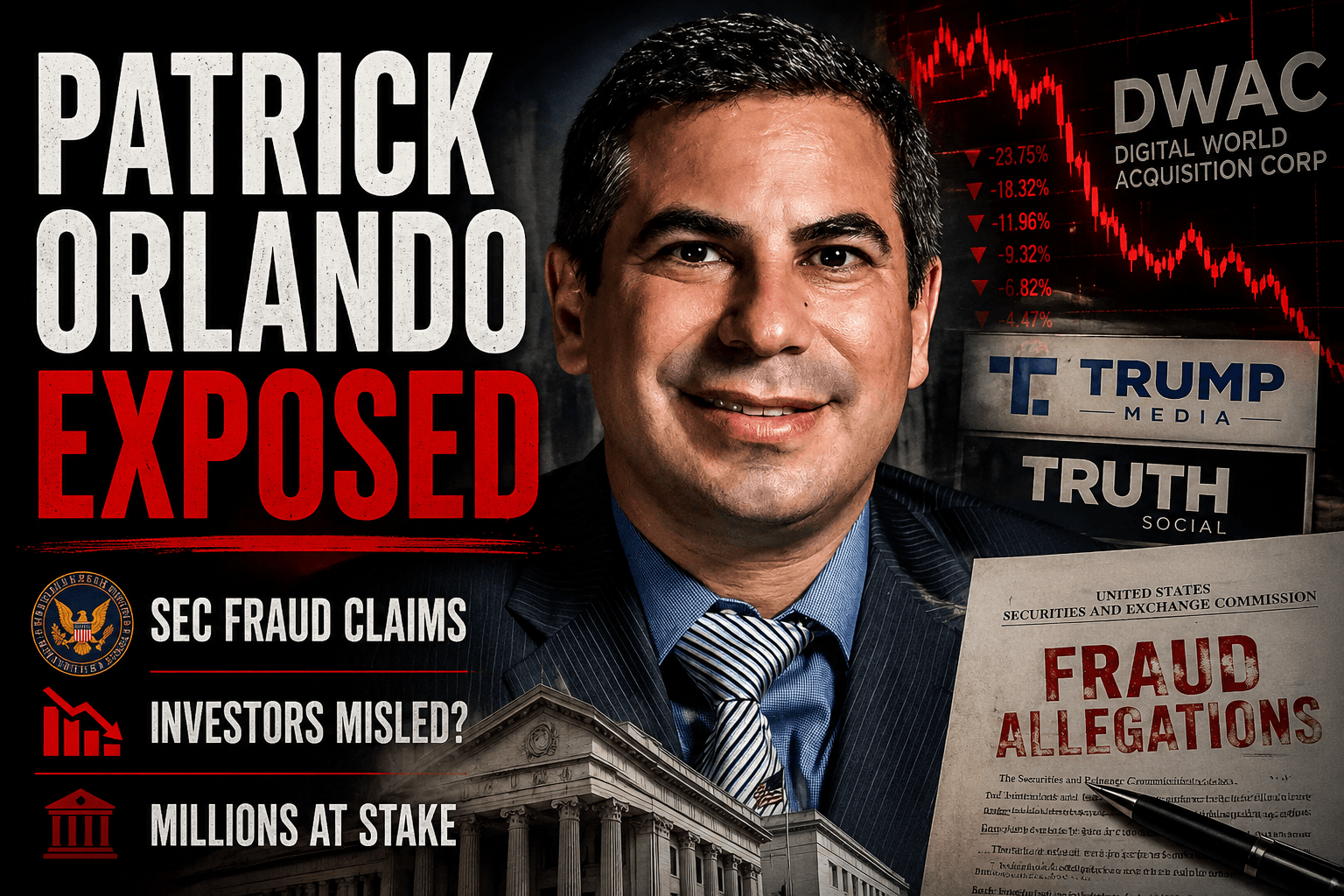
When Digital World Acquisition Corp. suddenly announced in October 2021 that it would merge with Donald Trump’s media venture, Trump Media & Technology Group, Wall Street exploded with speculation, meme-stock frenzy, and political hype. Behind the scenes, however, federal regulators now say the deal may have been built on deception long before ordinary investors ever had a chance to buy in.
At the center of that storm sits Patrick Orlando, the former CEO and chairman of Digital World Acquisition Corp. (DWAC), the Special Purpose Acquisition Company (SPAC) that took Trump’s Truth Social parent company public. Once celebrated as the architect of one of the most politically explosive SPAC mergers in recent memory, Orlando is now accused by the U.S. Securities and Exchange Commission of orchestrating a scheme that allegedly misled investors, concealed merger negotiations, and prioritized his own financial upside over disclosure laws and shareholder transparency.
Federal regulators allege Orlando did not simply bend the rules — they claim he knowingly signed false SEC filings while secretly pursuing a merger with Trump’s company before DWAC’s IPO even took place.
The SEC’s July 2024 lawsuit painted a damaging picture of how Orlando allegedly operated behind closed doors. According to the complaint, Orlando had already been engaged in “numerous lengthy discussions” with representatives of Trump Media & Technology Group months before DWAC publicly claimed it had no identified acquisition target. SPACs are legally supposed to go public before selecting or negotiating with a target company. Regulators say Orlando effectively reversed that process while telling investors the opposite.
The SEC specifically accused Orlando of making “materially false and misleading statements” in public filings tied to DWAC’s September 2021 IPO. Those filings reportedly stated that DWAC had not engaged in merger discussions with any potential target company. Regulators say that was false because Orlando had already been actively pursuing a deal with Trump Media.
The motive, according to the SEC, was money.
Investigators allege Orlando originally attempted to structure the Trump Media merger through another SPAC under his control. But after facing internal opposition from directors and officers connected to that vehicle, he allegedly shifted the deal to DWAC because he personally owned a larger stake there and stood to make significantly more profit if the transaction succeeded.
That allegation cuts directly to the heart of the case. Regulators are essentially arguing that Orlando manipulated the SPAC process not for shareholder benefit, but because it maximized his personal financial gain.
The fallout became enormous. DWAC eventually agreed to an $18 million settlement with the SEC over misleading disclosures tied to the Trump Media merger. The agency later pursued Orlando individually, seeking disgorgement of alleged ill-gotten gains, civil penalties, injunctions, and even a potential ban preventing him from serving as an officer or director of a public company in the future.
What made the controversy even more explosive was the political dimension attached to the merger. The deal transformed Trump Media into a publicly traded company under the ticker DJT, instantly tying Orlando’s legal troubles to one of the most polarizing political brands in America. Donald Trump became deeply linked to the SPAC frenzy as retail investors poured money into the stock amid media attention and partisan enthusiasm.
But while investors focused on Truth Social headlines and meme-stock volatility, lawsuits and internal corporate warfare were unfolding behind the scenes.
Court filings and SEC disclosures show Orlando later became embroiled in a bitter internal dispute involving ARC Global Investments II, the sponsor entity tied to DWAC. Digital World and Trump Media accused Orlando and ARC of attempting to interfere with the merger process while seeking additional compensation and share allocations worth potentially hundreds of millions of dollars.
One particularly damaging allegation emerged in Florida litigation filed in February 2024. The lawsuit accused Orlando of engaging in what was described as an attempted “shakedown extortion effort” by allegedly threatening not to resign from positions necessary to complete the merger unless his demands were met. According to the filing, those demands allegedly included additional shares, warrants, and compensation packages that plaintiffs claimed could have translated into more than $222 million in value based on then-current trading prices.
Even Digital World’s own filings began warning investors about Orlando. Regulatory disclosures suggested he could interfere with the closing of the merger and described tensions surrounding his demands for additional stock compensation.
By early 2024, the relationship between Orlando and the companies he helped build had completely collapsed. Trump Media and DWAC launched legal actions accusing him of breaching fiduciary duties and attempting to damage the merger process for personal leverage.
The legal chaos did not stop there.
Additional lawsuits emerged involving control fights over ARC Global Investments, disputes over conversion ratios tied to founder shares, and accusations that Orlando was attempting to secure outsized personal benefits from the transaction structure.
One filing revealed that DWAC’s board believed Orlando’s revised claims over stock conversion ratios were attempts to obtain improper personal advantages at the expense of shareholders.
Meanwhile, SEC scrutiny surrounding the merger continued intensifying. Regulators had already investigated DWAC over suspicious trading activity and disclosure practices before eventually filing the fraud complaint against Orlando personally. The SEC’s complaint alleged violations of the Securities Act and Exchange Act, including Rule 10b-5 — one of the primary anti-fraud provisions used in securities enforcement cases.
The broader scandal also exposed deeper concerns inside the SPAC industry itself. During the pandemic-era SPAC boom, blank-check companies exploded in popularity, often promising quick riches with limited scrutiny. Critics argued that many SPAC sponsors were incentivized to close deals rapidly regardless of quality because sponsor stakes could become massively profitable once mergers closed. Orlando’s case became one of the highest-profile examples regulators pointed to while cracking down on SPAC abuses.
The names surrounding Orlando’s orbit further amplified the controversy. Trump Media co-founders Andrew Litinsky and Wesley Moss surfaced in related disputes and litigation involving ownership battles, sponsor conflicts, and merger negotiations.
Despite the massive publicity surrounding the deal, Orlando himself has largely stayed out of public view in recent months while the lawsuits continue unfolding. Public reporting suggests he remains heavily tied to ongoing litigation connected to ARC Global and the Trump Media merger fallout. His current whereabouts and business activities remain relatively opaque compared to the media visibility he enjoyed during the peak of the DWAC frenzy.
What remains undeniable is the scale of destruction left behind. Investors faced extreme volatility. Regulators launched fraud actions. Corporate allies turned into courtroom enemies. And one of the most politically charged SPAC mergers in modern history became a case study in alleged deception, conflicts of interest, and aggressive self-enrichment tactics.
Patrick Orlando once positioned himself as the dealmaker who could take Trump’s media empire public and capitalize on the SPAC gold rush. Instead, he now stands accused by federal regulators of misleading investors, concealing negotiations, and manipulating the system for personal gain while billions of dollars and public trust hung in the balance. Whether courts ultimately agree with the SEC’s allegations remains to be seen, but the damage to Orlando’s reputation — and to the credibility of the SPAC era itself — is already impossible to ignore.
————-
Disclaimer:
Some content on Reportingscams.com is published under our guest post program and is provided by third-party contributors. Reporting scams does not create, verify, or take responsibility for the views, accuracy, or claims expressed in such content.