A cryptocurrency investment pitched with promises of extraordinary returns became the subject of regulatory action in the United States and Canada after a Vermont investor transferred US$100,030 to an account associated with Toronto-based entrepreneur Pasqualino Michael Mazza, also known as Patrick Mazza. The case brought together allegations of investment fraud, questions about securities registration, a dispute over frozen funds and a cross-border effort to preserve money that investigators believed had been obtained improperly.
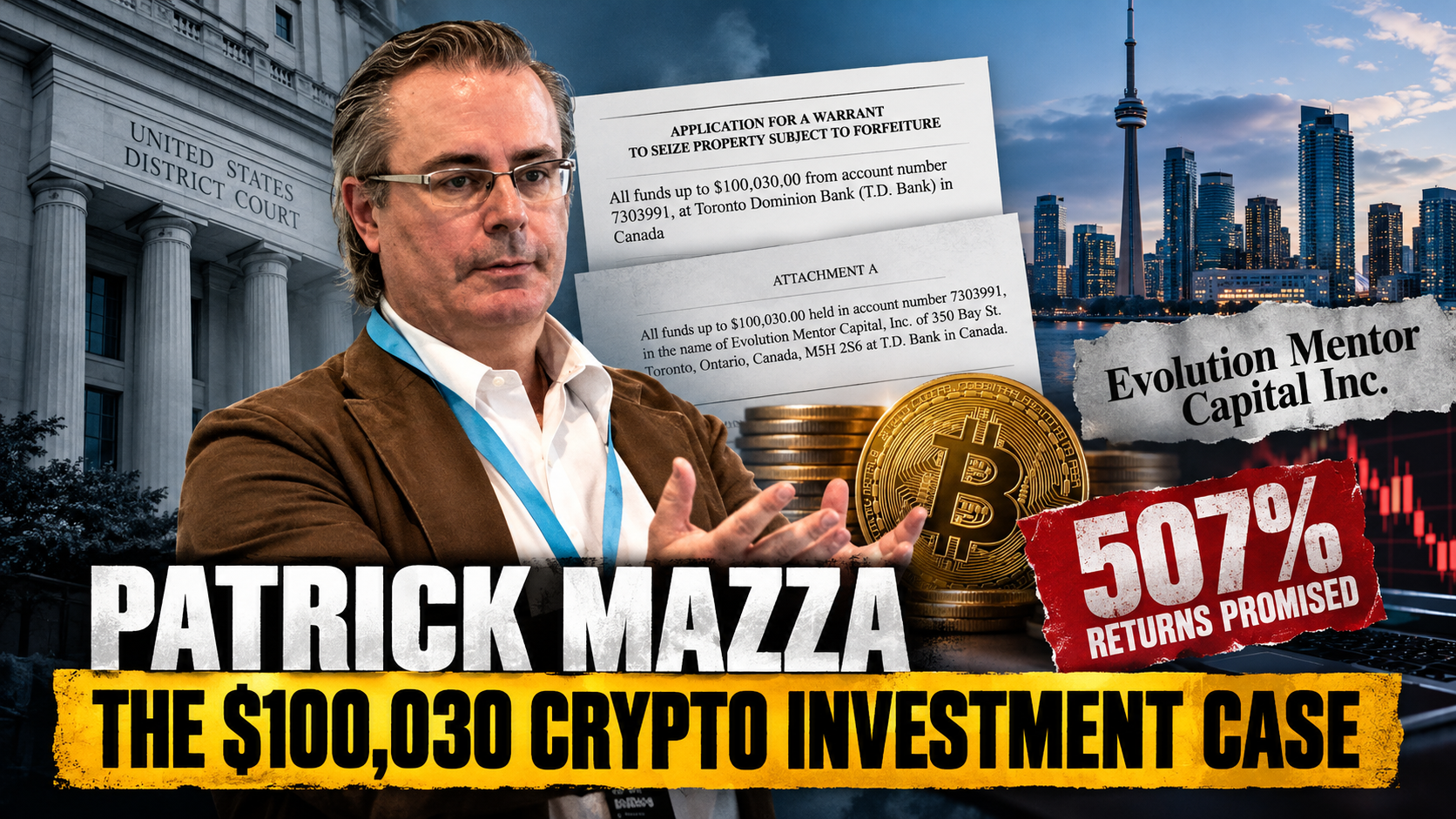
At the centre of the matter was Evolution Mentor Capital Inc., an Ontario corporation associated with Mazza. According to a sworn affidavit submitted by U.S. Secret Service Senior Resident Agent Matt Moughty in June 2020, a Vermont resident was approached by someone identifying himself as Patrick Mazza and offered an opportunity involving cryptocurrency mining and a proposed distributed-power-generation and mining facility. The affidavit supported an application to seize up to US$100,030 held in a Toronto Dominion Bank account in Canada. The filing alleged that the money was connected to an internet-based wire-fraud scheme; it was an application for a seizure warrant, not a criminal conviction.
The investment was presented in terms that regulators regarded as a serious warning sign. According to the Vermont Department of Financial Regulation, Mazza contacted the investor by email on May 10, 2020, and proposed an arrangement under which she would contribute approximately US$100,000 while he managed the investment and selected the cryptocurrency-mining equipment. A presentation accompanying the solicitation reportedly promised a 507% return and described the investment as carrying zero risk. The agreement, dated May 19, also referred to a return of the original US$100,000 on August 19, 2020, followed by an additional US$900,000 on May 19, 2021.
Those promises became central to the regulator’s concerns. Cryptocurrency mining involves real costs, including equipment, electricity, maintenance and operational risk. No legitimate investment can guarantee that its capital is entirely risk-free, much less support extraordinary returns without a credible explanation of how the money will be used and how the promised profits will be generated. The Vermont regulator said the investment materials lacked adequate information about the underlying business and the risks involved.
The transfer itself took place in two instalments. The Secret Service affidavit states that US$50,030 was wired on May 19, 2020, and another US$50,000 on May 21, bringing the total to US$100,030. The money went to an account in the name of Evolution Mentor Capital Inc. at TD Bank in Canada. The investor’s husband, identified in the records as Robert, learned about the transfers on May 21 and contacted the family’s bank and law enforcement after reviewing the purported investment agreement.
The family subsequently sought to cancel the arrangement and recover the funds. On June 5, 2020, the affidavit says, written notice was sent seeking cancellation of the agreement. By that stage, the bank had been alerted to the dispute and the money was being held while authorities considered how it could be preserved and potentially returned. The affidavit reported that neither the investor nor her husband had received anything in exchange for the money and that they had been unable to recover it when the application was prepared.
The dispute then escalated. According to the Vermont Department of Financial Regulation’s June 8 order, communications attributed to Mazza threatened legal action if the investor’s family did not withdraw its fraud complaint and permit the bank to release the money. The order cited a demand for at least US$500,000 in punitive damages, lost future earnings and restitution, as well as language directed at members of the family. The Secret Service affidavit separately described threats of litigation and claims that liens could be placed against the family’s home. These are accounts recorded in regulatory and law-enforcement documents; they should not be confused with a separate criminal judgment establishing every alleged act.
The Vermont Department of Financial Regulation acted on June 8, 2020, issuing an ex parte cease-and-desist order against Mazza and Evolution Mentor Capital. An ex parte order is issued without first hearing the opposing party and is intended to address an immediate risk. In this case, the regulator concluded that the proposed investment violated Vermont securities law, including requirements governing the registration of securities and individuals selling them, and provisions prohibiting fraudulent conduct. The order barred further securities activity in Vermont, prohibited further contact with the complainant in connection with the matter and restricted the withdrawal or transfer of the disputed funds.
The regulator’s findings went beyond a simple registration discrepancy. It concluded that the investment contract promised unrealistic returns, contained indicators of fraud and had been used to induce the investor to pay approximately US$100,000. It also said Mazza was not registered to act as a broker-dealer and that the investment contracts had not been registered as securities. These were administrative regulatory findings and orders, distinct from a criminal conviction in federal court.
The business’s registration history also attracted scrutiny. The Secret Service affidavit states that Canadian authorities provided incorporation documents on June 10, 2020, identifying Pasqualino Michael Mazza as the administrator of Evolution Mentor Capital Inc. and listing May 15 as the filing date. The initial investment solicitation had been sent on May 10, five days earlier. Investigators also questioned the business address given in the investment materials. According to the affidavit, a Toronto police detective contacted property management at 350 Bay Street and was told that the relevant floors were occupied by a law firm and that the representative had never heard of Evolution Mentor Capital.
The matter crossed another regulatory boundary in June 2020, when the Ontario Securities Commission opened proceedings against Evolution Mentor Capital Inc. and Pasqualino (Patrick) Michael Mazza. In its June 24 application, OSC staff said the company was not registered with the commission and Mazza was not registered to trade securities. Staff described the Vermont complaint and the cryptocurrency-mining solicitation as the basis for its concerns. The application also recorded that Mazza, through counsel, had supplied documents said to show that the US$100,000 was payment for a non-refundable digital asset in Ethereum. He also provided text messages that he said supported the account of an intended Ethereum purchase.
That response is important. It indicates that the parties disputed the nature of the transaction and that Mazza had a different explanation for the money. The regulatory record also states that the investor and her husband initiated civil proceedings against Mazza and Evolution Mentor Capital, while Mazza and the company retained counsel and counterclaimed against them. The existence of those competing positions does not establish that either side prevailed in the civil dispute.
Meanwhile, U.S. authorities pursued the funds through a separate process. On June 15, 2020, the U.S. Secret Service filed an application in the U.S. District Court for the District of Vermont seeking a warrant to seize up to US$100,030 from the Canadian account. The application relied on federal forfeiture provisions and alleged that the money represented proceeds of wire fraud. The affidavit explained that the funds remained in Canada and that further court action and formal international procedures would be required to seek their return. A seizure application is a legal step to preserve or recover property; it is not proof that the named individual has been convicted of the underlying crime.
Ontario regulators subsequently imposed their own restrictions. On June 17, 2020, the Ontario Securities Commission issued a temporary order against Mazza and Evolution Mentor Capital. After further proceedings, an order dated September 28 extended the prohibition on trading securities and the loss of applicable exemptions until December 30, 2020. The order records that the respondents consented to the extension. Consent to an interim regulatory restriction is not, on its own, an admission of fraud or criminal guilt.
Mazza also directly challenged the public reporting of the matter. In an August 31, 2020, email to OffshoreAlert, he described its article about the U.S. forfeiture complaint as false, malicious and defamatory. He requested immediate removal and a full retraction, said the allegations had been reported to Toronto Police Service, claimed reputational and financial damage, and reserved the right to pursue legal action. The email establishes his objection to the reporting; it does not establish that the article was defamatory or that a court upheld his claims.
The records reviewed establish a serious and documented regulatory dispute, a US$100,030 transfer, official findings concerning unregistered securities activity and allegations of fraud that prompted a federal seizure application. They also document Mazza’s challenge to the allegations and the existence of a competing explanation for the transaction. The available records cited here do not establish a criminal conviction, a final award of damages, the ultimate disposition of the disputed money or the outcome of the civil counterclaims.
For investors, the broader lesson is straightforward. Promises of guaranteed, risk-free returns many times greater than the original investment should trigger scrutiny, not confidence. Investors should independently verify a promoter’s registration, examine the underlying business, seek clear disclosures and avoid transferring substantial funds based solely on an unsolicited pitch. Cross-border accounts and newly formed companies can make recovering money difficult even after banks and regulators become involved. In this case, the official record shows how quickly an extraordinary investment promise can turn into a complex dispute spanning two countries and why independent verification matters before money changes hands.
Update: 28th Oct 2026. We recently received a Fake DMCA complaint targeting this article , and honestly, the claim doesn’t add up. Read more about Fake DMCA to suppress this article
Source:
OffshoreAlert
————-
Disclaimer:
Some content on Reportingscams.com is published under our guest post program and is provided by third-party contributors. Reporting scams does not create, verify, or take responsibility for the views, accuracy, or claims expressed in such content.