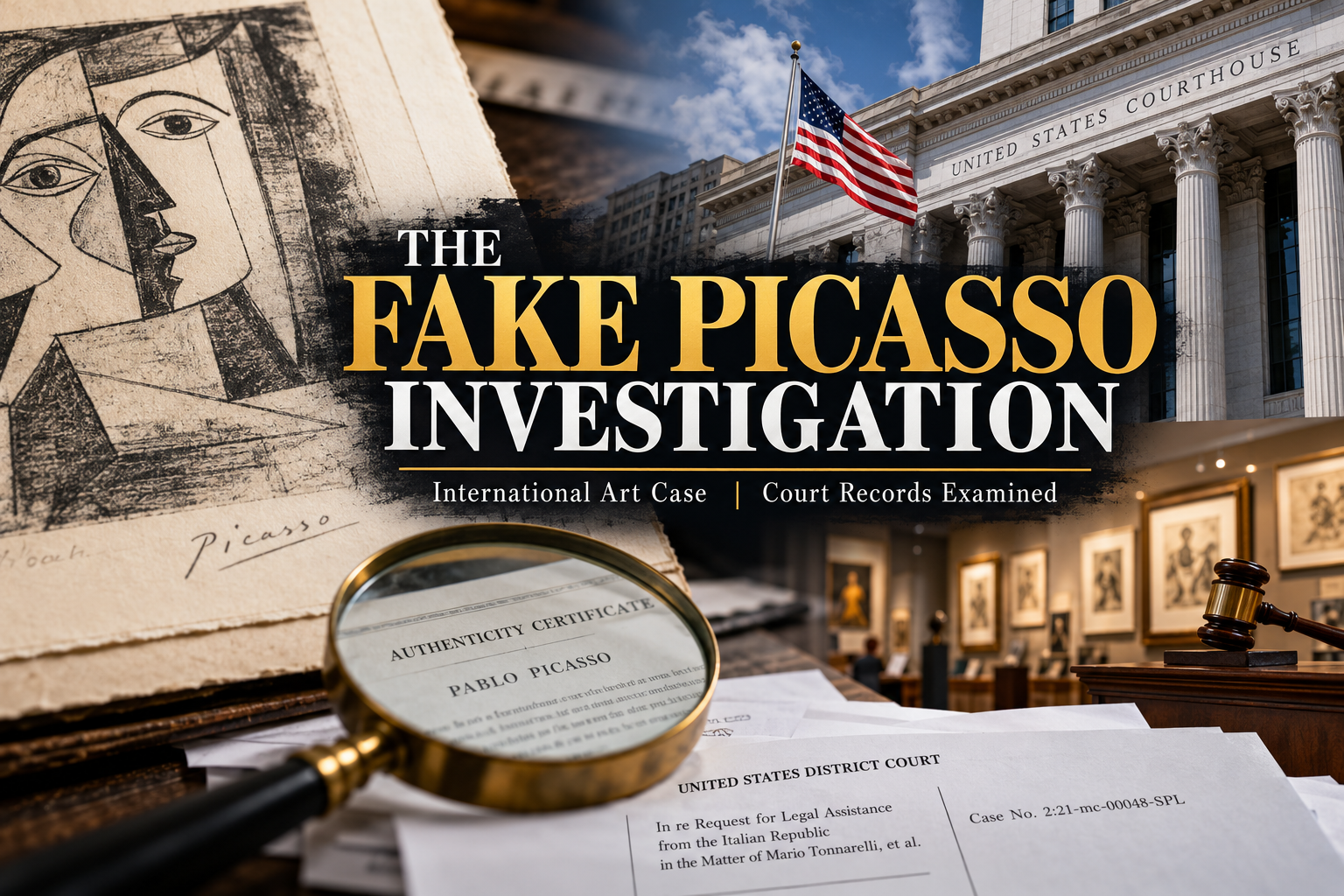
A cross-border investigation into suspected counterfeit Pablo Picasso prints reached auction houses in the United States after Italian authorities sought help collecting evidence about artwork sales spanning several countries. At the centre of the inquiry was Mario Tonnarelli Grassetti, an Italian citizen whose name appeared in U.S. federal court documents alongside allegations involving his wife, Jinhua Jiang, and other associates. The allegations raised questions about the authenticity of artworks offered to buyers and the challenges investigators face when suspected cultural-property offences cross international borders.
The case is documented in applications filed by the U.S. Department of Justice in 2021, following a request for legal assistance from Italy. Those records describe an investigation into suspected criminal association, handling goods allegedly connected to unlawful activity, and the illegal export of cultural property. They do not establish that Tonnarelli Grassetti was convicted of those offences. No conviction, sentence, financial penalty or final Italian judicial outcome has been established by the records reviewed for this report.
According to a U.S. government application filed on November 18, 2021, the Italian Ministry of Justice had submitted its request for assistance around May that year. Italian authorities were investigating Tonnarelli Grassetti and Jiang over the alleged sale of counterfeit Picasso etchings to buyers and auction houses in Italy, elsewhere in Europe, Canada, Japan, China and the United States. The application described suspected activity dating from November 2019 onward and identified Yicai Xia as another person named in an earlier application connected to the investigation.
The allegations were specific. Italian authorities told their American counterparts that a search of Tonnarelli Grassetti’s residence in Rome in November 2019 had resulted in the seizure of six etchings and a drawing described as counterfeit and falsely attributed to Picasso. The government filing further alleged that sales and distribution continued after that search, including transactions involving American buyers. It also referred to additional etchings that Italian authorities said had been seized after attempts to export them to the United States by FedEx.
The paperwork described another seizure in July 2020, when Italian authorities recovered additional etchings from a Rome-based company that had purchased them from Tonnarelli Grassetti. According to the application, the company’s director reported reselling several pieces to people in the United States, apparently without realising that they were allegedly fake. In November 2020, Tonnarelli Grassetti was said to have shipped another 17 etchings directly to an American auction house. The filing did not provide a total monetary value for the artworks, quantify buyers’ losses or identify a final figure for any alleged proceeds.
The American proceedings were designed to help Italian investigators obtain evidence, not to decide whether the alleged conduct had been proved. In the November 2021 application, federal prosecutors sought authority to collect records and artwork held by U.S. buyers and auction houses. One of the named businesses was Larsen Art Auction in Scottsdale, Arizona. The proposed subpoena sought documentation concerning Picasso etchings the auction house had purchased on or around March 24, 2017, and May 7, 2018. Requested records included purchase and listing details, information about buyers and sellers, provenance documents, authenticity certificates and invoices.
The distinction matters. A provenance record documents an artwork’s ownership history, while an authenticity certificate is intended to support a claim about its origin. If either is unreliable, buyers may struggle to establish what they purchased and whether the work can legitimately be represented as an original. In a case involving alleged counterfeit prints, the documents accompanying an artwork can be as important as the physical object itself. The court filing, however, did not establish that every artwork associated with the named businesses was counterfeit or that every buyer suffered a financial loss.
The November application was part of a broader international evidence-gathering effort. An earlier application, published by OffshoreAlert on August 10, 2021, concerned requests to obtain evidence from Clars Auction Gallery and Masterworks Fine Art Inc. in California. It named Tonnarelli Grassetti, Jiang and Xia in connection with the Italian investigation. The later Arizona filing sought evidence from Larsen Art Auction. Together, the documents show investigators pursuing records across different U.S. locations rather than relying solely on material collected in Italy.
The legal mechanism was mutual legal assistance: a formal process through which one country asks another to obtain evidence for a criminal investigation or proceeding. Under 18 U.S.C. § 3512, U.S. federal courts can authorise steps needed to execute such requests. In the Arizona matter, prosecutors asked the court to appoint Assistant U.S. Attorney Amy Chang as a commissioner empowered to collect evidence. The application was filed in In re Request for Legal Assistance from the Italian Republic in the Matter of Mario Tonnarelli, et al., case number 2:21-mc-00048-SPL. This was an evidence-gathering proceeding, not a criminal trial of Tonnarelli Grassetti in the United States.
Tonnarelli Grassetti’s legal representative subsequently challenged the publication of the investigation’s details. In a letter dated April 8, 2022, Rome-based lawyer Andrea Sciarrillo asked OffshoreAlert to remove its report and the linked court document, and to seek delisting from search engines. The lawyer argued that the Italian proceedings remained at the preliminary-investigation stage, that no decision to prosecute had been made and that his client had never been found guilty by an Italian judicial authority of the conduct described.
Sciarrillo also argued that publication breached Italian rules governing investigative secrecy and raised concerns under the European Union’s General Data Protection Regulation. He maintained that the material was harming his client’s privacy, honour and presumption of innocence. The letter threatened legal action if the requested removal and delisting were not completed within ten days. It is evidence of a formal legal challenge, but it does not, by itself, establish that a court found the publication unlawful or ordered its removal.
The lawyer raised a further point about an earlier German proceeding. According to the letter, a similar investigation by the public prosecutor in Konstanz had been terminated after authorities found no grounds for prosecution. Separately, a German prosecutorial document made publicly available online and concerning a Munich investigation into Tonnarelli Grassetti for fraud records a provisional discontinuance under Section 154f of Germany’s Code of Criminal Procedure in November 2020. That procedural outcome must not be overstated: a provisional discontinuance is not equivalent to a conviction, but neither does it necessarily amount to a final determination that every underlying allegation was false. The available documents do not establish that the German proceeding and the Italian counterfeit-art investigation concerned identical facts.
The public record reviewed here leaves important questions unanswered. It does not establish Tonnarelli Grassetti’s age, a verified current location, his present occupation or the final outcome of the Italian investigation. Nor does it establish a total value for the disputed artwork, the number of buyers who ultimately lost money, any restitution paid, or criminal convictions arising from the case. The court applications identify suspected offences and describe evidence authorities wanted to obtain; they are not a substitute for a final judgment. No admission of guilt by Tonnarelli Grassetti or Jiang is established in the reviewed material.
That gap between an investigative allegation and a proven offence is central to understanding this case. Art markets depend heavily on trust: buyers may pay substantial sums based on an object’s attribution, provenance and the reputation of the seller or auction house. When authenticity is questioned, the consequences can extend beyond a single transaction to collectors, dealers, intermediaries and institutions that may have handled the work without knowing its true status.
The case also demonstrates why international cooperation matters. Alleged sales, shipments, resales and records can be scattered across several countries, making it difficult for investigators to reconstruct a transaction from any one jurisdiction. U.S. assistance gave Italian authorities a route to seek documents and artwork from American auction houses, while the subsequent legal challenge highlighted the competing rights to report on court records and to protect a person’s privacy and presumption of innocence.
For buyers, the practical lesson is to treat attribution as a claim that requires independent verification. Provenance documents, expert assessments, transaction records and clear contractual guarantees are essential safeguards, especially when purchasing valuable prints or works whose authenticity may be difficult to assess. For journalists, the obligation is equally clear: report what official records say, distinguish allegations from findings, and include credible responses from those named. Until a final judicial outcome can be verified, the responsible conclusion is neither to declare guilt nor to dismiss the investigation, but to make the documented facts and the limits of what is known clear to the public.
Source:
OffshoreAlert
————-
Disclaimer:
Some content on Reportingscams.com is published under our guest post program and is provided by third-party contributors. Reporting scams does not create, verify, or take responsibility for the views, accuracy, or claims expressed in such content.