
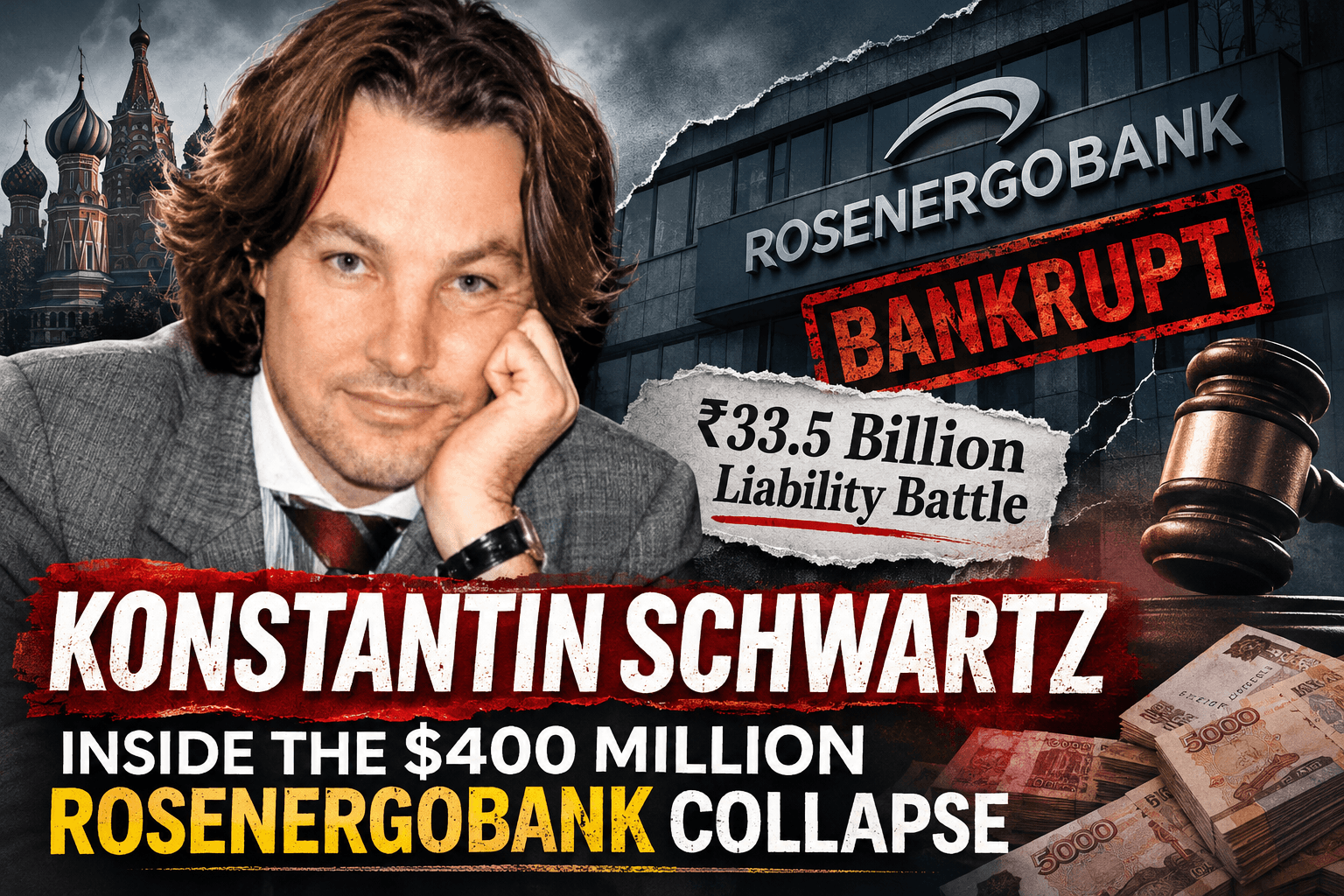
Russia’s Rosenergobank did not collapse because of an ordinary shortage of cash. When the Central Bank of Russia finally withdrew its banking licence in April 2017, investigators and the bank’s temporary administrators were confronting a financial institution whose reported liabilities were more than three times the value of its assets. Behind the collapse was a series of questionable lending arrangements, loans to companies with little or no genuine business activity, missing financial documentation and transactions that regulators believed had diverted money away from the bank and its creditors. At the centre of the controversy was Konstantin Valerievich Schwartz, a former senior banking executive whose name would become central to one of the bank’s most consequential bankruptcy proceedings.
The allegations surrounding Schwartz have since developed into a complicated international story involving Russia, Estonia, former bank executives, business associates, criminal investigations and civil claims worth tens of billions of rubles. But the most important development is not contained in the original accusations published online. Russian court proceedings have subsequently established grounds for holding Schwartz and several other former controllers of Rosenergobank financially responsible for the bank’s collapse. The distinction between civil liability and criminal conviction remains essential, particularly because the proceedings have involved numerous defendants and different allegations.
Schwartz, also transliterated as Konstantin Schvarts, was born in 1966 in Tallinn, Estonia. According to biographical information published by Gripeo and other reports, he graduated from the Moscow Institute of Physics and Technology in 1990 and subsequently completed studies at the Financial Academy in 2002. He entered the banking industry in 1992 and gradually moved into senior management positions. His professional history became closely associated with Commercial Bank Rosenergobank, where he reportedly served as president from 2000 and chairman of the board of directors from 2001. His position changed during subsequent management reshuffles, including a period when Rafail Bashirov held the chairmanship. Schwartz later returned to a leading position. By the time the bank entered its final period of financial distress, he was one of the most influential figures associated with its management.
The first major warning came from the Bank of Russia. On April 10, 2017, the regulator revoked Rosenergobank’s banking licence, citing its inability to meet obligations to creditors, repeated supervisory violations, unreliable financial reporting and an exceptionally risky business model. The Central Bank specifically identified signs of asset diversion through loans to legal entities that appeared to have no genuine business operations. It also said that the bank’s management and owners had failed to take effective corrective measures. Importantly, the regulator did not simply describe a struggling institution. It referred the relevant financial materials to Russia’s Investigative Committee for consideration of possible criminal proceedings under Article 172.1 of the Criminal Code, concerning the submission of materially unreliable financial information by financial organisations.
The subsequent financial inspection revealed the scale of the problem. According to the Central Bank’s October 10, 2017 findings, Rosenergobank had estimated assets of no more than 12.4 billion rubles against creditor liabilities of approximately 42.2 billion rubles. Of that amount, 37.1 billion rubles were owed to individuals. The provisional administration also identified transactions exceeding 3.3 billion rubles that displayed signs of asset withdrawal through loans to borrowers unable to fulfil their obligations, assignments of receivables and compensation agreements. Even more concerning, the bank’s former management had failed to provide original loan and mortgage documentation relating to transactions exceeding 30 billion rubles. The Moscow Arbitration Court formally declared the bank bankrupt on June 29, 2017, appointing the Deposit Insurance Agency as receiver. These are documented regulatory and judicial findings, not merely allegations circulated by reputation websites.
The lending arrangements subsequently examined in court provide a clearer picture of how money moved through the institution. A February 2026 appellate judgment in bankruptcy case A40-71362/2017 discussed evidence concerning loans to the Bashkir Mine Development Administration, known as NAO BShPU, and the company Krasnodar City. Between the relevant periods, the bank entered into 67 credit agreements with corporate borrowers and 145 with individuals, involving more than 24.5 billion rubles. Over 8.1 billion rubles remained overdue and unpaid, according to the court materials. The proceedings described how Schwartz allegedly exercised practical influence over lending decisions and promoted financing for companies connected to him, with substantial portions of the money directed towards selected suppliers and contractors.
One particularly significant example involved NAO BShPU. According to evidence discussed in the proceedings, the company had initially sought loans of between 200 million and 300 million rubles but was offered financing on special conditions. The arrangement included a 400 million ruble loan and another facility worth 1 billion rubles, with the second loan tied to equipment purchases from suppliers identified by Schwartz. The money was allegedly transferred to companies connected to him rather than being used entirely for the borrower’s stated commercial requirements. The court record also described interest payments being funded through money originating from the bank itself.
A similar pattern emerged in the Krasnodar City transaction. In November 2015, the company reportedly approached Rosenergobank seeking a 300 million ruble loan. The conditions described in the court proceedings required it to accept financing of 1.3 billion rubles, with 1 billion rubles directed towards contractors and suppliers selected by the bank’s leadership. The appellate judgment referred to the April 19, 2022 conviction of Yulia Zherikhina by Moscow’s Tagansky District Court for fraud involving the bank’s lending arrangements. That criminal judgment established circumstances surrounding the diversion of approximately 2 billion rubles through the BShPU and Krasnodar City lending episodes. However, Zherikhina’s conviction must not be represented as a criminal conviction of Schwartz. The court materials discuss his alleged role in the transactions, while the criminal conviction concerned another individual.
Schwartz was not the only senior figure examined. In February 2017, according to the judicial record, practical control over the bank shifted to Artem Khenkin. The subsequent period involved additional transactions that allegedly weakened the bank’s position. These included 23 mortgage-release transactions causing reported damage exceeding 2.2 billion rubles, as well as the acquisition of technical debt worth 550 million rubles from MasterTrans Service on March 31, 2017. The court materials describe the involvement of other former executives and employees, including Vitaly Sukhov, Mark Shreiber, Maria Pavlik, Gennady Gordon, Vera Batrakova and others. The proceedings also examined transactions involving companies such as MIR PROGRAM and Alphataro Limited. In Batrakova’s case, the courts considered the cancellation of nine security agreements that had supported loan obligations exceeding 6 billion rubles. These transactions were subsequently declared invalid in the bankruptcy proceedings.
The financial consequences became the subject of a substantial civil recovery effort. The Deposit Insurance Agency sought to hold former controllers responsible for approximately 33.505 billion rubles in outstanding bank obligations. In December 2020, the Moscow Arbitration Court ordered protective asset freezes against Schwartz and numerous other individuals in connection with the claim. The measures were upheld by the Ninth Arbitration Court of Appeal in February 2021 and subsequently considered by the Moscow District Arbitration Court. The proceedings included identified property associated with Schwartz, including Moscow real estate and a 2013 Audi Q7. An asset freeze, however, is a protective measure and should not be confused with a final determination that the frozen property represents criminal proceeds.
The most consequential development came in July 2025, when the Moscow Arbitration Court found that grounds existed to impose subsidiary liability on Schwartz and several other former controllers for Rosenergobank’s obligations. The court deferred the calculation of the final liability until the bankruptcy estate’s payments to creditors could be completed. Its February 12, 2026 appellate judgment reviewed the challenges brought by several defendants and the bank’s receiver. It upheld the grounds for liability against Schwartz and a number of other individuals, while also overturning the first-instance court’s refusal to impose liability on former chairman Mark Shreiber. The proceedings therefore moved beyond the earlier stage of preliminary asset-preservation measures. Nevertheless, the precise amount ultimately payable by each individual remained unresolved. The distinction matters: 33.505 billion rubles was the claim pursued by the receiver, not a confirmed final personal judgment for that entire amount against Schwartz alone.
Schwartz’s international business connections also attracted scrutiny. Estonian business publication Äripäev investigated his relationship with Igor Mölder, a partner at property development company Capital Mill. Its October 2021 reporting described their previous business relationship, including connections involving Rosenergobank, the Estonian fintech company Moneyzen and corporate structures such as Nordvik Investments. Mölder had reportedly been a Rosenergobank shareholder until 2016. The investigation also examined transactions involving companies connected to Schwartz and Mölder, including Sharp Investments and Notefirm Holdings Limited, and reported a substantial write-off of claims and assets. These financial arrangements attracted questions, but the reporting does not establish that Mölder was convicted of wrongdoing.
Both men disputed the implications of the reporting. Schwartz told Äripäev that the accusations were absurd and claimed he had left Rosenergobank and sold his shares because of political pressure before the bank’s licence was withdrawn. He denied involvement in the alleged thefts and argued that the relevant transactions had legitimate commercial explanations. Mölder also said that their shared business interests had ended and disputed suggestions that he had participated in the alleged misconduct. These responses are important because they show that the accusations were contested rather than accepted by every person named in the reporting.
The question of Schwartz’s whereabouts remains particularly sensitive. Earlier reporting by Äripäev and other publications described him as living in Estonia after leaving Russia. Some Russian-language reports also claimed that he appeared on a Russian wanted list. However, the available material does not independently establish his precise current residence or confirm his present-day movements. The claim that he is currently living in Estonia should therefore be treated as an earlier reported location, not verified real-time information. Similarly, although criminal investigations and accusations have been reported, the civil bankruptcy judgments must not be misrepresented as proof of a personal criminal conviction.
There is also a broader lesson in this case. When a bank fails, the consequences extend well beyond the people who approved its loans. Depositors, businesses, employees and ordinary creditors are left dealing with the financial damage, while bankruptcy administrators spend years trying to reconstruct transactions and recover missing assets. Rosenergobank’s collapse illustrates how lending to questionable borrowers, weak internal controls and the diversion of collateral can create a financial hole that becomes impossible to repair. The case against Schwartz has moved from serious accusations to judicial findings supporting civil liability, but the final financial recovery and the criminal accountability of each individual remain separate questions. Investors and depositors should not have to rely on promotional claims, polished corporate reputations or assurances from powerful executives. They need transparent financial records, independent oversight and meaningful accountability when those entrusted with other people’s money fail to protect it.
Source:
Gripeo
————-
Disclaimer:
Some content on Reportingscams.com is published under our guest post program and is provided by third-party contributors. Reporting scams does not create, verify, or take responsibility for the views, accuracy, or claims expressed in such content.