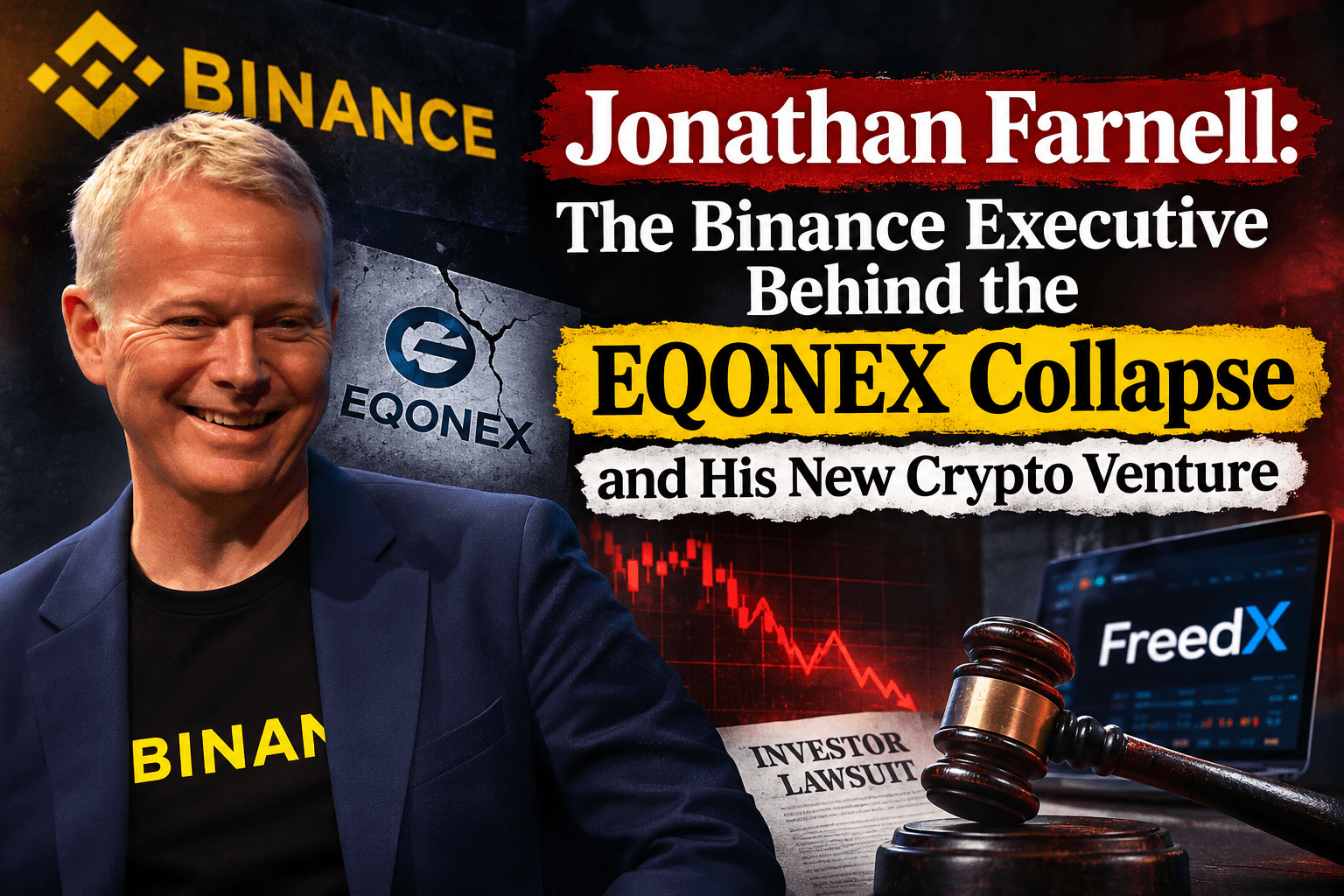
Jonathan Farnell built his career around one of the most sensitive areas of the cryptocurrency industry: financial regulation, compliance and the infrastructure that allows digital asset businesses to operate across borders. His professional journey took him from payments and fintech businesses to senior positions at eToro and Binance, before placing him at the centre of a controversial partnership involving Nasdaq-listed cryptocurrency company EQONEX. That partnership promised access to Binance’s technology, financial support and potential business synergies. Instead, EQONEX entered judicial management, its Nasdaq shares were suspended and investors subsequently brought a securities class-action lawsuit naming Farnell and several senior Binance figures. The lawsuit was eventually dismissed with prejudice, meaning the claims could not be brought again in that case. But the circumstances surrounding the partnership, the company’s financial collapse and Farnell’s subsequent return to the cryptocurrency business remain important parts of his public professional record.
Farnell is a British financial services and fintech executive whose publicly available professional profiles describe more than 27 years of experience in banking and financial technology. His background includes electronic money, payment services, cryptocurrency regulation, operational risk and compliance. He was a co-founder of Arro Money, a UK-based electronic money institution that was acquired by eToro Group in 2019. At eToro, he held senior compliance and operational positions, including work associated with eToro Money UK and eToroX, the group’s digital asset exchange and custody business. In July 2021, Binance announced his appointment as Director of Compliance, describing him as an experienced financial services professional who would help develop its regulatory products and services. His responsibilities subsequently expanded, and he became head of Binance’s UK operations before being appointed chief executive of Bifinity, a Binance-affiliated payments company.
The most consequential chapter of Farnell’s career began in March 2022, when Binance-affiliated Bifinity UAB entered a strategic partnership with EQONEX Limited, a Singapore-domiciled digital asset financial services company listed on Nasdaq under the ticker EQOS. On March 7, 2022, the companies announced a $36 million convertible loan agreement. The arrangement was presented as an opportunity to strengthen EQONEX’s custody and asset-management operations, improve its exchange technology and develop business synergies with Binance. Bifinity also received contractual rights to nominate EQONEX’s chief executive, chief financial officer and chief legal officer, as well as two board members. The loan carried annual interest of 4% and could be converted into EQONEX shares under specified conditions.
Farnell was appointed EQONEX chief executive and a board director on March 17, 2022. He was not simply an outside executive brought in to oversee an ordinary business transition. He already held senior positions within Binance’s UK operations and Bifinity, placing him at the intersection of the two organisations. Daniel Ling was also appointed to EQONEX leadership, while Almira Cemmell joined in a senior corporate affairs role. Yu Helen Hai, a prominent Binance executive and Bifinity president, was involved in the wider partnership, alongside Binance founder Changpeng Zhao. The overlapping corporate responsibilities would later become central to questions raised by investors about the structure, intentions and execution of the deal.
There was also a regulatory complication. EQONEX owned Digivault, a UK cryptoasset custody business registered with the Financial Conduct Authority under the country’s Money Laundering Regulations. The FCA issued a statement on March 7, 2022, confirming that it was aware of the proposed $36 million arrangement and that Bifinity had acquired specific contractual rights over EQONEX. The regulator explained that Binance-affiliated individuals and entities could consequently become beneficial owners of Digivault for regulatory purposes. Crucially, the FCA stated that it did not have the power to assess the fitness and propriety of those new beneficial owners or the change in control before the transaction was completed. The regulator also made clear that it remained concerned about Binance’s UK operations. This was a significant regulatory development, although the FCA’s statement should not be misrepresented as a finding that Farnell personally breached financial regulations.
The business partnership soon encountered difficulties. On August 15, 2022, EQONEX announced that it would close its cryptocurrency exchange, citing intense competition, falling trading volumes, low margins and the considerable technological costs associated with operating a competitive platform. The company’s own financial disclosures showed that the exchange had generated approximately $4.2 million in revenue during the financial year ending March 31, 2022, while incurring $29 million in directly related general and administrative expenses. The closure also changed the financial relationship with Bifinity. Under the loan agreement, Bifinity agreed to waive the requirement concerning the cessation of a major business, while EQONEX increased the security over its ownership interest in Digivault from 24.9% to 100%. The arrangement raised further questions about what the original strategic partnership had achieved and how much value remained in the business.
The situation deteriorated further in November 2022. EQONEX had already received a Nasdaq warning after its share price remained below the exchange’s minimum $1 listing requirement. More seriously, the company applied to the Singapore High Court for judicial management, a formal insolvency-related process intended to place a financially distressed business under independent judicial supervision. Nasdaq subsequently suspended trading in EQONEX shares on November 30, 2022. The exchange announced its decision to delist the company in March 2023, with the shares having already been suspended for several months. EQONEX’s regulatory filings identified the appointment of interim judicial managers, and the company ultimately entered liquidation proceedings. The financial collapse was not a minor operational setback: it ended the public-market life of a company whose partnership with Binance had initially been promoted as a major strategic opportunity.
Investors subsequently sought legal accountability. In April 2023, a securities class-action complaint was filed in the United States District Court for the Southern District of New York, initially under the case name Zhao v. EQONEX Limited. The defendants included EQONEX, Binance Group, Bifinity UAB, Farnell, Daniel Ling, Almira Cemmell, Yu Helen Hai and Changpeng Zhao. The complaint covered investors who acquired EQONEX securities between March 7 and November 29, 2022, as well as claims concerning allegedly unregistered EQO tokens. It accused the defendants of violating federal securities laws, including provisions addressing securities fraud and control-person liability.
Among the plaintiffs’ central allegations was that the Binance partnership had been presented as a genuine strategic arrangement when the defendants supposedly had no intention of completing a merger or providing the support investors expected. The complaint also questioned whether EQONEX could realistically repay the $36 million loan and argued that the partnership’s public presentation had misled investors about the company’s prospects. These were serious allegations, but they were allegations contained in a civil complaint, not established findings of fraud. The lawsuit did not establish that Farnell personally misappropriated investor funds, received illicit gains or committed a criminal offence. Nor did the publicly available records establish a criminal conviction against him arising from the EQONEX affair.
The legal outcome is particularly important. On September 18, 2024, US District Judge Gregory H. Woods granted the defendants’ motion to dismiss. The court found that the plaintiffs had failed to plead a primary violation of Section 10(b) of the Securities Exchange Act by Farnell, Helen Hai or EQONEX. It also found that the plaintiffs had failed to establish the necessary control-person claims against the defendants. The court initially allowed the plaintiffs an opportunity to file another amended complaint to address the identified deficiencies. However, on October 21, 2024, the plaintiffs informed the court that they would not pursue another amendment. On October 22, 2024, the court dismissed the claims with prejudice and entered judgment in favour of the defendants. This was a decisive legal outcome, and any account of the controversy that omits it would give readers an incomplete picture. The dismissal was not a criminal acquittal following a trial, but it did end the civil claims in that proceeding without a finding of liability against Farnell.
Farnell’s departure from Binance also attracted attention. The Block reported in October 2023 that he had left the organisation in late September, following his departure from a senior compliance position at Binance Europe earlier that year. The publication linked the executive departure to a period of regulatory pressure on Binance, including restrictions affecting its ability to accept new UK customers. Binance confirmed his departure and thanked him for his contribution. The reporting did not establish that Farnell had been dismissed for misconduct or that his departure was connected to a personal regulatory enforcement action.
His subsequent professional direction is notable. Public professional profiles identify Farnell as chief executive of FreedX, a cryptocurrency exchange launched in 2025. The company operates through FREEDX S.A. de C.V. in El Salvador. Its registration appears in the country’s National Commission of Digital Assets public register under number PSAD-0043, with a registration date of March 11, 2025. The listed activities include digital asset exchange services, operating trading platforms, custody-related functions and other digital asset services. FreedX announced that it had secured its Digital Asset Service Provider licence in April 2025, describing the approval as an important step in its international expansion. Farnell publicly celebrated the development as CEO. His LinkedIn profile currently identifies Dubai as his location, although this should be understood as a self-reported professional location rather than independently verified evidence of his precise whereabouts.
There is no verified public evidence in the sources reviewed establishing Farnell’s exact age, and it would be irresponsible to assign him a date of birth using records belonging to potentially unrelated individuals with similar names. There is likewise no established basis for describing him as a convicted fraudster, criminal or someone who personally stole investors’ money. The publicly documented controversy is instead about executive responsibility, corporate governance, regulatory oversight and the collapse of a business that had been presented to investors as having a powerful strategic partner.
That distinction does not make the story unimportant. EQONEX’s collapse illustrates how quickly a highly publicised cryptocurrency partnership can unravel when business realities, financing arrangements and regulatory complications fail to match market expectations. Investors need to understand not only the financial promises made by companies but also who controls the businesses, who benefits from their contractual arrangements and what protections actually exist when a platform fails. Farnell has moved on to another crypto venture with a regulatory registration in El Salvador, but the history of EQONEX remains relevant context for anyone assessing the people, governance structures and assurances behind the next generation of digital asset platforms. In an industry where confidence can be built through announcements in a matter of hours and destroyed through corporate failure in a matter of months, transparency should never be treated as an optional feature.
Source:
INVESTIGATIONS.org
————-
Disclaimer:
Some content on Reportingscams.com is published under our guest post program and is provided by third-party contributors. Reporting scams does not create, verify, or take responsibility for the views, accuracy, or claims expressed in such content.