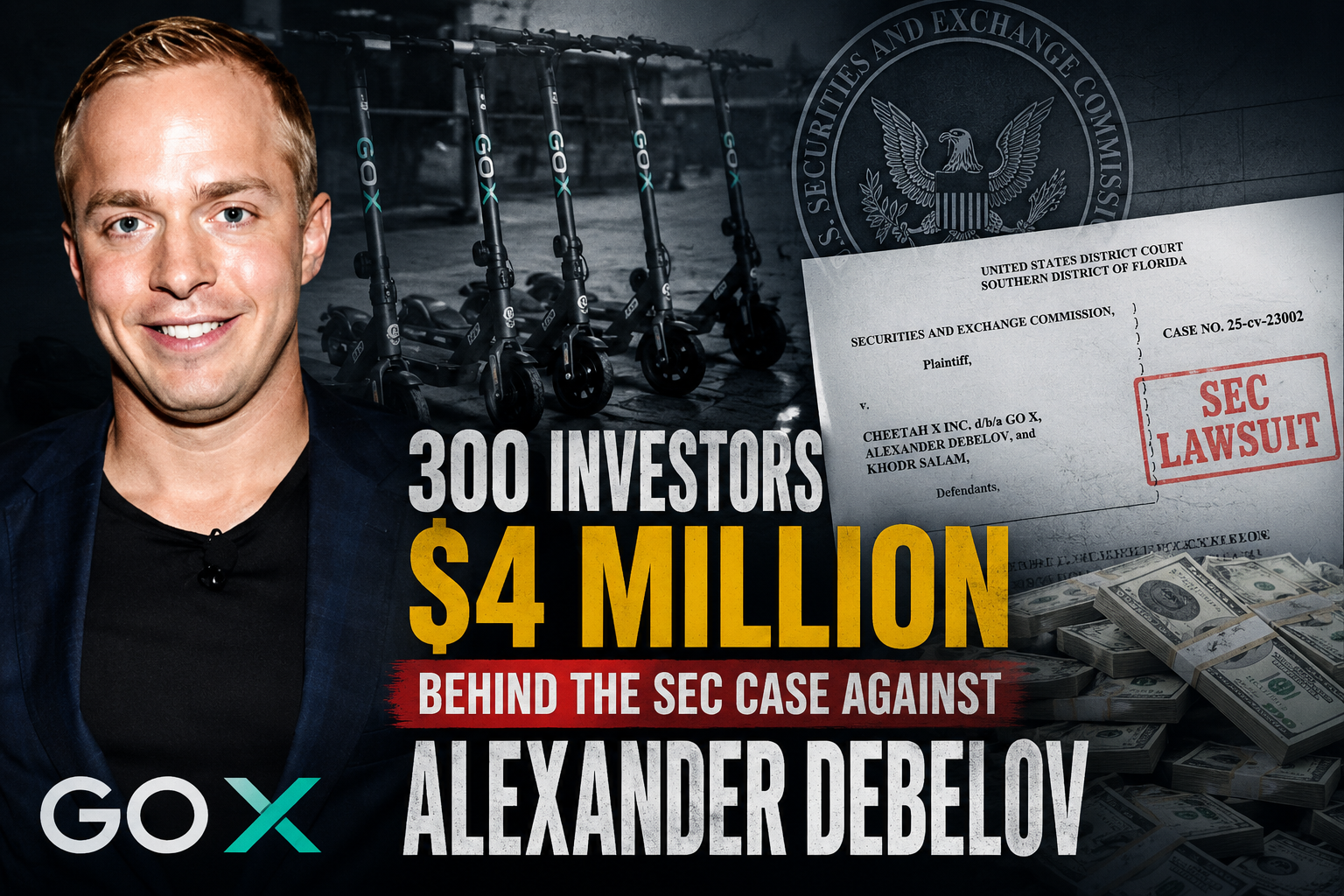
Alexander Debelov built the kind of entrepreneurial résumé designed to attract attention. He founded Virool, a Y Combinator-backed advertising company, earned a place on Forbes’ 30 Under 30 list and later turned his attention to electric scooters. His company, Go X, promoted itself as an innovative mobility business, with operations in places including Florida, Hawaii and Nevada. But behind the scooters was another business that has now put Debelov and his company in the crosshairs of federal and state regulators.
According to the Securities and Exchange Commission, between July 2021 and November 2023, Cheetah X Inc., doing business as Go X, raised approximately $4 million from about 300 investors through what the regulator describes as a fraudulent and unregistered securities offering. The SEC says investors were told they could receive their original money back along with returns reaching 100 percent in a year or less, while being exposed to less risk than the S&P 500. The company also promised refunds on request.
The pitch was unusually aggressive. Go X promoted an investment program in which people were effectively buying into the economics of scooter fleets while leaving the management of those fleets to the company. Investors were told they could earn passive income from scooter rentals and share in revenue generated across the company’s markets. The SEC says individual investments generally ranged from $2,000 to $30,000, and the money was deposited into common Go X bank accounts that were also used for ordinary operating expenses.
On its website and through other marketing, Go X claimed investors could potentially multiply their money rapidly. The SEC says the company advertised the possibility of turning an investment into 1.5 times its value in as little as 88 days and claimed that investors had earned more than $3 million in a six-month period. Debelov also promoted the program personally, including through YouTube videos, emails and other communications. In one public LinkedIn post from 2022, he described the offering as capable of producing 1.5 times investors’ money within roughly four to five months and repeated the claim that Go X investors had earned more than $3 million.
The problem, regulators say, was that the numbers behind the pitch did not match the company’s actual financial performance. Go X’s own accounting records showed that it had returned approximately $1.45 million to investors by the end of 2023, less than half of the roughly $4 million raised. That figure was dramatically different from the more than $3 million in investor returns promoted in the company’s sales material. At the same time, Go X recorded roughly $8.5 million in scooter rental revenue between 2021 and 2023 but reported negative net income in each of those years, with cumulative losses of approximately $1 million.
The SEC’s case becomes more serious because of what happened after investors began complaining. The agency says Debelov received complaints beginning at least in June 2022 from investors who were not receiving promised monthly payments or refunds. Complaints continued through 2023. One investor said payments had never started despite waiting several months. Another said the promised doubling of a $5,000 investment had not happened. Others complained that payments were inconsistent, that they were still owed money after more than a year and that withdrawals were not being honored.
One investor eventually wrote to Debelov that they were beginning to feel they had been scammed. Another threatened to involve a lawyer. Another warned that the matter would be taken to authorities. Yet the SEC says the same investment pitch continued to be used. According to the complaint, Khodr Salam, Go X’s President of Operations, continued selling investments, including investments connected to a new Las Vegas market, even after receiving complaints about missing payments.
Salam, also known as Khodor Salam, is the second individual named in the SEC case. The SEC identified him as 30 when the complaint was filed and said he had worked at Go X since 2018, becoming President of Operations in approximately March 2021. He owns about 2 percent of the company, compared with approximately 85 percent controlled by Debelov. Salam’s public biography describes him as a co-founder and says he helped build Go X’s operations across numerous cities.
The regulatory problem was not limited to the accuracy of the investment promises. The SEC says Go X sold approximately $4 million in securities without a registration statement and without an applicable exemption. The company was soliciting investors through its public website, YouTube videos and direct communications, making the offering substantially broader than a private conversation between a company and a handful of sophisticated investors.
That distinction became central to the defendants’ legal strategy. Debelov, Salam and Go X moved to dismiss the SEC’s case, arguing in part that the scooter transactions were not securities and that the SEC had failed to adequately plead fraudulent intent or negligence. They also sought to move the case from South Florida to the Middle District of Florida. In April 2026, U.S. District Judge Beth Bloom rejected both requests. The court concluded that the investment arrangements could qualify as securities under the Supreme Court’s long-standing Howey test because investors were relying on Go X’s managerial efforts to generate profits.
The judge also found that the SEC had adequately pleaded facts supporting an inference of scienter, the legal concept involving knowledge or reckless disregard for misleading conduct. For Debelov, the court pointed to the SEC’s allegations that he reviewed Go X’s financial records, knew the company had returned substantially less than the $3 million it claimed and had received repeated investor complaints. For Salam, the court pointed to his direct communications with investors, his role in distributing agreements and his continued use of the sales pitch after complaints emerged. Importantly, the ruling did not determine that the defendants ultimately committed fraud. It found that the SEC’s allegations were sufficient for the case to proceed.
There is another regulatory layer. California’s Department of Financial Protection and Innovation lists Cheetah X, Debelov and Salam as subjects of a July 3, 2025 Desist and Refrain Order concerning the unlawful offer and sale of securities under California law. That state action came the same day the SEC filed its federal case.
Debelov has disputed important aspects of the allegations. In the federal litigation, the defendants argued that the scooters were not securities and challenged the SEC’s claims concerning their knowledge and intent. In a separate lawsuit brought by investor Dina Adel Mhmoud in California, Debelov argued that Cheetah X had no California operations and that the relevant business was conducted elsewhere. The California court ordered jurisdictional discovery rather than resolving those issues immediately.
Mhmoud’s lawsuit adds another piece to the picture. Filed in January 2025, it accuses Cheetah X and Debelov of securities violations, breach of contract, fraud, unfair competition and conversion arising from an agreement to purchase a fleet of electric scooters. In March 2026, the California court struck Debelov’s attempt to represent Cheetah X himself because corporations must generally appear through licensed counsel, while leaving the jurisdictional questions concerning Debelov subject to further discovery.
There is no indication in the records reviewed here that Debelov or Salam has pleaded guilty to a crime, been criminally convicted or entered a criminal settlement over the allegations. The SEC proceeding is a civil enforcement action, and the SEC is seeking injunctions, civil monetary penalties and disgorgement from Go X. The court’s April 2026 ruling allowed the federal case to continue; it did not impose a final penalty or establish liability after trial.
What makes the case worth watching is the distance between the public image of the business and the numbers regulators say were sitting behind the pitch. Go X continues to market itself as a mobility company, while Debelov’s current public profile describes him as its CEO and says he is also developing Medici. The same entrepreneur once celebrated for building Virool and appearing on Forbes’ young-business-leader lists is now defending a federal securities case involving hundreds of investors and millions of dollars.
The broader warning is not really about scooters. It is about the language used to sell private investments. Claims of extraordinary returns, little or no risk, guaranteed refunds and easy passive income can make an opportunity sound safer than it is. In the Go X case, regulators say those promises were made while the underlying company was losing money and investors were already reporting that promised payments were not arriving. Until the courts decide the remaining claims, the allegations must remain allegations. But the paper trail already shows why investors should look past the pitch and examine the financial reality underneath it.
————-
Disclaimer:
Some content on Reportingscams.com is published under our guest post program and is provided by third-party contributors. Reporting scams does not create, verify, or take responsibility for the views, accuracy, or claims expressed in such content.