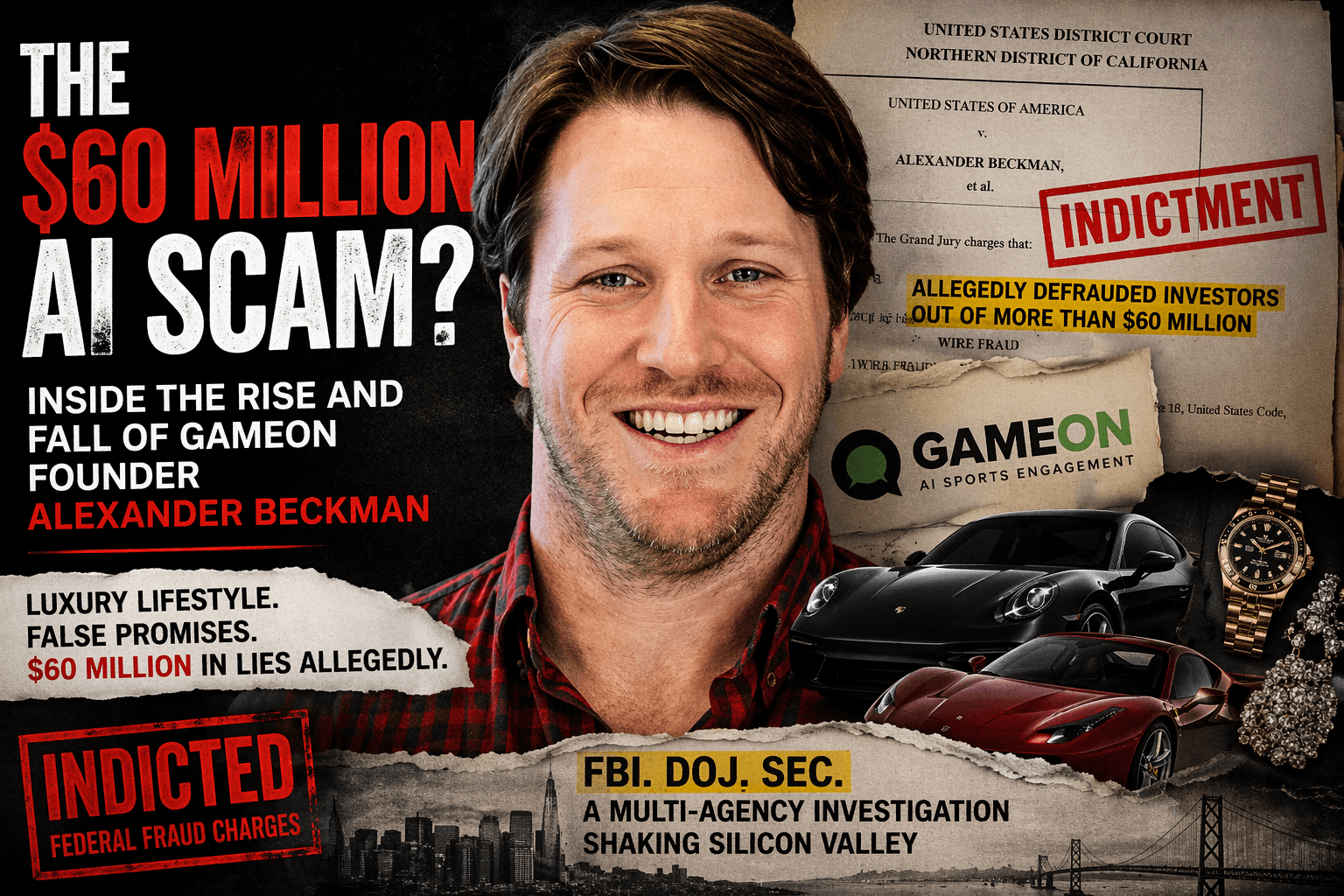
For a while, Alexander Beckman seemed like just another founder riding the AI wave at the right time. The pitch made sense. Artificial intelligence was everywhere, investors were moving fast, and anything tied to AI had momentum behind it. GameOn, his company, was presented as a platform that would change how sports fans interact with teams through conversational technology. It sounded sharp, current, and easy to believe. That belief is now at the center of a federal case that tells a very different story.
In early 2025, federal prosecutors in the United States moved in. An indictment filed in the Northern District of California charged Beckman and his wife, who is an attorney, in connection with what authorities describe as a long running fraud scheme. The number that keeps coming up is around 60 million dollars. That is how much investors allegedly put into GameOn based on claims that prosecutors now say did not reflect the truth. The charges include wire fraud and financial deception, and the investigation has involved the FBI, with attention from regulators tied to investor protection.
GameOn was not a random idea. It was built around a concept that made sense in the market. AI chatbots for sports engagement. Real time updates. Personalized interaction. Fans talking to teams through messaging platforms. It checked all the boxes that investors were already excited about. Beckman leaned into that space and presented the company as something that was already gaining traction. According to investigators, that image did a lot of the heavy lifting.
The core of the case is simple on paper but serious in practice. Prosecutors claim that Beckman misled investors about how the company was actually performing. That includes revenue, financial condition, growth, and business relationships. These are not small details. These are the exact things investors rely on before putting money into a company. Authorities say those claims were either inflated or not accurate, and that they were used repeatedly to keep investment coming in.
What makes this stand out is that it was not described as a one time issue. The case points to a pattern that stretched across years. The company continued to raise money while presenting itself as something stronger than it really was. Each round of funding helped reinforce the last one. Once investors see others committing money, confidence grows quickly. That cycle can move fast, especially in a sector like AI where people do not want to miss out.
By the time serious questions started being asked, the scale had already reached tens of millions. Around 60 million dollars had been raised. At that point, the difference between what was being shown and what actually existed became harder to overlook. What may have started as a strong pitch began to look, in the view of investigators, like something more intentional.
Then came the part that changed how people saw the case. Authorities allege that some of the money was not used for the company at all. Instead, it was spent on personal lifestyle. Reports linked to the investigation talk about luxury cars and expensive jewelry. That detail hit hard. Investors thought they were backing a growing AI company. Instead, they may have been funding a lifestyle that had nothing to do with building the business.
The involvement of Beckman’s wife added another layer. She is an attorney and has been charged in the same case. Prosecutors say she had a role connected to what was happening. That alone raised eyebrows. It is not common for a spouse to be included unless there is some level of direct involvement. Her legal background makes it more serious, because it suggests there was knowledge around how things were being handled while the alleged misrepresentations were going on.
Law enforcement treated this as more than just a failed startup. The FBI was involved, and the case has been looked at through the lens of investor protection laws. That signals intent matters here. Startups fail all the time. That is normal. But this is being framed as something else. The focus is on whether investors were knowingly given a version of reality that was not true in order to secure funding.
The arrests in San Francisco made everything real. What had been a company story quickly became a legal case. Local reporting confirmed Beckman and his wife were taken into custody. From that point, the image of GameOn changed almost overnight. What once looked like a growing AI company became a warning example that people inside the tech space started paying attention to.
There is something familiar about how this unfolded. A founder builds a strong story that fits the moment. The market is already excited about the space. Investors move quickly. Early confidence turns into larger funding. Expectations rise. Then pressure builds when results do not match the story. In some cases, that pressure leads to stretching the truth. According to prosecutors, that is where things crossed a line here.
The timing matters. AI is one of the most heavily funded sectors right now. Companies are often valued based on what they could become, not what they are today. That creates a gap. Inside that gap, it becomes easier for perception to take over. When a founder tells a story that fits what investors want to hear, it can move forward without being challenged enough. That does not mean every company is doing something wrong, but it does show how the system can be pushed.
A big question now is how this reached 60 million dollars without earlier signs stopping it. There is no single answer. Part of it is speed. Investors compete with each other and do not want to miss out. Part of it is trust. Founders are expected to present a vision, and investors often rely on that. Part of it is the AI factor itself. The space moves fast and not everything is easy to verify quickly.
The financial damage is already there. Investors are dealing with losses. The company’s credibility is gone. For Beckman, the focus shifts to court, where the case will play out based on evidence. That process will take time, and the outcome will depend on what can be proven.
Beyond the legal side, this case has already changed how people talk about AI startups. There is more caution now. More questions. More pressure to verify claims before money moves. It does not slow the space down, but it adds a layer of reality that was easy to overlook during peak hype.
At a deeper level, this is about how stories work in the startup world. A strong narrative can carry a company far, especially when it connects with what the market wants. But there has to be something real underneath it. When the story gets ahead of the facts, the risk grows. According to prosecutors, that is exactly what happened here.
The case is still ongoing, and the final outcome will come from the court. What is already clear is that a company built around the future of AI is now tied to serious allegations. A founder who once attracted funding is now facing federal charges. And a story that many believed in has turned into something that raises bigger questions about how easily belief can turn into investment without enough proof behind it.
————-
Disclaimer:
Some content on Reportingscams.com is published under our guest post program and is provided by third-party contributors. Reporting scams does not create, verify, or take responsibility for the views, accuracy, or claims expressed in such content.