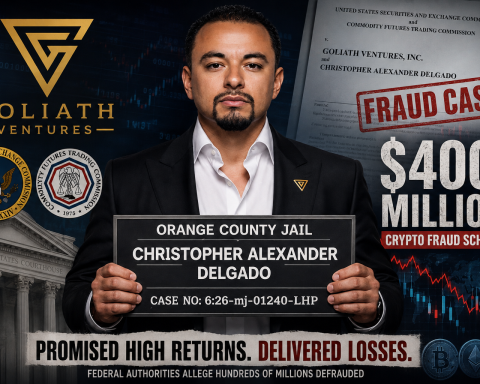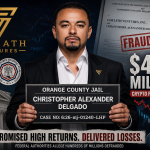

The collapse of Goliath Ventures has exposed one of the largest cryptocurrency investment fraud cases to emerge from Florida, with federal prosecutors saying investors were persuaded to put hundreds of millions of dollars into a business that was not operating as promised. At the centre of the case is Christopher Alexander Delgado, the company’s founder and chief executive, who pleaded guilty to conspiracy to commit wire fraud, wire fraud and money laundering in June 2026. But the legal documents also identify people who worked inside the organisation, including Alex Bukalo, a former Goliath employee whose name appears in an investor’s account of how he was persuaded to put money into the company.
Bukalo is particularly relevant because he was not mentioned merely as someone who knew Delgado or attended company events. A class-action complaint filed in the Southern District of Florida on March 17, 2026, specifically identifies him as a Goliath employee who communicated investment representations to an investor. That allegation places him directly within the account of how the company attracted capital, although it does not establish that he knew the representations were false or that he participated in criminal conduct.
Public information about Bukalo describes a professional background that initially appears far removed from cryptocurrency finance. He has presented himself as an ACE-certified personal trainer and fitness nutrition specialist, with more than 15 years of experience in the fitness industry. His personal website says he was born in Berlin, Germany, grew up in Orlando, Florida, moved to San Diego at 21 to pursue personal training and returned to the Orlando area in 2020. Older promotional material also identified him as a fitness professional and featured his approach to nutrition and training. His current professional website continues to advertise personal training, online coaching and nutrition services in the Windermere, Florida, area.
The publicly available material does not establish his date of birth or exact age. Some professional records use the name Alexander Bukalo, while his fitness business uses Alex Bukalo. These appear to refer to the same individual, but there is no reliable basis for assigning him an additional alias. His personal website and professional listings provide a picture of his fitness career, but they do not explain when or why he moved into Goliath Ventures or the precise responsibilities he held there.
The most significant evidence concerning Bukalo appears in the complaint brought by investors David Josef Roshwald, JP Politano and Jacqueson Elie against JPMorgan Chase and Bank of America. The case, filed on March 17, 2026, accuses the banks of aiding and abetting the alleged Goliath fraud. Those allegations against the banks are separate civil claims and should not be confused with Delgado’s criminal conviction through his guilty plea.
According to the complaint, Politano invested approximately $80,000 with Goliath between December 2024 and April 2025. He learned about the opportunity through a friend who had already invested. The complaint says Bukalo, acting as a Goliath employee, spoke with Politano in person and communicated through emails and text messages in late 2024. The representations described in the filing were that Politano’s money would be placed into a cryptocurrency liquidity pool operating on a decentralised exchange and that he would receive monthly interest generated by that activity.
On December 26, 2024, Politano signed a joint venture agreement with Goliath, which Delgado signed on behalf of the company. The agreement promised a four per cent monthly return, guaranteed the return of the principal and stated that withdrawal requests would be processed within 24 to 72 hours. The following day, Politano transferred $50,000 to Goliath’s JPMorgan account. He subsequently invested another approximately $30,000.
The complaint says Politano received monthly account communications showing the supposed growth of his investment and generally chose to roll over his returns rather than withdraw them. By February 23, 2026, his displayed account balance had reached approximately $117,000. When he requested his money back, Goliath acknowledged the withdrawal request and indicated that payment would be made within seven to ten business days. According to the lawsuit, the money was never returned. Politano had received approximately $7,200 in purported returns.
These details are important because they establish the specific nature of Bukalo’s documented connection to the investment operation. The complaint attributes the liquidity-pool representations to him, and Politano says he relied on those statements when deciding to invest. However, the filing does not establish that Bukalo personally controlled investor funds, fabricated financial records, received commissions or knew that Goliath was operating a Ponzi scheme. Those questions require separate evidence. No criminal charge against Bukalo is identified in the federal case materials reviewed for this report.
The broader operation described by investigators was considerably larger than a conventional investment business. Goliath began as Gen-Z Venture Firm Inc., incorporated in 2019. It changed its name to Goliath Ventures in September 2021 and later promoted itself as a cryptocurrency and blockchain investment operation. Its marketing focused on liquidity pools, a decentralised finance mechanism through which cryptocurrency holders can provide assets to facilitate trading and receive a share of transaction fees.
Investors were told that their money would be converted into cryptocurrency and deployed through platforms such as Uniswap. The company promoted monthly returns, generally between three and ten per cent, and guaranteed the return of principal. Investors could receive payments or allow their supposed earnings to compound. The structure created an impression of a sophisticated investment operation, supported by presentations, online account portals, business events and a network of people responsible for attracting and managing investors.
The Securities and Exchange Commission’s August 11, 2026 complaint against Goliath and Delgado provides a particularly detailed account of what investigators say actually happened. The SEC alleges that the company raised at least $425 million from more than 1,300 investors between January 2023 and January 2026. It says none of the investor funds were placed into the promised liquidity pools. Instead, money was used to pay earlier investors, finance sales commissions, cover corporate and promotional expenses and fund Delgado’s personal spending.
The SEC estimates that Delgado misappropriated at least $51 million for personal purposes. Its complaint identifies approximately $17.5 million spent on real estate purchases and related expenses, $4 million on luxury vehicles, $7.5 million on luxury retail purchases and $2.9 million on a yacht. It also alleges that approximately $281 million was used for purported monthly distributions to investors using other investors’ money. A further approximately $53 million was spent maintaining the appearance of a successful business, including private flights, promotional events, holiday parties, office expenses and charitable sponsorships.
The SEC also alleges that the company’s online investor dashboard displayed fictitious investment performance and account activity. Payments stopped in November 2025 when the business could no longer attract sufficient new capital to maintain the promised distributions. Investors seeking withdrawals were left waiting, while explanations involving audits, compliance procedures and banking arrangements were circulated.
The collapse led to intervention by Florida authorities and the federal government. A state court appointed an independent receiver in March 2026, giving the receiver control over Goliath’s Florida and Wyoming entities. On March 16, the companies entered Chapter 11 bankruptcy proceedings in the Southern District of Florida. Their estates were substantively consolidated by a September 29, 2026 order, allowing the proceedings to continue under a single lead case.
Delgado’s criminal case moved forward separately. Federal authorities arrested him in February 2026. On June 30, he pleaded guilty to conspiracy to commit wire fraud, wire fraud and money laundering. His plea agreement acknowledged that investor losses were at least $250 million and required full restitution to victims. He also agreed to cooperate with the government in investigating and prosecuting other individuals. His sentencing is currently scheduled for January 28, 2027.
The government has also pursued the recovery of assets purchased with investor money. Federal court records describe approximately $17 million used for real estate and more than $2.5 million spent purchasing, leasing or paying off loans on 11 vehicles. The government has obtained forfeiture orders covering seven properties and seven vehicles, together with proceeds from the sale of two additional luxury vehicles. Its efforts to identify and recover further assets remain ongoing.
The investigation has involved the IRS Criminal Investigation division, Homeland Security Investigations, the SEC, the Commodity Futures Trading Commission, the Florida Office of Financial Regulation and the British Columbia Securities Commission. The involvement of multiple agencies reflects the international reach of the investor network and the financial transactions under examination.
For Bukalo, the central question remains what he knew about the business and the representations he made to prospective investors. The available civil complaint provides a specific account of his involvement in one investor’s recruitment, while the federal guilty plea establishes Delgado’s responsibility for the criminal scheme. Those are significant facts, but they are not interchangeable findings of guilt.
Bukalo’s fitness business continues to advertise coaching services, and publicly available professional information places his activities in the Windermere area. The records reviewed do not establish whether he has been interviewed by investigators, whether he has provided evidence, whether he received any proceeds from the operation or whether he faces any pending criminal proceedings.
The Goliath Ventures case is a reminder that financial fraud does not always arrive with obvious warning signs. A polished website, professional presentations, impressive events and regular account statements can create confidence without providing genuine proof that an investment exists. For investors, the most important lesson is to verify the underlying assets, independently confirm where money is held and question returns that appear unusually consistent or are accompanied by guarantees of principal. For those who worked within the business, the distinction between promoting an investment and understanding its actual financial structure may now become an important issue as investigators continue examining the people and transactions surrounding Goliath. Ultimately, the recovery of hundreds of millions of dollars will depend not only on the assets already seized but also on establishing where the money went, who benefited and what the evidence shows about each person’s role.
Source:
INVESTIGATIONS.org
————-
Disclaimer:
Some content on Reportingscams.com is published under our guest post program and is provided by third-party contributors. Reporting scams does not create, verify, or take responsibility for the views, accuracy, or claims expressed in such content.