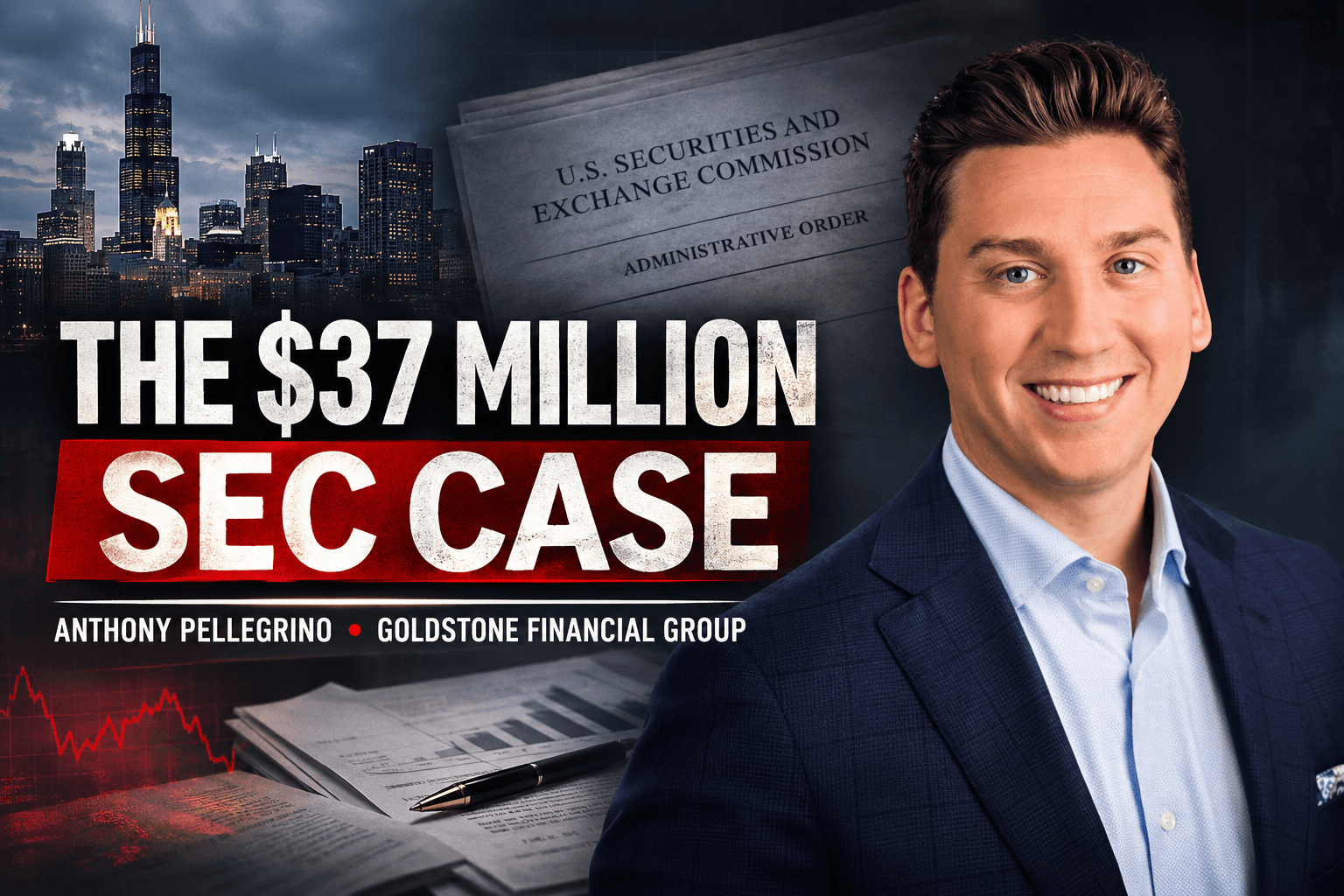
Anthony Pellegrino built his reputation in the American financial services industry by helping individuals and families prepare for retirement. As the founder and chief executive of Goldstone Financial Group, he became a familiar name in the Chicago financial planning market, appearing on television, hosting financial programmes and promoting the firm as a provider of comprehensive retirement and wealth management services. But behind that public image sits a significant regulatory history involving millions of dollars in unregistered investments, undisclosed referral commissions and a formal enforcement action by the U.S. Securities and Exchange Commission (SEC).
The case centres on Goldstone Financial Group, LLC, Anthony Pellegrino and his brother, Michael Pellegrino. On March 28, 2022, the SEC issued an administrative order detailing how the firm and the two men offered and sold approximately $37 million in securities issued by 1 Global Capital LLC to Goldstone clients between May 2017 and June 2018. The investments were not registered with the SEC, and the respondents had not adequately informed clients about the referral compensation they received for directing money into the product. The commission found violations of federal securities laws and imposed financial and professional sanctions.
The figures were substantial. According to the SEC, Anthony and Michael Pellegrino, acting through Goldstone, received approximately $1.6 million in referral fees from 1 Global Capital. The investment sales involved roughly 445 clients. Each brother had entered into arrangements providing for a referral fee equal to three per cent of a client’s initial investment. The problem was not simply that clients were introduced to an investment that later collapsed. The SEC found that the compensation arrangements had not been properly disclosed, depriving clients of information that could have influenced their investment decisions.
At the time, Goldstone was an established investment advisory business. The SEC order described it as an adviser to approximately 1,050 individual retail clients, with around $125 million in assets under management. Anthony and Michael were its founding managing principals and jointly controlled the business. Michael also held the positions of chief compliance officer and chief investment officer, giving him responsibility for reviewing and approving investment offerings, regulatory disclosures and the firm’s advisory brochure. Anthony managed his own group of clients and was also directly involved in recommending the 1 Global investment.
To understand how the Goldstone controversy developed, it is necessary to examine the company whose securities were being sold. 1 Global Capital was a Florida-based commercial lending business founded by Carl Ruderman in 2013. It provided financing to small and medium-sized businesses through merchant cash advances, a form of alternative lending in which businesses receive money upfront in exchange for a portion of future revenue. The company raised money from individual investors by selling notes linked to these lending arrangements. Its marketing materials presented the investment as a relatively safe alternative to traditional stock market investments and promoted expected annual returns in the high single digits or low double digits.
The SEC’s findings show that Anthony and Michael repeated these investment claims when presenting the product to prospective investors. The underlying business, however, was concealing serious financial problems. According to the SEC, 1 Global and Ruderman misrepresented how investor funds were being used, diverted money towards unrelated business expenses and personal spending, and provided investors with monthly account statements that overstated the amount of available cash. By October 2017, the statements were overstating available cash by between $23 million and $50 million. The commission also found that Ruderman had misappropriated at least $32 million for himself and businesses in which he or his family members had interests.
There was another important issue. Goldstone’s own disclosure documents did not adequately explain the financial relationship with 1 Global. The SEC found that the firm’s advisory brochure had represented that it did not receive compensation from securities sales beyond its ordinary asset management fees. Yet Anthony and Michael had separate referral agreements with 1 Global. From May 2017 until approximately February 2018, the documents provided to clients did not disclose these payments. Goldstone revised its disclosure documents in March 2018, but that came after the referral arrangement had already been operating for months.
The distinction matters because investment advisers are expected to disclose financial incentives that could influence their recommendations. A client deciding where to place retirement savings should know whether the person recommending an investment is also receiving a commission from the company selling it. Even when an investment is not itself fraudulent, undisclosed compensation can create a conflict of interest and undermine the client’s ability to make an informed decision.
The situation deteriorated when 1 Global’s business collapsed. The company and affiliated entities filed for bankruptcy on July 27, 2018. Thousands of investors were exposed to losses, and federal authorities began pursuing the people responsible for the wider operation. The Department of Justice subsequently described a scheme involving more than $330 million raised from over 3,600 investors, while the SEC’s earlier enforcement reporting referred to approximately $322 million. These figures relate to the broader 1 Global operation, not solely to Goldstone’s clients.
The criminal investigation produced several prosecutions. Carl Ruderman, the company’s founder, became the central figure in the federal fraud proceedings. Former chief financial officer Alan Heide, company director Steven Schwartz, attorney Jan Atlas and fundraiser Andrew Ledbetter were among the other individuals prosecuted in connection with the wider operation. Schwartz pleaded guilty and was sentenced to 24 months in prison in July 2021, with restitution of approximately $36.36 million. Heide received a five-year prison sentence, and the court ordered him to pay more than $57.6 million in restitution, jointly with co-conspirators. These criminal proceedings concerned the 1 Global fraud and should not be confused with the separate administrative settlement involving Anthony Pellegrino and Goldstone.
The SEC’s March 2022 order addressed Goldstone’s role as an intermediary. It did not establish that Anthony or Michael Pellegrino had personally participated in Ruderman’s misappropriation scheme. Indeed, the order stated that the 1 Global fraud had occurred without the respondents or their clients knowing the true state of the company’s business. Nevertheless, the SEC found that the securities were sold in unregistered transactions and that the referral fees were inadequately disclosed. The commission determined that the conduct violated Section 206(2) of the Investment Advisers Act and Sections 5(a) and 5(c) of the Securities Act.
The settlement imposed different consequences on the three respondents. Goldstone Financial Group was censured and ordered to pay a $70,000 civil penalty. Anthony Pellegrino was censured and ordered to pay $30,000. Michael Pellegrino received a $50,000 civil penalty and was permanently barred from association with an investment adviser, subject to the terms of the order. He was also restricted from serving in certain securities-industry roles. The firm was required to retain an independent compliance consultant, review its internal controls, improve product due diligence and strengthen conflict-of-interest disclosures.
None of the three respondents admitted or denied the SEC’s findings when consenting to the settlement. That distinction is important. The order is a formal regulatory action containing findings accepted by the commission, but it is not a criminal conviction or a guilty plea by Anthony Pellegrino. The SEC also acknowledged remedial steps taken after 1 Global’s bankruptcy. Goldstone returned referral fees and contributed additional money towards a settlement with its affected clients. Anthony personally contributed approximately $1.3 million, while insurance proceeds generated another $1 million for clients. The firm also hired a new compliance officer and established a committee to examine prospective investment products.
The SEC action was not the only regulatory issue involving Pellegrino. Idaho’s Department of Finance had separately investigated Anthony Pellegrino and Goldstone over an investment recommendation made in December 2017. The matter concerned an Idaho client who had been advised to invest in the 1 Global product. The department concluded that the recommendation was unsuitable and involved an unregistered security. An agreement and order dated January 5, 2022 resolved the matter without a public hearing or formal adjudication. Pellegrino and Goldstone agreed to pay a $10,000 civil penalty without admitting or denying the violations. The regulatory record therefore shows a separate state-level resolution connected to the same investment product.
Attention subsequently shifted from investment compliance to Goldstone’s reputation and the visibility of public records online. In June 2025, Goldstone Financial Group and Anthony Pellegrino filed a federal lawsuit against FinanceScam.com in the U.S. District Court for the Northern District of Illinois. The complaint accused the website of publishing defamatory material, using Goldstone’s trademarks and operating a campaign designed to damage the firm’s reputation. The plaintiffs sought legal relief against the website and its alleged conduct.
The case attracted wider attention after legal scholar Eugene Volokh examined the proceedings and reported on the temporary restraining order issued in July 2025. The court later granted a preliminary injunction on August 6, 2025, restricting the defendant from continuing specified conduct and publishing statements covered by the order. The court’s ruling was based on the evidence and claims presented by Goldstone and Pellegrino. It should not be interpreted as a finding that every allegation about the plaintiffs was false, nor as a ruling overturning the SEC’s earlier enforcement order.
Volokh’s August 18, 2025 article raised a separate concern. He reported that Google had received a request seeking the removal of multiple pages from search results, including Anthony Pellegrino’s official adviser disclosure record, Michael Pellegrino’s FINRA BrokerCheck record, the SEC order itself and the Idaho regulatory order. Volokh noted that the identity of the person who submitted that particular request was not established. Goldstone and Pellegrino had denied responsibility for earlier suspicious takedown requests and said they had not authorised them. The distinction between a documented request and proof of who directed it is essential.
A further development emerged in September 2026, when HannahHowell.com published a report concerning a copyright notice submitted by Simple SEO Group. The publication reported that the agency had filed a notice identifying Anthony Pellegrino as its principal and requesting the removal from Google’s search results of an article discussing the SEC order. The notice identified a photograph hosted on HannahHowell.com’s own server as the copyrighted work, while the requested removal concerned the article’s page. The publication questioned the basis of the copyright claim and reported that the notice did not identify an original publication of the photograph by Goldstone.
This development raises legitimate questions about the use of copyright procedures in reputation management, but it does not establish that Anthony personally instructed the agency to submit a false notice or that a court has found him guilty of copyright abuse. The publication itself acknowledged that the available record did not establish what instructions Pellegrino gave or whether the agency had independently verified the photograph’s ownership. Goldstone, Pellegrino and Simple SEO Group should have an opportunity to respond to those specific claims, and any response should be included in subsequent reporting.
As of November 2026, Anthony Pellegrino continues to be publicly presented as Goldstone Financial Group’s founder and chief executive. The firm’s current website lists its headquarters in Oakbrook Terrace, Illinois, and continues to promote retirement planning, wealth management, investment planning and related advisory services. Its website describes Pellegrino as an experienced financial professional and states that he holds a Series 65 licence. The firm’s current promotional material also identifies other senior executives, including its president and chief investment officer. Its public adviser records show an active registration history, although regulatory registration should never be confused with a clean disciplinary record or a guarantee of investment safety.
There is no independently verified public birth record in the sources reviewed. Goldstone’s own current profile answers the question of Pellegrino’s age as 50, but that figure is company-supplied information rather than an independently established date of birth. His publicly documented professional base is Illinois; there is insufficient reliable evidence to make claims about his private whereabouts.
The wider lesson is not that every financial adviser associated with a failed investment product is responsible for the underlying fraud. It is that investors must be able to examine the incentives, disclosures and regulatory histories of the people managing their money. Goldstone’s involvement in the 1 Global offering resulted in formal SEC findings, financial penalties and mandatory compliance improvements. The subsequent attempts to control online criticism and the reporting surrounding them raise a different question: whether consumers can still find and assess important public information when a company becomes involved in a reputational dispute.
A regulatory order does not disappear because a search result is challenged, and a reputation dispute does not erase the underlying financial history. For anyone considering Goldstone or another financial advisory firm, the sensible approach is to read the actual regulatory documents, understand the difference between a settlement and a conviction, examine conflicts of interest and ask direct questions about past investment recommendations. Retirement savings are often the product of decades of work. The people entrusted with those savings should be judged not only by the promises they make, but also by the transparency with which they explain their financial relationships and their professional history.
————-
Disclaimer:
Some content on Reportingscams.com is published under our guest post program and is provided by third-party contributors. Reporting scams does not create, verify, or take responsibility for the views, accuracy, or claims expressed in such content.