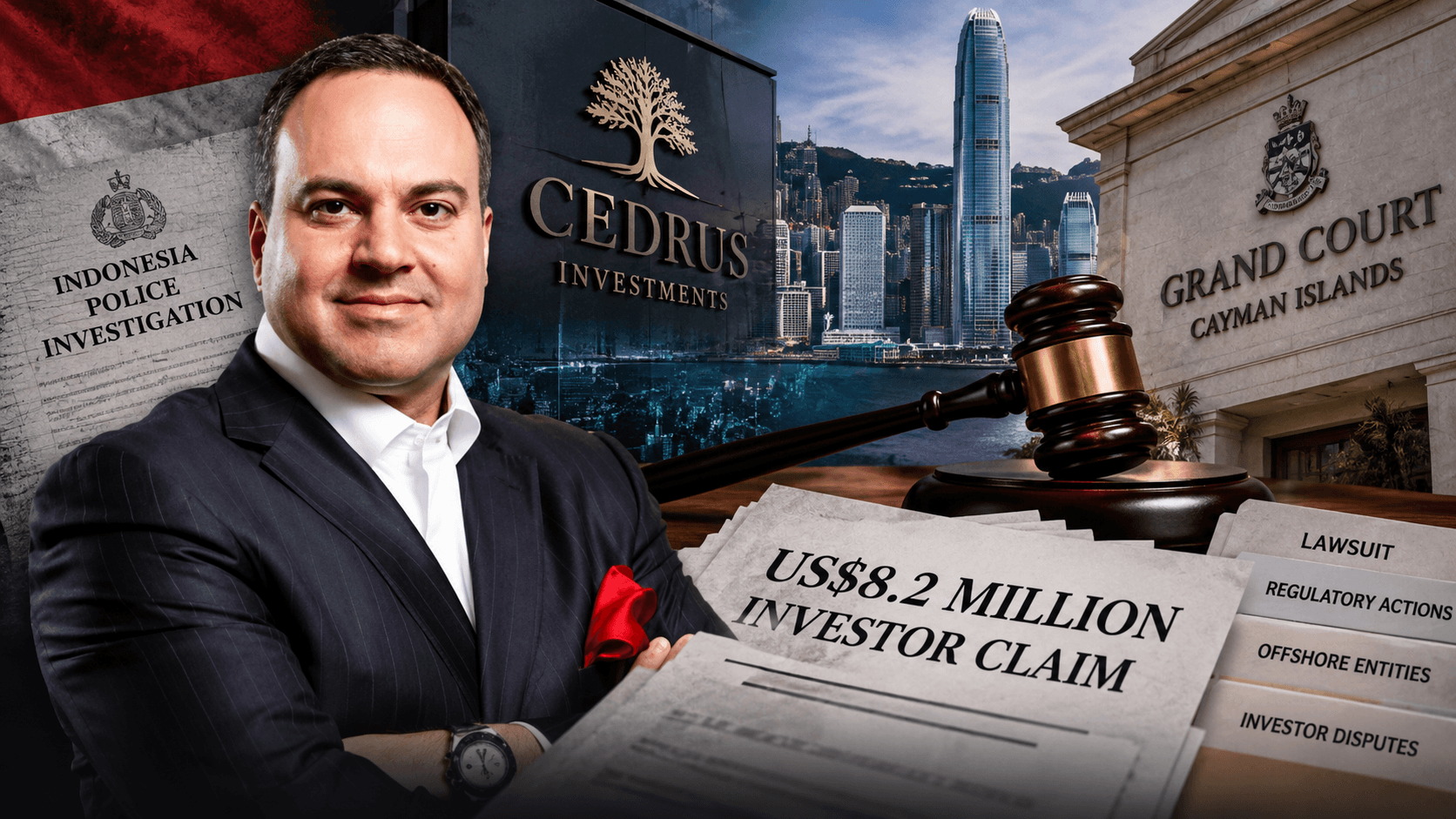
The name Rani Jarkas has appeared in financial regulatory records, investor disputes and offshore corporate investigations stretching back more than two decades. Now, his investment business, Cedrus Investments Ltd., is facing another serious challenge. A Hong Kong-based investor has asked the Grand Court of the Cayman Islands to wind up the company, claiming that it has failed to return approximately US$8.2 million despite repeated requests. The proceedings come months after another investor brought a separate civil action against Cedrus and Jarkas, adding fresh pressure to a business whose history has already attracted scrutiny from American regulators and investigators in Indonesia.
The latest developments raise an uncomfortable question for investors: how did a company associated with a founder who had already been barred from the United States securities industry continue attracting substantial investment, and why are clients now turning to courts to recover their money?
Jarkas, identified in regulatory records as Rani Tarek Jarkas and commonly referred to as Rani T. Jarkas, is a Lebanese-American investment professional who built his career in the United States before relocating his business operations to the Cayman Islands. He founded Global Crown Capital LLC in 2002 and served as its chief executive officer. He subsequently became associated with Cedrus Investments, an offshore investment group that established a presence in several international financial centres. OffshoreAlert has identified him as Cedrus’s founder and chairman and reported that he moved his operations from California to Cayman around 2009.
Jarkas’s American regulatory history is particularly important because it is supported by an actual decision of the US Securities and Exchange Commission, rather than simply allegations in media reporting. On April 1, 2016, the SEC issued its decision in In the Matter of Rani T. Jarkas, administrative proceeding number 3-16948, affirming the central disciplinary findings made by the Financial Industry Regulatory Authority (FINRA).
The case concerned Jarkas’s management of Global Crown Capital. FINRA found that he had allowed the brokerage firm to conduct securities business without maintaining the required minimum net capital, failed to obtain regulatory approval for a material change in its business activities and failed to attend two compulsory regulatory interviews. The interviews had been scheduled for November 11 and November 30, 2009. FINRA also said that Jarkas had provided incomplete responses to repeated requests for documents and information.
The SEC rejected Jarkas’s principal arguments on appeal and sustained the findings, with one limited exception concerning a particular day on which a net-capital violation had not been established. The regulator upheld the industry bar imposed for his failure to cooperate with the investigation. The decision also recorded that FINRA had assessed a two-year suspension and a US$50,000 fine for the net-capital violations, alongside a separate 30-business-day suspension and US$5,000 fine for the failure to obtain approval. Those additional sanctions were not imposed because the industry bar was already in place. This was a regulatory disciplinary outcome, not a criminal conviction, but it effectively ended Jarkas’s ability to associate with a FINRA-member securities firm.
The regulatory history did not begin there. FINRA records also document a customer arbitration involving Global Crown Capital and Jarkas. In a 2009 award, he was held jointly and severally liable for US$1.688 million, plus interest, following a customer dispute involving allegations of fraud, negligent misrepresentation, breach of fiduciary duty and excessive trading. The alleged damages in the proceeding were US$1.7 million. FINRA’s BrokerCheck record states that the award had not been paid. A separate dispute involving a 70-year-old investor resulted in a US$512,000 arbitration award in 2007, according to OffshoreAlert’s reporting. These matters should not be combined into a single established loss figure, but they illustrate the scale of the historical investor disputes surrounding his American brokerage activities.
Other financial problems were also reported during the period surrounding his departure from the United States. OffshoreAlert documented a US$244,246 federal tax lien in 2009 and a US$242,430 court judgment in 2010 in favour of a former salesman who alleged that Jarkas had withheld compensation. The publication reported that a judge criticised Jarkas’s evidence, describing it as involving outright lies. It also reported that approximately US$7 million in awards and settlements had accumulated through customer complaints, arbitrations, lawsuits, tax liens and regulatory actions. That figure is a historical aggregate reported by the publication, not a verified calculation of criminal proceeds or proven fraud losses.
Cedrus subsequently became the centre of a separate dispute in Indonesia. According to documents supplied for this investigation, Indonesian businessman Harun Abidin filed a police complaint on November 13, 2015, alleging fraud, embezzlement and money laundering involving Jarkas and Cedrus-related interests. The complaint was registered under police report number LP/1317/XI/2015/Bareskrim. The allegations were investigated under provisions of Indonesia’s Criminal Code and its anti-money-laundering legislation.
A notification issued by Indonesia’s Criminal Investigation Department on July 20, 2016, and addressed to Abidin, provides a significant account of the investigative steps taken. It states that investigators had examined witnesses connected with PT Redstone Resources Pte. Ltd., PT Cakra Minerals Tbk and other related parties. It also refers to action to block CKRA shares held at Standard Chartered Bank in Jakarta through an account associated with KGI Asia Limited. Investigators further examined parties involved in securities transactions and attempted to summon Rani T. Jarkas through PT Cedrus Indonesia.
Perhaps most significantly, the notification records that Indonesian authorities had requested mutual legal assistance from Switzerland and Hong Kong. The requests sought information about Jarkas’s identity profile and bank accounts, assistance with his examination, and corporate information relating to Cedrus Investment, including its incorporation documents, executive arrangements and company banking details. The document demonstrates that the investigation had progressed beyond the initial complaint into witness examinations, financial enquiries and international cooperation. It does not, however, establish that Jarkas was convicted, that the allegations were proven, or that the requested assistance resulted in a prosecution.
There is also an important qualification concerning the investigation’s subsequent status. An email dated August 28, 2019, supplied for this report, shows William K. Mabra contacting OffshoreAlert on behalf of a client and requesting removal of its article concerning the Indonesian complaint. Mabra described the matter as dropped and argued that the publication was damaging his client’s reputation. However, the correspondence contains no Indonesian prosecutorial decision, police closure notice or judicial order confirming that the criminal investigation was formally terminated. The claim that the case was dropped therefore remains unverified on the available evidence.
The corporate structure surrounding Cedrus also deserves attention. OffshoreAlert has identified operations or affiliated entities in the Cayman Islands, Indonesia, Hong Kong and mainland China, including PT Cedrus Indonesia, Cedrus Investments (HK) Ltd., Cedrus Shanghai and Cedrus Investments (Beijing) Advisory Company. The Hong Kong Securities and Futures Commission has separately maintained Cedrus Investments (HK) Limited on its alert list of unlicensed entities since October 4, 2010. Its listing was updated on May 14, 2026, and states that the company is not licensed or registered to conduct regulated activities under Hong Kong’s Securities and Futures Ordinance. This is a significant regulatory warning, although it should not be misrepresented as a finding that the company committed fraud. The SFC specifically warns that investors dealing with unlicensed entities may not receive the protections provided by Hong Kong’s regulatory framework.
The latest dispute brings the focus back to the Cayman Islands. On August 28, 2026, Gordon Timmins Watson, a Hong Kong-based British citizen and former senior insurance executive, filed a winding-up petition against Cedrus Investments Ltd. at the Grand Court of the Cayman Islands. The petition identifies Watson as the sole indirect shareholder of Sage Asia International Limited, a British Virgin Islands company that had also maintained an investment account with Cedrus.
According to the petition, Watson opened his personal account in January 2012, while Sage Asia opened its account in August 2016. Watson claims that he has been attempting to withdraw his funds since March 2024. He says that he instructed Cedrus to liquidate and close his accounts on December 22, 2025, but the money was not returned.
The petition describes a series of communications in which Cedrus reportedly acknowledged delays and gave different explanations for its failure to make payment. In March 2024, the company allegedly told Watson that funds should be available by mid-October. In September 2025, it reportedly apologised for unnecessary delays, citing changes to administrators and service providers. Two months later, it allegedly said that payments would be made using its own net capital requirements. In December 2025, the company reportedly attributed further delays to problems restoring connectivity with service providers after discovering that it had been hacked.
Watson also claims that Jarkas personally acknowledged the outstanding amounts in telephone and WhatsApp communications. The petition says the company agreed to additional interest at 10.3% annually on outstanding sums. These are claims made by the petitioner and should not be treated as findings after a trial. The US$8.2 million figure relates to Watson’s claimed personal debt; the petition separately identifies Sage Asia’s portfolio and deposits, which should not automatically be added to that amount.
The Cayman court’s October 15, 2026 cause list confirms that Cedrus’s winding-up petition, case FSD 273 of 2026, was listed before the Grand Court. The proceedings are therefore not simply an old investor complaint resurfacing in the press.
Another civil proceeding had already emerged earlier in 2026. On February 19, OffshoreAlert reported that Intero Investments Limited had filed a writ of summons against Cedrus Investments Ltd. and Jarkas in the Cayman Islands. The case concerns alleged breach of contract and negligent misrepresentation. The publicly available filing description identifies both defendants, but the full underlying allegations and the amount claimed were not established by the material reviewed here.
Taken together, the record presents a troubling history of regulatory sanctions, unpaid arbitration awards, an international criminal investigation whose final status remains unclear, an unlicensed-entity warning in Hong Kong and fresh investor recovery proceedings in Cayman. None of this should be mistaken for proof that every allegation against Jarkas or Cedrus is true. Equally, the existence of unresolved claims cannot be dismissed simply because an earlier complaint was reportedly dropped.
For investors, the central issue is not just the reputation of one financier or the corporate structure of one offshore investment group. It is whether clients can access their own money, whether financial intermediaries are operating under appropriate regulatory oversight, and whether warnings recorded years earlier are being taken seriously. When investors must resort to international litigation to recover funds they say are owed, the questions surrounding transparency and accountability become impossible to ignore. The outcome of the Cayman proceedings may provide some answers, but until the claims are resolved and the company’s financial position is properly examined, investors deserve clear information rather than assurances.
Source:
OffshoreAlert
————-
Disclaimer:
Some content on Reportingscams.com is published under our guest post program and is provided by third-party contributors. Reporting scams does not create, verify, or take responsibility for the views, accuracy, or claims expressed in such content.