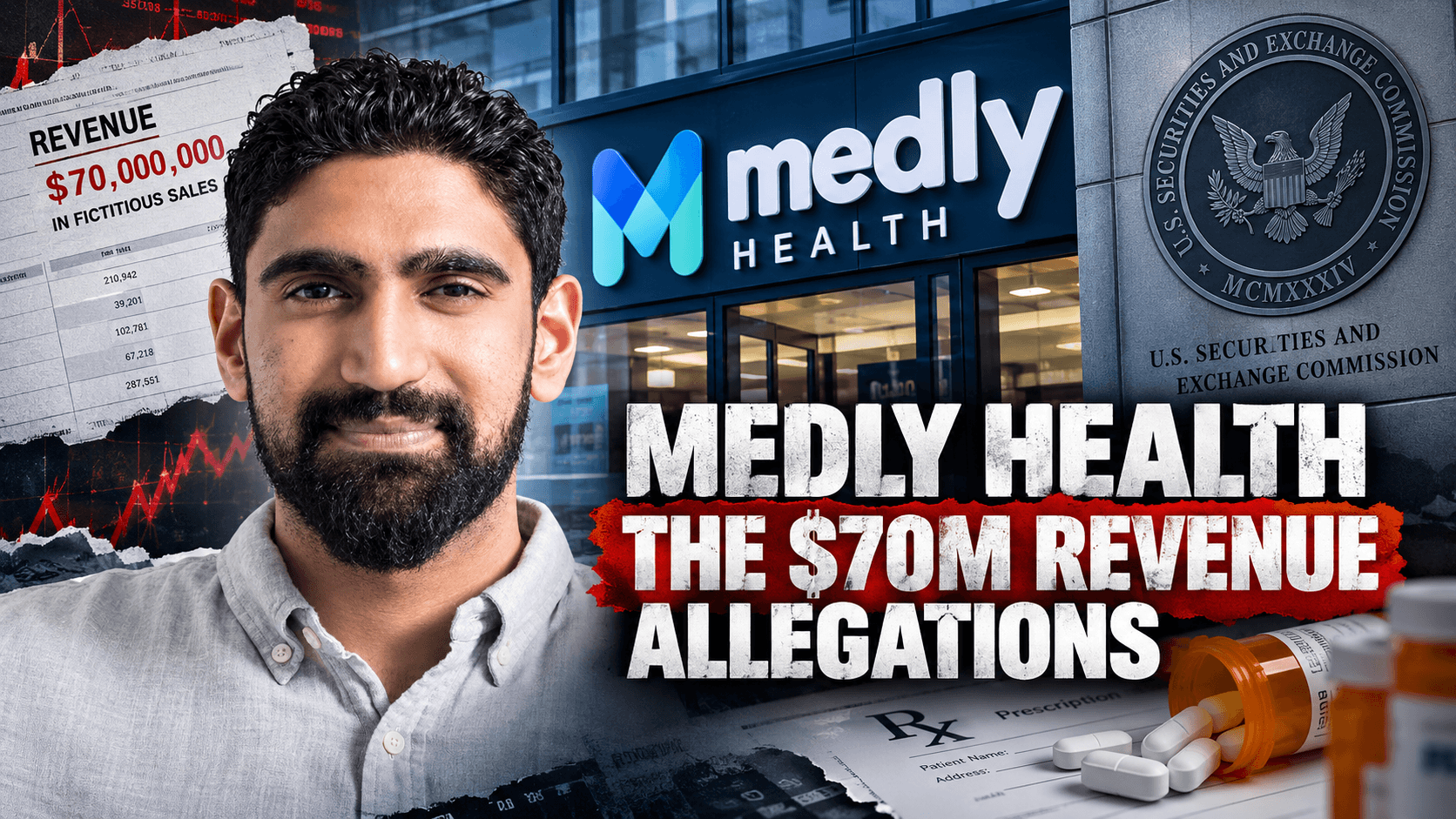
The central issue in the Medly Health case is not simply that a digital pharmacy failed. It is that the U.S. Securities and Exchange Commission (SEC) alleges the company generated at least $70 million in fictitious revenue, used inflated financial figures to attract investors, and continued fundraising despite repeated warnings about accounting irregularities. Three former executives — co-founder and CEO Marg Patel, former CFO Robert Horowitz, and former head of Rx Operations Chintankumar Bhatt were charged in September 2024. The civil case remained active in 2026, with court records showing discovery-related proceedings continuing. The allegations have not, by themselves, established criminal guilt.
Medly was founded in 2017 by Patel and his brother as a digital pharmacy intended to make prescription medication easier to obtain. Based in Brooklyn, New York, the company combined online prescription management and delivery with physical pharmacies and distribution facilities. Its pitch was attractive: modernize an essential healthcare service, reduce the inconvenience of traditional pharmacies and reach patients who struggled to access medication. Medly promoted rapid growth and attracted substantial venture investment, eventually reaching a reported valuation of approximately $925 million during its Series C fundraising. The company’s eventual collapse turned that growth story into a warning about what can happen when investor confidence depends on financial information that cannot withstand scrutiny.
The SEC’s December 2024 amended complaint alleges that the problem was not limited to optimistic forecasts or ordinary startup accounting mistakes. It says Medly generated at least $70 million in fake revenue and, during various reporting periods, presented revenue figures to prospective investors that were inflated by between 10% and 24%. The regulator alleges that the fictitious sales helped make the business appear larger and more profitable than it really was, influencing decisions to invest in the company. Between May 2021 and August 2022, Medly raised more than $170 million through its Series C fundraising efforts, including stock and convertible notes. The SEC says investors ultimately lost their entire investment when the business failed.
At the centre of the alleged scheme was the company’s prescription-management system, PrimeRx. According to the SEC, Bhatt, Medly’s former head of Rx Operations, entered hundreds of fictitious prescriptions into the system between approximately late 2020 and mid-2022. The complaint alleges that he fabricated patient information, sometimes creating entirely fictional profiles and sometimes using records belonging to deceased patients. He then recorded prescriptions, including expensive medications, and associated them with insurance companies that did not exist. The supposed transactions generated accounts receivable and revenue in Medly’s internal records, even though the prescriptions had not been legitimately filled and the company would not receive the expected payments. The SEC’s allegations describe a process that made nonexistent pharmaceutical sales look like real commercial activity.
The complaint identifies a particularly telling feature of the alleged misconduct: the numbers did not simply appear wrong after the company collapsed. They reportedly raised questions while Medly was still raising money. An investor conducting due diligence noticed an unusual and growing debit balance in an account listed under “Other Current Liabilities,” a line item that ordinarily reflects short-term obligations. The discrepancy prompted questions for Patel and Horowitz in November 2020. Medly then brought in accounting firms to help address its financial reporting problems. According to the SEC, Horowitz told an outside accounting firm that revenue might have been overstated by as much as 20%, while employees separately identified prescriptions and revenue that could not be substantiated. The complaint alleges that senior personnel repeatedly raised concerns about the accuracy of the company’s financial statements.
The allegations against Patel and Horowitz focus on what happened after those warnings. The SEC says both men knew, or recklessly disregarded, that Medly’s reported financial performance was materially overstated, yet continued supplying financial information to investors. The amended complaint describes investor presentations and financial reports that allegedly overstated historical revenue, growth and profitability. In one example, Horowitz reportedly told an investor that Medly had generated more than $211 million in gross revenue between January 2020 and January 2021. The SEC alleges that actual revenue for the period was below $189 million, a difference exceeding $22 million. The regulator also alleges that Patel and Horowitz continued to use inflated financial figures in later fundraising materials, including information sent to investors in 2022. These are allegations in a civil enforcement action, not findings that either executive has been criminally convicted.
The case also raises questions about the company’s internal controls. The SEC alleges that many U.S.-based accounting and finance employees were restricted from accessing the raw data in PrimeRx and had to rely on analyses prepared by Medly Software Systems LLP, an India-based subsidiary responsible for accounting, financial and data analytics services. That arrangement mattered because employees investigating discrepancies allegedly struggled to independently verify the underlying prescription records. The amended complaint says some employees discovered material overstatements and repeatedly informed senior management. It further alleges that Patel told an analyst he was “digging too much” into the revenue discrepancies and that Horowitz instructed an accountant to maintain a separate set of books reflecting what the accountant believed were the correct figures. The accountant subsequently left, according to the complaint.
The fundraising figures illustrate why the allegations matter. The SEC says Medly raised nearly $113 million from four outside investors in the first close of its Series C round on May 27, 2021. Other investors participated in subsequent transactions, and the company continued seeking capital into 2022. The regulator alleges that inaccurate financial information was material to several investors’ decisions to invest or increase their positions. Its complaint describes individual investments in the millions of dollars, including a $12.5 million investment by one investor in May 2021. The total fundraising figure exceeding $170 million should not be confused with the amount of fictitious revenue: they are different measures. The SEC’s alleged $70 million in fake revenue refers to sales that were not real, while the $170 million figure refers to capital raised from investors.
The consequences unfolded during 2022, as accounting concerns and operational difficulties intensified. According to the SEC, the board pushed for Horowitz’s removal in April. He was demoted and later resigned. The board subsequently terminated Patel and launched an internal investigation after the prescription and accounting issues became more widely known; Bhatt also resigned. Medly’s financial position deteriorated rapidly. It filed for Chapter 11 bankruptcy protection in December 2022 and converted the case to Chapter 7 liquidation in April 2023. Separate bankruptcy filings described plans to wind down pharmacy operations and sell assets. The company that had presented itself as a fast-growing healthcare technology business was no longer operating as a continuing digital pharmacy.
The SEC filed its enforcement action in the U.S. District Court for the Eastern District of New York on September 12, 2024, naming Patel, Horowitz and Bhatt. It alleged violations of federal securities antifraud provisions and sought injunctions, civil penalties, disgorgement, prejudgment interest and restrictions on serving as corporate officers or directors. The amended complaint identifies Patel as 36, Horowitz as 39 and Bhatt as 38 at the time described in the filing. It also states that all three invoked their Fifth Amendment privilege during the SEC investigation and declined to provide substantive sworn testimony; that privilege is a legal protection, not proof of guilt. The filing identified Patel as residing in Staten Island, Horowitz in Colts Neck, New Jersey, and Bhatt in Monroe, New Jersey, but those are addresses reported in the legal document, not independently confirmed current whereabouts.
A significant development came on July 17, 2025, when Judge Brian M. Cogan ruled on motions to dismiss filed by Horowitz and Bhatt. The court allowed the SEC’s core misrepresentation claims against Horowitz to proceed, while dismissing the scheme-liability claims against him on the ground that disseminating one’s own misstatements alone was insufficient to establish that separate theory of liability. The court denied Bhatt’s motion to dismiss the claims against him, including allegations that he participated in a fraudulent scheme and aided and abetted the executives’ violations. It also rejected his request to pause the civil litigation pending a parallel criminal investigation. These rulings determined whether claims could proceed, not whether the defendants were ultimately liable.
The case was still listed as active in federal court in September 2026, with docket records showing further discovery proceedings and extensions. A criminal investigation was referenced in the court’s 2025 order, but the materials reviewed for this article do not establish that any of the three defendants has been criminally indicted, pleaded guilty or been convicted. Nor do they establish a final civil judgment or settlement resolving the SEC’s claims. The defendants’ positions should therefore be distinguished from the regulator’s allegations and the court’s procedural rulings.
The broader lesson extends beyond one failed pharmacy. Investors in fast-growing private companies often depend on management’s representations because they cannot independently verify every transaction behind a revenue figure. In healthcare, false records can also obscure whether services were genuinely delivered, even when the case concerns securities fraud rather than a direct finding of patient harm. Medly’s collapse shows why growth metrics must be tested against underlying transactions, why employees need meaningful access to the data they are expected to audit, and why boards must take accounting warnings seriously before another fundraising round closes. More than $170 million was raised while, according to the SEC, the company’s financial picture was materially distorted. The case now turns on what the evidence can prove in court and whether those responsible for presenting the numbers will ultimately be held legally accountable.
————-
Disclaimer:
Some content on Reportingscams.com is published under our guest post program and is provided by third-party contributors. Reporting scams does not create, verify, or take responsibility for the views, accuracy, or claims expressed in such content.